


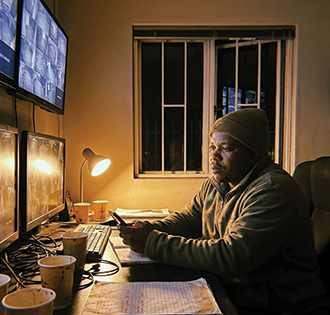
Walk into almost any control room in South Africa, and you will find the same scene: an operator surrounded by screens, toggling between CCTV feeds, alarm panels, and a phone with dozens, sometimes hundreds, of WhatsApp groups scrolling in real time.

WhatsApp has become the unofficial backbone of security communications across the mining and industrial sectors. Guards report incidents through it. Supervisors coordinate shift changes on it. Site managers receive updates on it. It is fast, free, and everyone already knows how to use it.
But it was never designed to be a security tool and the cracks are showing.
The information overload crisis
A typical control room operator monitoring a mining or industrial operation might be responsible for 50 to 400 WhatsApp groups simultaneously. Each group generates a constant stream of messages: incident reports mixed with casual conversation, photos of suspicious vehicles buried between shift check-ins, and urgent alerts lost in a flood of routine updates.
The result is predictable. Critical information gets missed. An operator scrolling through hundreds of messages at 2 am will not catch every report that matters. When something does get flagged, it is often too late to act and because none of this information is structured or searchable, it disappears into the chat history within hours, never to be retrieved or analysed.
For mining operations, where threats range from illegal mining syndicates and copper theft to logistics ambushes, a missed message is not an administrative inconvenience. It is a security failure with real operational and financial consequences.
The manual reporting burden
The problem extends beyond the control room. Security companies serving mining and industrial clients are under increasing pressure to demonstrate compliance with service-level agreements. That means producing regular reports showing patrol completion, incident response times, access control logs, and guard accountability.
In most operations, these reports are compiled manually. Someone in the office spends hours every week pulling data from different sources, formatting spreadsheets, and emailing PDFs to clients. The process is slow, error-prone, and relies on information that was never properly captured in the first place.
The result is a reporting system built on trust rather than verification. Clients receive reports that say guards were on site and patrols were completed, but there are limited ways to independently verify those claims.
How AI is changing the picture
A new generation of tools is emerging that addresses both problems simultaneously: the information overload in the control room and the manual reporting burden downstream.
The approach is built on a simple insight: rather than replacing WhatsApp, work within it. Instead of asking guards and operators to adopt new apps or hardware, these tools sit silently on existing WhatsApp groups and use AI to extract structured data from unstructured conversations.
Community Wolf, a South African safety data company, has developed what it calls Group Agents: AI-powered listeners that monitor WhatsApp groups in real time. When a guard reports a suspicious vehicle, the Group Agent captures the incident, tags it with a location and timestamp, and categorises it. When an access control breach is reported, it is automatically logged and escalated. The operator no longer needs to read every message to catch what matters.
The extracted data feeds into a centralised dashboard where control room operators see a filtered, structured view of what is happening across all their sites. Instead of scrolling through hundreds of messages, they see verified incidents, flagged vehicles, and categorised alerts. The signal is separated from the noise.
For mining and industrial environments, where a single operation might span multiple access points, perimeter zones, and logistics routes, this consolidation is significant. A control room that previously relied on one person’s ability to read fast enough now has an AI layer doing the extraction work around the clock.
From raw data to automated compliance
The second shift happens downstream. Once incident data, patrol check-ins, and access control logs are captured in a structured format, reporting becomes automated.
Community Wolf’s Export Flows allow security companies to set up scheduled, branded compliance reports that are automatically generated and delivered to clients. A mining client can receive a weekly PDF showing every patrol completed (with GPS-verified timestamps), every access control scan processed, and every incident reported and resolved, without anyone in the security company’s office touching a spreadsheet.
This moves the client relationship from trust-based reporting to evidence-based reporting. The data is GPS-verified, timestamped, and generated directly from operational activity rather than manually compiled after the fact. Ideal for auditors and risk managers.
The broader shift
The security sector is facing a convergence of pressures: more sophisticated threats, tighter compliance requirements, and the same budget constraints that affect every part of the value chain. The tools that control rooms rely on need to keep pace.
WhatsApp is not going away. It is too embedded in how security teams communicate, particularly in southern Africa, where it is the dominant messaging platform across all demographics. The question is not whether to use it, but how to extract real intelligence from it.
AI-powered extraction and automated reporting represent a practical step forward, one that works within existing communication habits rather than trying to replace them. For control rooms that have been doing it the hard way for years, that shift cannot come soon enough.
For more information contact Community Wolf,
| Tel: | +27 11 543 5800 |
| Email: | [email protected] |
| www: | www.technews.co.za |
| Articles: | More information and articles about Technews Publishing |






© Technews Publishing (Pty) Ltd. | All Rights Reserved.
 printer friendly version