Security grading systems explained

Issue 2/3 2023 Editor's Choice

Choosing the right sensors is crucial in ensuring the security and safety of any premise and the grade is one of the most important criteria. This article will examine the features, benefits, and applications of the different grades of security sensors, providing insights into when to use each type in different applications.

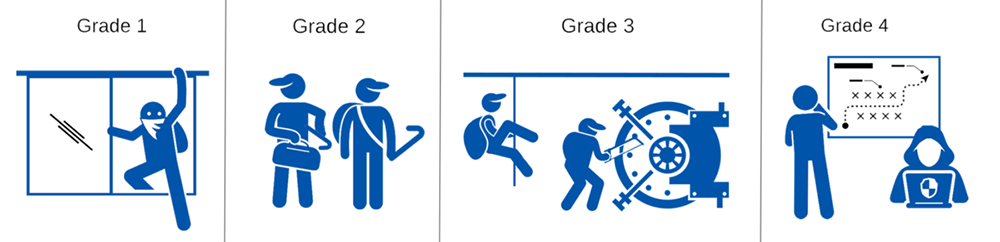
According to European and UK standards on intruder alarms (BS EN 50131) security systems are categorised into four grades based on their reliability and endurance against intruders. Out of the four grades, only Grades 2 and 3 can get police response to alarms.

• Grade 1: For sites with a very low intrusion risk that can resist inexperienced attackers by protecting obvious entry points like doors or windows. Commonly it does not have an insurance requirement for an alarm system.

• Grade 2: For sites with a higher risk of intrusion and resisting more experienced intruders that may try to overcome the system by using tools or checking for other entry points.

• Grade 3: For sites with a substantial risk where there is a more obvious motive for intruders to attempt an attack, for example, containing valuable assets. The security system should be able to resist experienced attackers that have specialised tools and in-depth knowledge, by protecting every possible entry point including walls and ceilings.

• Grade 4: For sites with the highest risk of attack where intruders may plan a detailed attack well ahead of time and have all kinds of specialised equipment. These types of systems are often used in the military or sites prone to terrorist attack.

The entire security system is graded based on the lowest ranking product. For example, a system with ten Grade 3 sensors and one Grade 2 sensor will be a Grade 2 system, so it is important to consider the types of sensors used throughout.
Testing and grading

To obtain a certification, manufacturers need to get their products tested by an independent test house, passing the following tests: general, functional, anti-tampering, environmental, power supply and responsivity to show that their sensors really can do the job. OPTEX sensors are tested at the prestigious KIWA and VDS, some of the most demanding testing houses.

Prior to the official tests at the independent certification body’s testing facilities, at OPTEX we like to be prepared and have our own dedicated testing facilities where we put our sensors through a rigorous testing process which includes over 150 tests.

To test the general capability and functionality of our sensors, we carry out human detection tests for both Grade 2 and 3 sensors, to make sure that even when intruders get creative with their movements, they will not make it past our detectors. We test for people running, creeping slowly, crawling, rolling (yes we do actually roll around in front of our sensors), people of different heights, hairstyles, clothes and more.

To further ensure durability, we really do push our products to the limit as we attempt to vandalise and physically harm them. Our relentless ‘shock tests’ actually involve squashing sensors with weights or hitting them with steel bats (another fun activity for our testing team) to make sure that even in these conditions they will still work. So, when we say certain products are resistant to vandalism … we really mean it. For our Grade 3 sensors, we go a step further and attempt to mask or cover them to be sure that even under these circumstances, their intelligent logic will be able to analyse this and trigger an alarm.

We also make sure our sensors work perfectly in all kinds of environment, including different temperatures and strong sunlight.

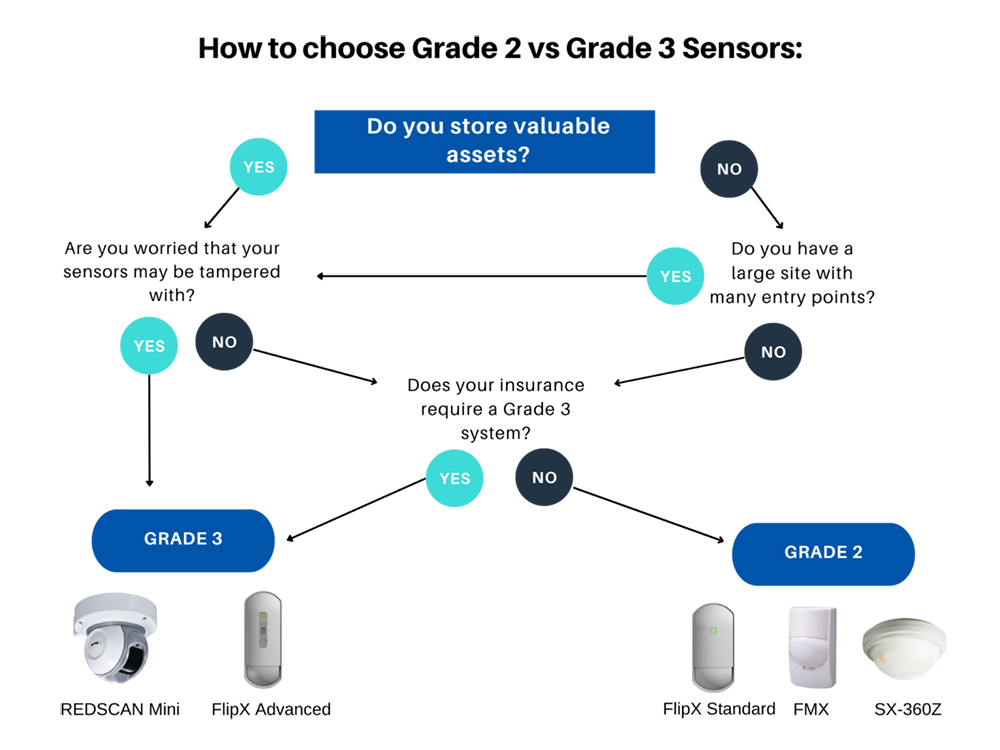
Grade 2 or Grade 3 sensors?

When it comes to choosing the right sensor for your security system, it is important to consider the level of risk in your environment. Grade 2 PIR sensors are best suited for low-risk environments, for instance residential, offices or small retail spaces, where security needs are on a smaller scale.

On the other hand, Grade 3 security sensors are a more advanced and sophisticated option. They are designed to provide a higher level of security and are ideal for commercial and industrial properties with increased security requirements, for instance, being able to cope with fluctuation of temperatures and background noise. Grade 3 sensors come with more advanced features such as anti-masking that make them more reliable against experienced intruders and can detect fast-moving intruders who are attempting to bypass security systems.

For more information, contact OPTEX, [email protected], www.optex-europe.com


Credit(s)


Share this article:
Share via emailShare via LinkedInPrint this page


Further reading:

Fire safety in South Africa
Technoswitch Fire Detection & Suppression Technews Publishing SMART Security Solutions Fire & Safety Security Services & Risk Management Editor's Choice
Fire safety is sometimes ignored, sometimes relegated to whatever is cheapest, and sometimes treated with the seriousness it deserves, given that it focuses on protecting life and assets. SMART Security Solutions asked Brett Birch, MD of Technoswitch, for some insights into the realities of fire safety in South Africa.

Read more...
Reduce nuisance alarms in high-mount outdoor detection
OPTEX Perimeter Security, Alarms & Intruder Detection Smart Home Automation Facilities & Building Management
OPTEX has launched the TXI Series, a range of high-mount outdoor curtain detectors designed to create an invisible curtain barrier along a building’s façade and to address the challenge of balancing reliable human detection with nuisance alarm reduction in external security.

Read more...
Balancing secure access control and fire safety
Editor's Choice Access Control & Identity Management Fire & Safety
In modern building management, few topics create as much tension as the intersection between security access control and fire evacuation safety. Nichola Allen of G2 Fire sheds light on this delicate balance.

Read more...
Preventing and suppressing lithium fires
SMART Security Solutions Technews Publishing Editor's Choice Fire & Safety Security Services & Risk Management Smart Home Automation
SMART Security Solutions asked Clyde Becker, director of Pyro Brand, for some insight into the mechanics of lithium-ion battery fire risks, especially thermal runaway, and to define a comprehensive, layered approach to fire detection and suppression.

Read more...
Integrated layers offer dependable security
OPTEX SMART Security Solutions Technews Publishing Perimeter Security, Alarms & Intruder Detection Integrated Solutions
A layered approach to security tightens protection and minimises downtime and operational risk. Moreover, integrating all the parts of a solution and proving they can do the job before spending money are critical.

Read more...
Global security in 2026
Editor's Choice News & Events Security Services & Risk Management Industrial (Industry) Mining (Industry)
The World Security Report 2026 states: “In a world of increasing volatility, physical security has evolved. It is no longer just a defensive measure; it is a critical driver of corporate value.”

Read more...
Who is to blame for autonomous mistakes?
Editor's Choice Security Services & Risk Management Industrial (Industry) Mining (Industry)
Most supply agreements for AI-integrated equipment still closely resemble plant hire contracts from ten years ago: bilateral, human-focused, and silent on who bears the risk when a machine makes a decision on its own.

Read more...
Beyond the checkpoint
Veracitech Editor's Choice
For decades, mining corporations have treated employee screening as a necessary friction point, an operational cost to be managed rather than a strategic capability to be optimised. A new generation of full-body X-ray technology, purpose-built for the realities of high-throughput precious-metals environments, is beginning to change that calculus.

Read more...
Persistent surveillance with rapid deployment
Editor's Choice
Sky Robots has introduced an aerial drone system designed to operate as a consistent layer within security environments, addressing long-standing challenges around visibility and response across large or complex sites.

Read more...
The control room problem that nobody wants to talk about
Technews Publishing Editor's Choice
WhatsApp has become the unofficial backbone of security communications across the mining and industrial sectors, but it was never designed to be a security tool.

Read more...


While every effort has been made to ensure the accuracy of the information contained herein, the publisher and its agents cannot be held responsible for any errors contained, or any loss incurred as a result. Articles published do not necessarily reflect the views of the publishers. The editor reserves the right to alter or cut copy. Articles submitted are deemed to have been cleared for publication. Advertisements and company contact details are published as provided by the advertiser. Technews Publishing (Pty) Ltd cannot be held responsible for the accuracy or veracity of supplied material.


© Technews Publishing (Pty) Ltd. | All Rights Reserved.