


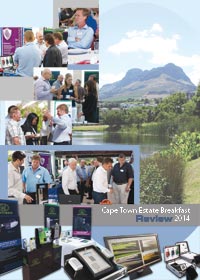
March saw Hi-Tech Security Solutions hosting the latest of its Executive Breakfasts in Cape Town, this time focusing on the residential estate market. The event was packed with a full house of attendees from estate managers through to consultants and integrators. Sponsoring this event were Castle Access Control Systems, Centurion Systems, Comb Communications, Elvey Security Technologies, Powell Tronics and VixNet.
The attendees were able to listen to presentations by Dr Craig Donald, a respected expert in the local surveillance industry and regular Hi-Tech Security Solutions contributor; Rob Anderson, a consultant with many years of experience in dealing with estate security; and Vagn Nielsen, CEO of the picturesque Helderberg Village where the event was held and who has been responsible for a multi-million rand security overhaul at Helderberg. Attendees were also able to network in the exhibition area and speak to the sponsors who had table top displays and people on hand to answer queries from visitors.
Integration and planning

First up was Rob Anderson, MD of Rob Anderson & Associates, who spoke on his 30-odd year journey in advising and overseeing estate security in 32 estates, as well as office and industrial estates.
Anderson said that the history of estate security has been maturing for years, from the early stages when it was anything but a science, through to modern estate security which is nearing the top of the maturity cycle. He also made a few pertinent points that most residents and estate managers would find interesting:
1. More positive perimeter alarms are caused by departing criminals than those arriving.
2. Most criminals use the front gate.
3. Estate security plans are, in most cases, not too good when an investigation is necessary.
4. Security staff often spend more time protecting themselves from residents, rather than protecting the residents.
Anderson then broke down security into various areas within the estate and gave tips on the security issues with each. At the front entrance, which he said is the main entrance for criminals, the design and layout of the entrance is very important. There must be space for vehicle stacking, turning, parking and large vehicles, among other issues. He also mentioned the placement of cameras and safety beams, noting that the time synchronisation between technologies must be perfect.
As far as the perimeter is concerned, Anderson said this remains the biggest challenge for a cost effective solution. A reliable solution will consist of electric fencing and CCTV with alarm verification and analytics. He also advised estates to use thermal cameras as well, also with alarm verification and analytics. This reduces manpower, while increasing security. He showed videos of these technologies at work, highlighting what works and what does not.
Buyer expectation was a sensitive area Anderson also touched on. Buyers believe that they are buying security so there will be no crime. There is often a disconnect between the capital cost of a security solution, what one pays for the design, installation and products, and the ongoing operational costs.
Finally, Anderson touched on the need for an integrated solution that incorporates all aspects of the security system, from perimeter, access control, CCTV, guarding and data security, providing comprehensive reports of the estate’s security and management teams. An important aspect of this is the new Protection of Personal Information (PoPI) Bill, which governs how estates (and any other organisations) handle the data they collect.
Human factors

Moving onto the human factor, Dr Craig Donald was next, presenting on the human factors and relationships that enable estate security. With years of experience in training and assisting in the operations of control rooms, Donald’s presentation covered several areas, including:
1. Having the right people and skill base. In this section, he discussed the right individual’s profile, the skills required (such as conflict resolution, listening, problem solving etc.), as well as knowing what surveillance was about in order to optimise their observations.
2. Creating a functional control room environment. A control room needs technology, but there is always the possibility that the premises can look impressive, but not be conducive to effective operations. Things to consider to ensure the effectiveness of a control room include line of sight, display size and volume, lighting and ventilation, space, multi-tasking facilities and noise interference.
3. Display management. Donald advised that more monitors to display more cameras is not necessarily a better solution, as the operators won’t know where to look. Additionally, cameras vary in importance over time and event-driven cameras can supplement detection. Control room designers need to consider a viewing strategy where operators focus on the most relevant cameras at the most relevant times.
4. Supervision. Intelligent and active supervision is required to ensure operators and the technology function are at optimal capacity. They also need to create an environment where formal and informal information is gathered, as well as supervising trend and a pattern analysis of various issues.
In summing up, Donald said, “Human factors can not be painted onto the system; they need to be designed in as part of an integrated strategic intervention”.
Security in practice

Vagn Nielsen, CEO of Helderberg Village ended the presentations with an overview of the challenges and successes involved in the R15.5 million security upgrade that is being rolled out at the estate. Helderberg is now a fully developed upmarket estate on about 84 hectares with 800 houses, a 66-bed healthcare facility, a golf course, pools, a clubhouse, sporting facilities, 1200 residents and 300 staff. Every day sees about 250 visitors, contractors and deliveries entering the premises.
Currently, the village’s security is outsourced to two companies that provide 24-hour security services. One provides guarding services, access control and roving guards, the other monitors the electric perimeter fence and armed/medical response.
Nielsen said criminals are refocusing. “Large estates are the new shopping malls and ‘shoppers’ are always looking for cheap and easily obtainable bargains. Petty and opportunistic theft happens on all estates, but organised crime is on the move and targeting estates. Some of these syndicates even rent premises on some estates to make their ‘shopping’ easier.
To minimise the risks involved, Nielsen said access controls, perimeter controls, surveillance and 24x7 monitoring is essential. SAPS clears all Helderberg staff, while contractors and visitors have their IDs and car registrations scanned on entry and exit. The perimeter fence is continually monitored and all alarms are responded to.
The security upgrade saw the installation of 54 thermal or high definition cameras on a fibre optic network along the perimeter. All are connected to the onsite control room, manned 24x7 and supported by onsite armed response unit and medical staff.
Nielsen said estate and security managers have a duty to keep their residents, their property and the estate's property safe. They also need to keep their trustees updated on security risks and threats, as well as mitigation measures.
To end his presentation, Nielsen showed the audience his iPad, which has a live feed from all the estate’s cameras broadcast to it over a 3G network. This allows him to monitor cameras at any time, and if an alarm is raised, he can call up the affected cameras and keep himself and other parties informed.
The final event of the breakfast was a tour of the Helderberg control room. Guests were transported to the control room by shuttle where the operations were explained with live feeds from the estate. Prizes were also handed out to the guests. These were sponsored by VixNet, Powell Tronics and the Consumer Goods Council.
| Tel: | +27 11 543 5800 |
| Email: | [email protected] |
| www: | www.technews.co.za |
| Articles: | More information and articles about Technews Publishing |






© Technews Publishing (Pty) Ltd. | All Rights Reserved.
 printer friendly version