

BitDefender offers users tips on how to avoid falling victim to mobile phishing scams

1 February 2011 Information Security

Fake Scotiabank login page highlights the danger of mobile banking phishing scams.

An easy target for cyber criminals is smartphone users who take advantage of mobile banking. BitDefender has identified a serious mobile banking phishing scam and is offering tips to help smartphone users avoid falling victim to this and to similar mobile phishing scams.

The phishing scam BitDefender had detected attempts to trick smartphone users into logging into a fake mobile version of the Scotiabank login page. At first glance, the Scotiabank mobile login page looks legitimate, however, users should be on the lookout for a dubious domain name and a request for the user’s Security Code (the three digit number printed on the back of a ScotiaCard) If the user fills in the fake form with his card number and the corresponding password, the cyber criminal has access to the user’s bank account.
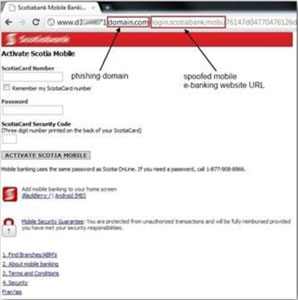
Paying attention to detail is key when it comes to avoiding phishing scams. Cyber criminals count on users being busy, always in a hurry, absent-minded or too distracted to catch a phishing scheme. Additionally, the small size of the smartphone screen can prevent users from seeing a fake URL; and since most smartphones lack an anti-virus solution and are not equipped with an antiphishing solution, targeting the smartphone is an easy decision for cyber criminals.

Tips to avoid becoming a mobile banking phishing victim

Before you click on a link, make sure it is legitimate. If the link is partially obscured, or if it looks suspicious, do not click on it. Even links that look legitimate can be bogus. It is common for mobile phishers to use a free web hosting company to host the phishing page in a folder named after the mobile website of the bank.

Remember that e-banking can be risky, especially when using a mobile device. It is much safer to manually type a URL into the mobile browser instead of accessing it from a bookmark or from an e-mail message sent from an unknown sender.

Always keep your mobile device operating system and antivirus solution updated. Cyber criminals will use any means necessary to scam you out of money.

For more information contact Alina Anton, BitDefender, +40 212 063 470, [email protected], www.bitdefender.com


Share this article:
Share via emailShare via LinkedInPrint this page


Further reading:

Compressing cyberattack timelines and targeting ungoverned AI identities
Information Security News & Events
Sophos AI Security 2026 report finds attackers are moving beyond experimentation and operationalising AI for attacks using identity as the primary initial access vector, rather than inventing new attack types.

Read more...
Zero-touch automation certificate life cycle management loop
Products & Solutions Information Security Security Services & Risk Management
ManageEngine completes the certificate life cycle management loop with CA-agnostic, zero-touch automation. New post-deployment automation in Key Manager Plus removes the last manual step in certificate renewal as lifespans gradually shrink to 47 days

Read more...
Sophos launches AI-native cybersecurity defence system
News & Events Information Security Security Services & Risk Management
Built for a threat landscape reshaped by AI, Sophos Fusion unites security operations, endpoint, network security, identity, email, and cloud into one defence system that prevents, detects, investigates, and responds at AI speed.

Read more...
Ungoverned AI agents and deepfakes pose critical threats
Information Security Security Services & Risk Management
Global study reveals 64% of South African organisations already deploy autonomous AI agents with little to no governance, while 63% of employees admit they are unlikely to be able to spot attacks such as deepfakes

Read more...
How ‘TikTok Brain’ is breaking legacy security training
Training & Education Information Security
Between doomscrolling, rapid-fire Slack notifications, and algorithmic video feeds, the average employee is trapped in an aggressive, highly engineered dopamine loop that automatically shuts down in traditional training situations.

Read more...
Quantum is coming
Infrastructure Information Security
The global cybersecurity landscape is approaching a turning point as quantum computing accelerates faster than most organisations realise; the shift is not a distant, theoretical concern, but a present-day business risk that demands immediate action.

Read more...
Outpacing cyberthreats in the age of AI
SMART Security Solutions Technews Publishing News & Events Information Security
SMARTpod talks to Fred Streefland, Global Field CISO for EMEA at Check Point Software Technologies, about framing modern cyber defence around adaptability, rapid decision-making, and the OODA loop adapted for cybersecurity.

Read more...
Prompt injection is the new phishing
Information Security Security Services & Risk Management
AI security is heading in an uncomfortable direction following Microsoft’s research showing how prompt injection can be chained to remote code execution vulnerabilities in AI agent frameworks, including work involving Semantic Kernel

Read more...
Cybersecurity needs actual intelligence before artificial intelligence
Information Security AI & Data Analytics
Cybersecurity depends on interpretation. A tool can tell you that something unusual has happened, but people need to determine whether it is a genuine risk, the business impact, and how to respond without causing unnecessary disruption.

Read more...
Duxbury Cybersecurity sharpens reseller offering
Duxbury Networking Information Security News & Events
Duxbury Networking has strengthened its Duxbury Cybersecurity business unit by adding WatchGuard and Cynet, giving South African resellers broader, more integrated coverage for the security risks customers are now asking them to address.

Read more...


While every effort has been made to ensure the accuracy of the information contained herein, the publisher and its agents cannot be held responsible for any errors contained, or any loss incurred as a result. Articles published do not necessarily reflect the views of the publishers. The editor reserves the right to alter or cut copy. Articles submitted are deemed to have been cleared for publication. Advertisements and company contact details are published as provided by the advertiser. Technews Publishing (Pty) Ltd cannot be held responsible for the accuracy or veracity of supplied material.


© Technews Publishing (Pty) Ltd. | All Rights Reserved.

