


The extremes inherent in today's advanced devices lead to situations where both purchasers and operators can become easily baffled. For instance, do your people know how to operate a parking gate or vehicle barricade system during a power outage? It is common that a guard does not know the proper procedures or, worse yet, does not even know who to contact for information. Tell that to the general that cannot get on base or the CEO who wants admittance to the parking garage when there has been a hiccup.
Today, training on the use of such equipment and systems is paramount. There must be a hand-over of knowledge on equipment, how it works, what to troubleshoot and how to maintain the equipment. Vendors must realise that this is the backbone of protecting their customers while end-users must undertake such training to assure they are reaping the benefits of what was bought and implemented. Unfortunately, it is not uncommon for an organisation to invest in increased security, only to have their operators not use it because they are improperly trained.
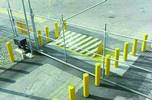
Ordering the right equipment to begin with
Let us look at a vehicle ingress/egress system and use it as an analogy for what one is installing. Remember, each facility is unique. A person needs to know the frequency of vehicles going in and out. What is the level of security needed? It will vary between a car rental agency and an embassy in a hostile country. Will there be vehicle inspections or is this system fully automated? It is important to remember to balance needs. Although some applications require that terrorists are stopped, others may require that people get in and out as easily as possible.
As with most security products, barrier selection is quite broad, from the devices that protect against the largest, highest speeds to small, low speed applications such as a normal parking lot. Frequency of operation is very important. Thus, one would not use a sliding gate if faced with admitting and releasing 400 cars per day. In reality, due to the inconvenience to the employees, operators would simply leave the gate open. This would mean that one would have no security at the time that security is most needed - when your people are present.
One needs to employ the simplest solution. Do not under-specify but do not over-specify either. Here is a simple example.
A sally-port is when one has two sets of barriers. As the vehicle approaches the first set, they open and the car passes through. Once passed, the first set of barriers goes back up. The second set still remains up. The car is now cordoned between the two barriers, stopped. Such systems are quite often employed at leading State Department outposts. Does one need a high crash-rated barrier as the first impediment? In many places, yes. Is the same high crash-rated barrier needed as the second part of your sally-port? Probably not. The car is at rest and a lower-cost, standard gate or bollard system should suffice.
As a prospective user, it is imperative that one knows what one is attempting and ask for advice and referrals.
Eliminating weak links
When the operator of the earlier mentioned sliding gate left it open for the 400 employees, he created a weak link in the whole system. Although that one was obvious, many are not. If any one component in the entire system is not being used, there is potential for a security breach. That is why it is important that operators are taught to use the tools that have been provided effectively. After all, these passive devices have lethal potentials and give guards the opportunity to truly guard entrances - when and if used appropriately.
With vehicle barriers, the most common breach is tailgating. When a system suspends a tailgating car, it is literally doing its job - stopping an unauthorised vehicle from entering a facility when it is supposed to do so. Most vehicle barrier systems are set up to allow only one car at a time. How does one avoid these 'accidents' yet avoid weak links?
The first solution is to employ loop detectors. These are little sensor subsystems that determine when the first car has passed by and automatically and immediately drop the gate or raise the bollards. Quite often, the loop detectors are turned off. Why? The Vice-President, who was tailgating, banged into a bollard. Although he didn't follow directions, he chewed out the security staff who reacted by turning off the loop detectors. Now have both a weak link in the system and the opportunity for even more accidents exists.
There is often no employee education for using the new system. It is imperative that all personnel be notified of a new system so that there are no surprises, especially in the early days of the system's use. A quick 3-minute videotape can show the system in action. In a barricade system that is designed to stop tailgating, it is extremely important that employees are warned, 'Do not tailgate'. Lastly, proper lighting and 'Do not tailgate' or 'One car per...' signs should be easily seen leading up to the system.
Nonetheless, companies should be prepared for that small percentage of its population that will completely ignore the signs or guard instructions. Count on it; these systems work. There will be complications. One needs to be prepared for the offender's screams of indignation, reminding them that the system behaved properly whilst they did not.
Another common mistake made with all types of security systems, especially those owned for some time, is to modify them with subsystems from other companies without learning if they are truly complementary. When doing so, it is always advisable to check with the original manufacturer of the system for a safety review. The original system manufacturer already has years of experience in knowing which subsystems will or will not work. One can be advised of any problems prior to installation so corrective actions can be built into the hardware and the training programme gets updated to handle the new twist to the system.
Lastly, mechanical failures can be avoided by simply following a regularly scheduled preventative maintenance programme. If one does not have one for the system, ask the vendors what they suggest.
Assuring success
With the above training in place, one should encounter no problems. In every system, there are five steps to assuring success viz:
* Specify the correct devices and system components.
* Install the equipment properly.
* Verify the system works the way you envisioned.
* Educate the public and operators in its use.
* Train on maintenance so that there are no mysteries.
By doing the above, one can reap the return on the investment that you were looking for in the first place -employee safety.
For details contact Delta Scientific, e-mail: [email protected]
ABOUT THE AUTHOR: David Dickinson has trained users ranging from embassy officers in hostile nations to parking lot owners and operators on products including advanced anti-terrorist barricades and booths to simple manually-operated gates.






© Technews Publishing (Pty) Ltd. | All Rights Reserved.
 printer friendly version