


When you are located just steps away from the campus of the Massachusetts Institute of Technology (MIT), one of the most prestigious technical schools in the world, building security and access control is a subject that has to be taken seriously.
Cambridge Innovation Center (CIC) is a full-fledged managed office services facility providing space for growing technology and life sciences companies, professional service firms and venture capitalists looking to locate in the MIT/Harvard technology cluster of the Greater Boston area in the USA. With offices on eight floors of the building, it services approximately 175 companies providing a range of high quality business and technology services tailored mostly towards small start up companies employing 1-5 people. These include flexible office configurations on a monthly rental basis, a secure facility featuring computerised access control and video surveillance for protection of intellectual property, advanced telephone and voicemail services, high-tech video conferencing systems, high-speed (100 Mb) LAN connections and more.
A better solution
For the past 10 months CIC has been exhaustively reviewing its door access control options. Since its inception, it has used a traditional card-access system, manufactured and installed by a leading US corporation which has served CIC well over the years. But as the business has grown, they have taken new space on additional floors that was only equipped with traditional mechanical key locks on the office doors. Because these doors were not hard wired, it would have been prohibitively expensive to upgrade the doors with the same electronic access control product fitted onto other doors within the building.
While it strives not to let these mechanical or what they call hard keys impact on their clients’ ability to move offices, they have not been happy with the limitations this imposes. For example, if a client needs access to two offices, they need two separate keys, and if an employee leaves and takes a key with them, they have to make the call on whether or not to change the locks.
So it started a search for a better solution. With the upcoming expansion onto the third and fourth floors, it would be adding about 200 new doors to the CIC, and this prompted the centre to accelerate its search for an alternative electronic system to control access.
Initially it considered going down the integration route, finding a new product to work with their existing system, but having looked at it closely, decided the results did not measure up and this option was rejected.
In January this year the centre discovered Salto Systems and found its approach to access control to be somewhat different to other providers, with door control based on a data on card system, reversing the more usual role of credential and controller. The advantage of this is that you do not have to hard wire every door, or install cumbersome and expensive controllers in a closet somewhere. This makes this system much faster to install and less expensive. This wireless system would allow them to put electronic access control on every door.
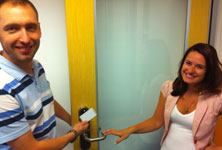
Sean Keenan, senior systems administrator at CIC says, “When we first started looking at the system, as a tech guy, I immediately frowned, however, on the idea that I would be carrying my credentials around on my key ring – what if it gets lost, stolen, decrypted or copied?
“You have to remember, we are just steps away from MIT where world-class hackers just wait looking for a challenge. After getting more familiar with Salto, doing a lot of research and testing with our existing wireless technology and Salto’s wireless locks to ensure compatibility, and exploring its layers of security features, we began warming to it. We also learned that it is in use at Heathrow Airport and at some US military bases – places that take security seriously.”
The solution
In the end CIC took the road less travelled, and decided to rebuild the entire system. And while this means a great deal of work upgrading every door both electronic and keyed throughout the whole centre (although retro-fitting a standard hard keyed door is a mere 15 minute operation), it is worth the effort.
The system they chose is the Salto XS4 wireless solution. The bi-directional technology of this system combines the advantages of both on-line and off-line solutions. Any number of doors can be wirelessly connected to the system thanks to its IEEE 802.15.4 and 2.4 GHz technology. Gateways and repeaters act as antennas, collecting and sending information from the PC via Salto SQL software, to the standalone wireless locks (which use AES 128 encryption) and one gateway can manage several repeaters and electronic locks, minimising infrastructure costs and maximising flexibility.
With a single click CIC can configure or make changes to the network in real-time. It can monitor the network, download audit trail information from the locks, delete users remotely and securely, collect battery status of the RF locks for maintenance and much more all from a single controlling PC and all in real-time. And thanks to its self-healing capabilities, if an individual lock should lose RF connection at any time it will automatically scan for a new connection to an alternative gateway or repeater, restoring communication and maintaining security.
“Although our eventual aim is to have Salto wireless locks on all our floors, the new system will appear to clients to be much like the old system, securing the lobbies and office doors while still allowing 24/7 access,” adds Keenan. “One added feature on this front will be electronic access to the stairwells. After the upgrade, CIC clients will be able to move between CIC floors without having to wait for the elevators.
Ion Murga, marketing manager Americas for Salto Systems says, “An effective, robust access control system is a key requirement for any building with multiple tenants. Its objectives should be to control and restrict access to authorised personnel and areas, prevent and prohibit all likely security threats from occurring and reduce the degree of vulnerability of critical assets to theft.
For more information contact Salto Systems, +34 943 344 550, [email protected]






© Technews Publishing (Pty) Ltd. | All Rights Reserved.
 printer friendly version