



The anti-corruption denunciation delivered recently by president Thabo Mbeki, is good news for South Africans at all levels of society. More than that, it sends a strong signal to foreign investors who, while attracted by the country's vast potential, may be hesitant about risking funds in a high-crime environment.
But to get corruption under control will take more than words. Effective action is vital, which is why all levels of government in South Africa are increasingly looking to biometric solutions to help reduce corruption, waste and inefficiency, while at the same time improving service delivery.
The solutions of choice are those based on fingerprint recognition technology developed by the French company Sagem over more than 20 years, during which the systems have proved themselves in the world's most demanding situations. Top international users include the United Nations, FBI and Interpol.
The primary distributor of Sagem technology in Southern Africa is Ideco Security Solutions, part of the privately owned Black Economic Empowerment (BEE) Ideco Group of companies that operates the sole licensed Sagem service and repair centre in the sub-continent.
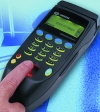
Technology supplied by Ideco is currently responsible for developing a system to manage the fingerprints of more than 38 million South African citizens. And while its reference sites are many and various, existing government applications and systems using equipment and software supplied by Ideco include:
* The South African Police Services (SAPS) for its Automated Fingerprint Identification System (AFIS), Fingerprint and Palm Conversion Centres, and the Criminal Record Centre's Access Control and Time & Attendance (T&A) System.
* The Department of Social Development for pension and social grant payments. Currently more than three million South Africans a month enjoy the security of having their pensions and other grants paid by this means.
Sagem technology supplied by Ideco is also at the heart of the Department of Transport's Driver's Licence Biometric Enrolment and Verification System; the Department of Home Affairs' National ID Card One-to-One Biometric verification and immigration management systems; the Department of Correctional Services' prisoner management and identification system; and the South African Port Operations' employee T&A system.
Access control systems are any organisation's front line against theft and threats to its security. It is essential, therefore, that these defences are rugged, reliable and effective. More than that, they need to be cost-effective.
It is because Sagem biometric-based access control solutions have been field-proven to embrace all the above benefits that sales are growing exponentially, says Vhonani Mufamadi, CEO of Ideco Biometric Security Solutions.
"Increasing security concerns have boosted the market for fingerprint-based access control, coupled to time-and-attendance systems. Logical access control - fingerprint access to computers - is also growing fast and is often integrated with physical access control."
An indication of the pace of this growth comes from the latest findings of the International Biometric Group covering the period up to 2007. Based on its research, IBG forecasts that global biometric revenues will increase from US $600 million in 2002 to more than $4 billion by 2007 - that is over a six-fold growth in five years.
There are many reasons why all levels of government have preferred Sagem-based systems, says Mufamadi.
"Fingerprint technologies offer distinct benefits over other identification methods, including the fact that they cannot be lost, stolen or forgotten. There is no need to carry physical tokens around, no need to remember passwords or PIN numbers; there is thus a major reduction in the administrative effort required for password maintenance," he says.
"Quite simply, the uniqueness of each person's fingerprint makes fingerprint recognition the most secure, efficient and cost-effective way to verify a person's identity at desired access or monitoring points."
"Systems based on Sagem technology operate four times as fast as the next best system. A search of 96 000 fingerprint records typically takes less than two seconds. And because Sagem is the standard selected by government for both civil and criminal applications, integration with existing systems is quick and easy.
"Sagem offers fake finger detection systems that cannot be fooled by a model, impression or a photograph. Rugged, low-maintenance systems operate for long periods even in difficult environments such as mines and industrial plants where, due to the heavy physical nature of their work, many employees have damaged and therefore difficult-to-identify fingerprints."
Importantly, he said, these benefits combine to deliver highly cost-effective operation and rapid return on investment (RoI). The benefits are even more marked when, for instance, access control is linked to time-and-attendance. So-called 'buddy clocking' is simply not possible.
"Almost instant secure identification reduces delays all along the line. Adding new fingerprints to the database is similarly quick and easy," he says.
Mufamadi predicts huge growth for 'logical control' applications because computers and networks are increasingly becoming the repositories of organisations' intellectual capital, making it essential to employ the highest level of security. Further, 'cyber' crime is reportedly growing at about 16% a year globally - higher than the world's economic growth rate.
Sagem's MorphoSmart multipurpose fingerprint-processing peripheral is based on a high-end optical sensor and unique algorithms that make it the most convenient device for controlling access to IT infrastructure, systems and information.
A significant number of applications can already be identified in this space, including Single-Sign-On (SSO) for corporate networks, authentication for Internet banking, encryption and decryption of files and folders and other password replacement applications. Password replacement is another growth sector. Managing passwords effectively is a time-consuming and expensive process; costs can be reduced significantly through the use of biometrics instead of passwords, with the added benefit of elevating the level of security.
It is important for senior executives in Government to be aware of new developments in biometrics, Mufamadi advises. South Africa is a country with a wide variety of climatic conditions, and a large percentage of the population is engaged in manual or physical labour. The result is a variety of challenges, which need to be catered for when implementing biometric systems. In particular, a high percentage of poor quality fingerprints are encountered in certain market segments.
Many biometric systems are prone to failure when presented with poor quality fingerprints. This is either due to the quality of the biometric technology, or the way in which the complete system is designed, implemented and operated. This is why Ideco exclusively distributes Sagem biometric technology, which successfully manages more than 1,5 billion fingerprint records worldwide. Only this type of expertise and experience can provide the accuracy, reliability and stability required in high-security and mission-critical situations.
"Our experience and success in the southern African market ensures our ability to meet the requirements of any customer, irrespective of the number of users or the type of environment in which the system must operate," concludes Mufamadi.
For more information contact Gary Jones, Ideco Group, 011 840 7800, [email protected]






© Technews Publishing (Pty) Ltd. | All Rights Reserved.
 printer friendly version