


In the previous article (Hi-Tech Security Solutions June 2004) we examined the various components required to create a fibre-optic link, starting with the transmitter and ending with the receiver. In this article, the third in the series, we take a closer look at optical fibres.
Optical fibres
An optical fibre is manufactured with a high refractive index central region called the core, surrounded by a lower index cladding, as shown in Figure 1. The fibre is specified by the diameters of these two regions - for example 50/125 means a fibre with a core diameter of 50 mm (microns) and an outside (cladding) diameter of 125 mm.
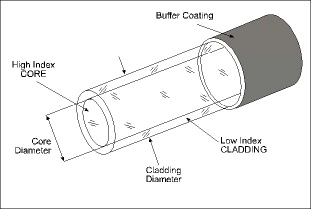
Light is guided within the core region by a series of total internal reflections at the interface between the core and cladding, behaving in many ways as if trapped within a hollow tube whose inside surface has been silvered like a mirror. However, unlike conventional mirror reflection, which is rather inefficient, total internal reflection is very nearly perfect - this is the vital difference, which permits light to be guided through long lengths of optical fibre with minimal loss.
A fibre constructed in this manner (Figure 2a) is called a step-index multimode fibre; step-index because there is a step change in refractive index between the core and cladding, and multimode because there are many possible transmission ray paths or modes. This multiplicity of modes results in pulse dispersion (broadening), since each mode travels a different distance, and hence experiences a different transmission delay, as it traverses from one end of the fibre to the other. The effect of this phenomenon is to limit the maximum frequency that can be transmitted over a given length of fibre - increasing either the frequency or the length of fibre beyond this eventually causes successive pulses to merge into one another, and become indistinguishable. Hence the fibre has a bandwidth limit, which is expressed in MHz.km. For a typical step-index multimode fibre this is about 15 MHz.km, which means that it could, for example, support a 5 MHz video signal for a maximum distance of 3 km (5 MHz x 3 km = 15 MHz.km). Attempts to transmit over greater distances would result in the progressive loss of high frequencies.
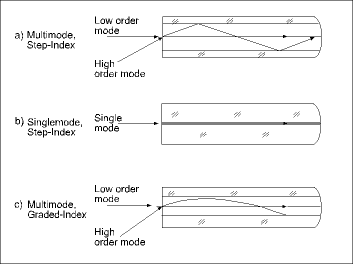
For many applications this figure is unacceptably low, and ways have been sought to design fibres with higher bandwidths. One way has been to reduce the core diameter to a very small size (typically 8-9 mm) so that only one transmission mode is possible - straight down the middle! Singlemode (or monomode) fibres as they are called (Figure 2b) are very effective in reducing dispersion, and result in fibre bandwidths of many GHz.km making them ideal for PTT and Cable TV applications. Unfortunately their very small core diameters necessitates the use of high powered, precisely aligned and hence relatively expensive laser based transmitters, which makes them less attractive for many short range CCTV surveillance applications.
Ideally, what is required is a fibre with a bandwidth similar to that of a singlemode fibre, but with the physical dimensions of a multimode fibre, in order to permit the use of lower cost LED transmitters. The graded-index multimode fibre (Figure 2c) goes some way to achieving this ideal. This is similar to the step-index multimode fibre described earlier, but features a core whose refractive index is not uniform, but is graded from a maximum in the centre to lower values towards the periphery. This has two effects - firstly the light follows a smooth oscillating path but secondly, and more importantly, variations in transmission delay between modes are minimised. This is because the high order (angle) modes that travel the greatest distance actually increase in speed as they move into the lower refractive index material away from the centre, and generally travel faster than low order modes, which stay in the high index material close to the axis. This increase in speed just compensates for the greater distance travelled.
Multimode graded-index fibres are not perfect, but nevertheless achieve very respectable bandwidths. Consequently this type of fibre is the preferred choice for the majority of short and medium range CCTV surveillance applications, and in practice means that fibre bandwidth is only rarely an issue, which needs to be considered.
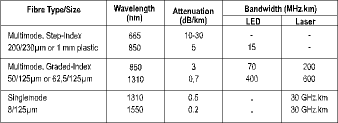
Not so with fibre attenuation, however. All fibres attenuate the optical signal, at a rate, which is dictated by the wavelength of the transmitted light source. As mentioned earlier, there are three wavelengths where fibres typically exhibit their lowest attenuations - 850, 1310 and 1550 nm (Figure 3). These are known as transmission windows. 850 nm is the first and most common (lowest cost) window for multimode fibre systems. At this wavelength a good quality multimode graded index fibre will exhibit an attenuation of about 3 dB/km, permitting CCTV links in excess of 3 km in length.
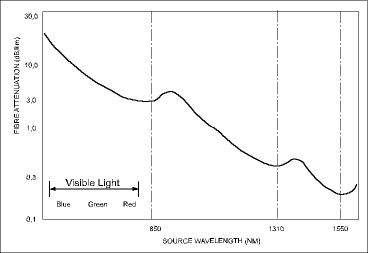
At 1310 nm these same fibres exhibit a much lower attenuation of about 0,7 dB/km, hence permitting proportionately greater link distances up to about 12 km. 1310 nm is also the first of the two operating windows for singlemode fibre systems, with fibre attenuations of less than 0,5 dB/km, which combined with the use of laser based transmitters permits link lengths in excess of 50 km. The second singlemode fibre window at 1550 nm is used for still longer singlemode fibre links (fibre attenuation less than 0,2 dB/km).
Table 1 summarises these figures for the most common fibre types in use today. The variation in fibre bandwidth with wavelength and source type (ie, LED or laser) is due to a secondary pulse broadening effect called chromatic dispersion.
For more information contact Elvey Security Technologies, 011 401 6700, [email protected], www.elvey.co.za
| Tel: | +27 11 401 6700 |
| Email: | [email protected] |
| www: | www.elvey.co.za |
| Articles: | More information and articles about Elvey Security Technologies |






© Technews Publishing (Pty) Ltd. | All Rights Reserved.
 printer friendly version