


Upgraded access control at Wits

Access & Identity Management Handbook 2007 Access Control & Identity Management

Motivation

The University of the Witwatersrand (Wits), based in Johannesburg, is one of Africa's leading research and teaching institutions.

The university's old access control system was becoming slow and cumbersome to manage and was clearly in need of upgrading.

Giles Watermeyer, ICAM manager at Wits, comments, "The system had reached the end of its lifespan. Even though the system was incredibly powerful and flexible, we could not achieve the functionality that a university as large as Wits requires. With about 25 000 students and more than 5000 full- and part-time staff members, a dynamic, state-of-the-art system was required to serve the Wits community.

"One on the biggest drawbacks was the three- to four-day delay for an access change to take effect. This caused much frustration and confusion for security officers and users alike. Generating access reports could take as long as eight hours, which posed a huge problem for the investigation team as it was trying to resolve card faults.

Vendor support was no longer available for the system either. The university identified the need for a more advanced system to meet its needs and embarked on an extensive process of investigating alternative products and assessing the impact of implementing a new system. "The process took almost three years to complete as we followed a thorough process to ensure that we selected a product that met the various needs of the university," adds Watermeyer.

Rewards

Wits has very specific requirements of the system as it not only controls access but also manages the student meal programme as well as the campus 'Wits Bucks' programme for photocopying, printing and retail purchases. In addition, the system has to monitor certain alarm systems on the campus.

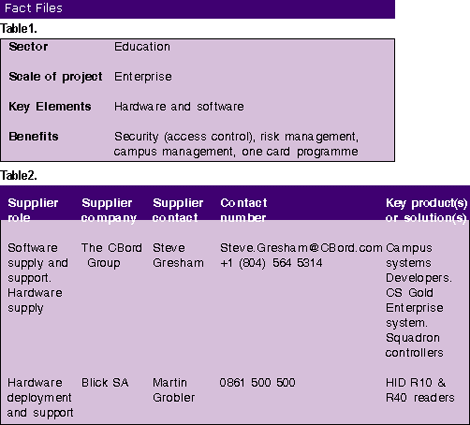
Wits drafted the specifications for the new solution after several meetings following a thorough analysis of the old system. Implementation was planned in consultation with three parties: Wits, CBord (the US developers of Wits' original solution) and Blick SA (security solutions providers).

The Wits project team was made up mostly of the group that is responsible for systems governance and included representatives from the major user groups of the system: libraries, catering services, security, finance and infrastructure.

Implementation

Consultants were used during the specification and tender process to ensure objectivity and compliance with procedures. Aside from that, the Wits team, which has the experience and knowledge of the inner workings of the needs and business processes of the University, drove the process. Thereafter, negotiations between the CBord Group and Blick SA were initiated and an implementation team was established

Success meters, defined by time lines and milestones for each task within the overall project, were developed. For example, the system was to be deployed over two weeks with only a three-day window of downtime. "In reality, there were only two hours of offline time for access systems and three days of downtime for financial systems, so this was a very successfully delivered task," comments Watermeyer.

Another deliverable that exceeded expectations was the conversion of the main access points. Grobler explains, "A timeline was approved that allowed a month of weekends to convert the four main gateways to the new system. This was achieved in three weeks without causing any significant disruption to the campus." During this period 67 readers and 40 controllers were upgraded.

Challenges

The selection and rollout of the new card technology was a major challenge to the project as Wits had to ensure that 50 000 cards were replaced before the first new reader could be deployed. As a result, the cards had to be rolled out from the beginning of the academic year. Custom applications were required to capture new data that the old system was not able to record.

Watermeyer comments, "The switchover was incredibly smooth with very few problems. Most IT deployments are plagued with the need to fix bugs before things start to work. In this case, the software was installed, the conversion was done and the biggest bug took a couple of hours to sort out."

Grobler adds, "The product selected is extremely configurable. The core system did not require any customisation but a fair amount of work was required to configure it to meet Wits' needs."




Share this article:
Share via emailShare via LinkedInPrint this page


Further reading:

Impro announces Primo update
News & Events Access Control & Identity Management Integrated Solutions
Impro Technologies recently held a launch event in which it introduced a series of new products, from new readers through to its updated Primo access management software.

Read more...
If you cannot prove identity, you cannot claim security
Access Control & Identity Management Information Security
Cybersecurity planning for 2026 is a structural change in how attacks are executed and how trust is exploited, demanding that companies stop layering tools on top of infrastructure and instead prioritise intelligence and identity.

Read more...
Paxton set to launch game-changing new system
Paxton Access Control & Identity Management News & Events
Access control is evolving fast. Installers and end users are looking for systems that are simple to install, easy to manage remotely, and flexible enough to scale. In response, Paxton is exploring how emerging technologies can reshape access control.

Read more...
NEC XON secures mobile provider’s hybrid identities
NEC XON Access Control & Identity Management Information Security Commercial (Industry)
For a leading South African telecommunications operator, identity protection has become a strategic priority as identity-centric attacks proliferate across the industry. The company faced mounting pressure to secure both human and non-human identities across complex hybrid environments.

Read more...
Cloud security in visitor management and access control
SA Technologies Access Control & Identity Management Infrastructure Residential Estate (Industry) Commercial (Industry)
Cloud has become the default platform for modern security operations, from visitor management portals and remote access control to incident logging, reporting, analytics, and integrations. But “in the cloud” does not mean “someone else is securing it for us”.

Read more...
Centurion raises the bar at HomeSec Expo
Centurion Systems News & Events Access Control & Identity Management Residential Estate (Industry) Smart Home Automation Commercial (Industry)
Centurion Systems unveiled its latest product lines at HomeSec Expo 2026, introducing SMART+, a simpler way for installers and end users to manage their Centurion installations - as well as a few new products.

Read more...
What’s in store for PAM and IAM?
Access Control & Identity Management Information Security
Leostream predicts changes in Identity and Access Management (IAM) and Privileged Access Management (PAM) in the coming year, driven by evolving cybersecurity realities, hybridisation, AI, and more.

Read more...
Protecting citizens’ identities: a shared responsibility
Access Control & Identity Management
A blind spot in identity authentication today is still physical identity documents. Identity cards, passports, and driver’s licences, biometric or not, are broken, forged, or misused, fueling global trafficking networks and undermining public trust in institutions.

Read more...
The challenges of cybersecurity in access control
Technews Publishing SMART Security Solutions Access Control & Identity Management Information Security
SMART Security Solutions summarises the key points dealing with modern cyber risks facing access control systems, from Mercury Security’s white paper “Meeting the Challenges of Cybersecurity in Access Control: A Future-Ready Approach.”

Read more...
Access as a Service is inevitable
Technews Publishing SMART Security Solutions ATG Digital Access Control & Identity Management Infrastructure
When it comes to Access Control as a Service (ACaaS), most organisations (roughly 90% internationally) plan to move, or are in the process of moving to the cloud, but the majority of existing infrastructure (about 70%) remains on-premises for now.

Read more...


While every effort has been made to ensure the accuracy of the information contained herein, the publisher and its agents cannot be held responsible for any errors contained, or any loss incurred as a result. Articles published do not necessarily reflect the views of the publishers. The editor reserves the right to alter or cut copy. Articles submitted are deemed to have been cleared for publication. Advertisements and company contact details are published as provided by the advertiser. Technews Publishing (Pty) Ltd cannot be held responsible for the accuracy or veracity of supplied material.


© Technews Publishing (Pty) Ltd. | All Rights Reserved.