


Image quality is clearly one of the most important features of any camera, especially for security surveillance and remote monitoring applications where lives and property may be at stake. Unlike traditional analog cameras, network cameras have processing power not only to capture and present images, but also to manage and compress them digitally for network transport. Image quality varies considerably and is dependent on several factors such as the choice of optics and image sensor, available processing power and level of sophistication of the algorithms in the processing chip. This article starts to cover some of the key areas that need to be considered when specifying network cameras for particular surveillance applications.
CCD and CMOS sensors
The camera's image sensor is responsible for turning light into electrical signals. There are two possible technologies for the camera's image sensor:
* CCD (charged coupled device).
* CMOS (complementary metal oxide semiconductor).
CCD sensors are produced using a technology developed specifically for the camera industry, while CMOS sensors are based on standard technology widely used in memory chips, inside PCs for example. Today's high quality cameras mostly use CCD sensors. Although recent advances in CMOS sensors are closing the gap, they are still not suitable where the highest possible image quality is required, though they may serve well for entry-level network cameras where size and price are key.
CCD technology
CCD sensors have been used in cameras for more than 20 years and present many quality advantages, including a better light sensitivity than CMOS sensors for better images in low light conditions. CCD sensors are however more expensive and more complex to incorporate into a camera. Besides, when there is a very bright object in the scene (such as a lamp or direct sunlight), the CCD may bleed, causing vertical stripes below and above the object, a phenomenon called smear.
CMOS technology
Recent advances in CMOS sensors bring them closer to their CCD counterparts in terms of image quality, but they still cannot deliver the highest image quality. CMOS sensors provide a lower total cost for the cameras since they contain all the circuitry needed to build cameras around them. They make it possible to produce smaller-sized cameras. Large size sensors are available, providing megapixel resolution to a variety of network cameras. A current limitation with CMOS sensors is their lower light sensitivity. In normal bright environments this is not an issue, but in low light conditions this becomes apparent. The result is either a very dark or a very noisy image.
Progressive scan versus interlaced video
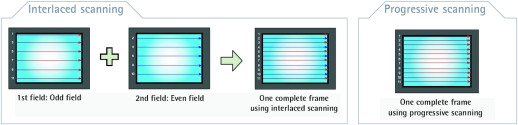
Today, two different techniques are available to render the video: interlaced scanning and progressive scanning. The choice of technique depends on the application, and particularly whether the system is required to capture moving objects and to allow viewing of detail within a moving image.
Interlaced scanning
Interlaced scan-based images use techniques developed for TV monitor displays, with 576 visible horizontal lines across a standard TV screen. Interlacing divides these into odd and even lines and then alternately refreshes them at 30 frames per second. The slight delay between odd and even line refreshes creates some distortion or 'jaggedness' because only half the lines keep up with the moving image while the other half waits to be refreshed. Interlaced scanning has served the analog camera, television and VHS video world very well for many years, and is still the most suitable for certain applications. However, now that display technology is changing with the advent of LCD- and TFT-based displays, DVDs and digital cameras, an alternative known as progressive scanning, has been created.
Progressive scanning
Progressive scanning scans the entire picture line by line every sixteenth of a second. In other words, captured images are not split into separate fields as in interlaced scanning. Computer monitors do not use interlacing so there is virtually no flicker, which can be critical for viewing detail in a moving image such as a person running away. However, a high quality monitor is required to get the best out of this type of scan.
Capturing moving objects
When a camera captures a moving object, the sharpness of the frozen image will depend on the technology used. Compare these JPEG images, captured by three different cameras using progressive scan, 4CIF interlaced scan and 2CIF respectively and note the following:
* All image systems produce a clear image of the background.
* Jagged edges arise from motion with interlaced scan.
* Motion blur caused by the lack of resolution in the 2CIF sample.
* Only progressive scan makes it possible to identify the driver.
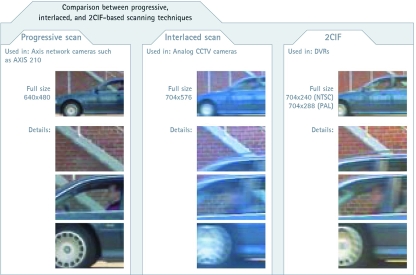
Note: In these examples, the cameras were using the same lens. The car was driving at 20 km/h.
In the next article in the series we will look at image compression methods.
For more information contact Roy Alves, Axis Africa, 011 548 6780, roy@axisafrica.com






© Technews Publishing (Pty) Ltd. | All Rights Reserved.
 printer friendly version