


Having a safe, reliable source of power is crucial for the continuous operation of any electrically powered piece of security equipment, and for the integrity of the overall installation. Given that the electricity supply incoming from Eskom is often unreliable, it is imperative that security installers make adequate provisioning against disturbances to that supply.
Broadly speaking, disturbances fall into three categories: brownouts, spikes and blackouts. Brownouts occur when the voltage of the incoming supply falls below a threshold which is adequate for a device to function correctly. The classic example of this, and one which most of us will be familiar with, is when the lights dim or flicker for a short period, and certain appliances may even switch off or reboot.
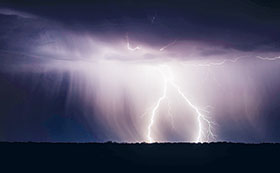
Spikes can be caused by fluctuations in the AC electricity supply, which power utilities have systems in place to guard against but sometimes slip through the net nevertheless, and by surges induced by lightning strikes, which are much harder to protect against and much more devastating in their effects. As for blackouts, suffice it to say that’s like what happens during load shedding.
Rules of thumb
While it may be out of the hands of security end-users to guarantee a reliable electricity supply, there are some key aspects that they can, and should, exercise as much control over as they reasonably can. These include the use of high-quality power supply and backup equipment, and employing trusted, reputable and professional installers and system integrators. While not set in stone, there are also some rules of thumb that can aid the decision-making process when planning and specifying equipment.
According to Pieter van Wyk, project leader at BT-SA, “You have to run the camera/system on an uninterrupted power supply (UPS), for example batteries and a solar system, or a UPS with a generator system. Each area is different so we do some research in that area to find out how long the power is typically out when they have an interruption, so for example when the average is one day we will at least triple that figure and design a system to those requirements.”
Clearline Protection Systems’ Vernon Kyzer, suggests either installing an online UPS or AVR (automatic voltage regulator). “With a UPS, one has to see what load (wattage/current) the system is pulling, then only will you be able to determine the type of UPS to use,” he elaborates. “As for a long-term outage, the more batteries you add the longer you have power. Similarly, with generators one has to see what load the system is pulling before deciding what generator to use. The longer the expected outage, the more diesel the generator must be filled with.”
Roberto Vizcarra from Eurobyte Technology says the specifying process depends on the type of electricity irregularity that must be catered for. “Short, intermittent cuts can be resolved by using a quality online UPS, or a system consisting of an inverter plus battery bank,” he explains. “These would need to be charged from the grid and could provide power for a good couple of hours depending on how much battery storage you have.
“For more intense outages, most professionals would recommend a battery bank system which would be connected to the grid, as well as alternative energy sources to assist power stability. This could include a variety of options such as generators, solar or, in less frequent cases, wind turbine technology.
Protection and maintenance
Especially for equipment that is located outside, a key consideration is the avoidance, or at least mitigation, of lightning damage. Beyond that, maintenance is essential to ensure that equipment is in optimal working order at all times, and to obtain the best working life out of it.
“You will never be able to stop the massive voltage spike of a lightning strike,” states van Wyk, “but the best you can do is to avoid installing equipment that will draw the lightning to you, for example if you plant a camera pole in an open field, opt for a wooden pole to avoid the lightning striking that pole.”
Vernon Kyzer further recommends that proper earthing is done, backed up by one of Clearline’s surge arrestors, which can furthermore be brought to the company for testing to ensure the unit is still in good working order.
Vizcarra goes so far as to say that for high incident areas such as Johannesburg, surge protection should be a standard requirement, attached to each camera and every piece of equipment. For more extreme cases, he says lightning poles mounted above cameras to divert energy away from the cameras may also be an option.
“As for maintenance, “For any enterprise or commercial systems, I would recommend procurement and risk managers insist on a SLA (service level agreement), and I encourage system integrators to insist on it.”
Van Wyk concurs on the importance of an SLA. “I would say if it is a big system, sign an SLA with the company that installed the system so they can service and test the equipment on a regular basis. For example, we recently installed a system at a mine where the environment is very harsh, so there is a maintenance team on site every day working on a strict schedule to optimise the system’s performance. I would say one has to calculate the service intervals based on the environment where the system is installed.”
For more information contact:
BT-SA: www.bt-sa.co.za
Clearline Protection Systems: www.clearline.co.za
Eurobyte Technology: www.eurobyte.co.za
Refer to Hi-Tech Security Business Directory ( www.hsbd.co.za) for further details on these companies.






© Technews Publishing (Pty) Ltd. | All Rights Reserved.
 printer friendly version