

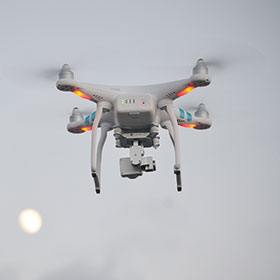
Fire-fighting drones

July 2017 Editor's Choice, Fire & Safety, Products & Solutions

In the midst of the worst wildfire to strike the southern Cape coast of South Africa in over 150 years, drones slowly started coming into play as a local fire fighting and disaster management tool. Fire fighters issued a call for drones equipped with heat mapping capabilities, which would allow them to identify hot spots at the greatest risk of flare-ups – a task virtually impossible for ground crews working in blinding smoke and dense undergrowth.

Drones were also harnessed by civilians who filmed the devastation in Knysna and Plettenberg Bay, allowing homeowners around the country and the rest of the world to witness the destruction and confirm whether their own properties were damaged or not.

In years to come, we can expect to see unmanned aerial vehicles (UAVs) or drones taking on an increasingly important role in fire fighting and disaster management, says specialist drone firm Airborne Drones South Africa.

JJ Rebello, foreign government relations manager at Airborne Drones South Africa, says drones will not only improve the effectiveness of fire fighting efforts; they will also reduce the risk to human life during fire fighting operations and stand to limit damage to assets by enabling fire fighters to work proactively, rather than reactively.

“Commercial drones can withstand temperature extremes from below 5 degrees Celsius, up to 50 degrees Celsius and they can be flown to an altitude of 4500 metres, making it possible for fire fighters to deploy drones over areas where fires are active. With the use of advanced thermal imaging cameras transmitting data to command centres, they can identify people or animals, even where visibility is limited by darkness, smoke or vegetation, so allowing emergency teams to pinpoint exactly where assistance is needed. Thermal imaging cameras also support proactive fire fighting measures, by mapping hotspots where flare-ups could occur.”

Rebello notes that in the security industry, it is estimated that a drone can take the place of 12 foot soldiers. “The same might apply in disaster management,” he says. “Sending in technology reduces risk to human life and allows resources to be deployed only where assistance is needed.”

Drones equipped with Light Detection and Ranging (Lidar) technology support the three-dimensional modelling of forest structures and surface topography, which allows for the development of fire behaviour models, fuel maps and prescribed burn plans. Drones are already being harnessed internationally to monitor and improve planned burns and provide real-time maps of fire progress.

For insurance purposes, drones also offer access to structures that are cut off from road traffic or too high to allow easy access, so supporting claims investigations and processing after disasters. Drone mapping allows insurance firms to rapidly document the scene without intruding on clean-up operations or exposing investigators to potentially hazardous materials; as well as providing data on risk factors associated with the damage.




Share this article:
Share via emailShare via LinkedInPrint this page


Further reading:

AI-enabled NVR for Milestone XProtect
Surveillance Infrastructure Products & Solutions
As surveillance environments continue to grow in scale and complexity, organisations need infrastructure that is easy to deploy, simple to manage, and ready for AI-driven workloads.

Read more...
Global security in 2026
Editor's Choice News & Events Security Services & Risk Management Industrial (Industry) Mining (Industry)
The World Security Report 2026 states: “In a world of increasing volatility, physical security has evolved. It is no longer just a defensive measure; it is a critical driver of corporate value.”

Read more...
Who is to blame for autonomous mistakes?
Editor's Choice Security Services & Risk Management Industrial (Industry) Mining (Industry)
Most supply agreements for AI-integrated equipment still closely resemble plant hire contracts from ten years ago: bilateral, human-focused, and silent on who bears the risk when a machine makes a decision on its own.

Read more...
Beyond the checkpoint
Veracitech Editor's Choice
For decades, mining corporations have treated employee screening as a necessary friction point, an operational cost to be managed rather than a strategic capability to be optimised. A new generation of full-body X-ray technology, purpose-built for the realities of high-throughput precious-metals environments, is beginning to change that calculus.

Read more...
Persistent surveillance with rapid deployment
Editor's Choice
Sky Robots has introduced an aerial drone system designed to operate as a consistent layer within security environments, addressing long-standing challenges around visibility and response across large or complex sites.

Read more...
The control room problem that nobody wants to talk about
Technews Publishing Editor's Choice
WhatsApp has become the unofficial backbone of security communications across the mining and industrial sectors, but it was never designed to be a security tool.

Read more...
Controlling access for people and vehicles
IDEMIA STid Security Technews Publishing Editor's Choice Access Control & Identity Management Asset Management Industrial (Industry) Mining (Industry)
When it comes to access control, the security requirements of mines and the industrial sector are similar, requiring a layered approach that combines physical barriers, digital authentication, and continuous monitoring to protect personnel, assets, and operational continuity.

Read more...
The rise of the smart alarm
Spectrum Security Products Perimeter Security, Alarms & Intruder Detection Products & Solutions
As modern homes across South Africa and the broader Africa region become more connected, expectations around security are rapidly evolving. Today’s homeowner wants a fully integrated smart home security system that delivers control, visibility, and flexibility from anywhere.

Read more...
SWEAR integrates with Milestone
Milestone Systems Surveillance Products & Solutions
Security footage, legal evidence, and other critical surveillance assets face increasing risks of tampering, raising chain-of-custody questions, jeopardising admissibility, and undermining the timely operational decisions that depend on credible video.

Read more...
The AI goldrush has a credibility problem
Refraime Editor's Choice Surveillance AI & Data Analytics
The single most important question a surveillance buyer can ask is deceptively simple: “Was this system programmed or was it trained?” That question alone will reveal more about what you are evaluating than any feature list or marketing video.

Read more...


While every effort has been made to ensure the accuracy of the information contained herein, the publisher and its agents cannot be held responsible for any errors contained, or any loss incurred as a result. Articles published do not necessarily reflect the views of the publishers. The editor reserves the right to alter or cut copy. Articles submitted are deemed to have been cleared for publication. Advertisements and company contact details are published as provided by the advertiser. Technews Publishing (Pty) Ltd cannot be held responsible for the accuracy or veracity of supplied material.


© Technews Publishing (Pty) Ltd. | All Rights Reserved.