

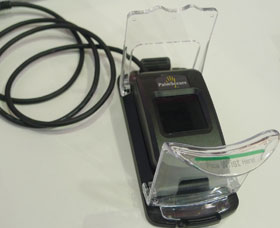
In the palm of your hand

May 2013 Access Control & Identity Management

Fujitsu announced the general availability of authentication solutions based on its PalmSecure technology, which uses individuals’ unique palm vein patterns to combat identity fraud. With Fujitsu PalmSecure, a contactless scan of the palm vein pattern of a user’s hand is enough to confirm their identity, using biometrics that are more secure, harder to defraud and easier to use than traditional authentication methods, such as chip & PIN. Fujitsu PalmSecure was introduced at CeBIT, in Hanover, Germany.

Fraudulent use of electronic authentication technology such as chip and PIN is a multi-million dollar problem for banks and government agencies worldwide. By adopting Fujitsu PalmSecure, which reads an individual’s unique pattern of oxygen-depleted veins on the palm of their hand, users can be authenticated in seconds, simply by holding their hand over a sensor.

Fujitsu PalmSecure is a robust and scalable enterprise solution that is easily adapted to a wide variety of applications in vertical industries. Based on its heritage in developing ICT infrastructures, combined with the strength of its global services organisation, Fujitsu is already in discussions with organisations considering the introduction of PalmSecure for industries ranging from aviation – where it could be used to replace boarding cards – to entertainment and retail. Client software and technical support services are also included in each solution.

“PalmSecure is a proof point of Fujitsu’s increasing focus on end-to-end technology solutions designed to solve real-world problems, and is already tried, tested and proven to combat identity fraud. In the future, as companies of all sizes rely ever more heavily on technology innovation to run their business, solutions like Fujitsu PalmSecure will provide early adopters with a huge competitive advantage in the market,” said Dr Joseph Reger, CTO, Fujitsu Technology Solutions.

In December 2012, the major European commercial banking group UniCredit carried out the first of a series of proof-of-concept tests of its Papillon payment system which is based on Fujitsu PalmSecure technology. Fujitsu provided the sensor which captures the payer’s vein pattern data, a Solution Development Kit enabling UniCredit to independently develop its bespoke application and solution, plus project support. UniCredit plans to gradually introduce Papillon, primarily as a mobile payment mechanism and to complement other payment methods.

Fujitsu PalmSecure is available in Central Europe, Middle East, Africa and India as a tailored security solution direct from Fujitsu. Price varies depending on component configuration and related services required.

How it works

Fujitsu PalmSecure scans the unique pattern of veins within the palm. As veins are internal in the body and have a wealth of differentiating features resulting in high levels of certainty, attempts to forge an identity are virtually impossible. Featuring authentication accuracy with extremely low false rates, the non-intrusive and contactless reader device provides ease of use with virtually no physiological restriction for any and all users. The no-touch sensor also helps prevent the spread of germs and diseases, which are mostly transmitted by hand.

The PalmSecure Palm Vein Unit emits near-infrared rays that are absorbed by deoxidised haemoglobin present in blood flowing through the patient’s palm veins. A proprietary algorithm takes this image, converts it into a digitised biometric template, and then matches it against a database of pre-registered templates. lf a perfect match is found, identity is verified.

Relevant applications

* Aircraft industry: physical access to aircraft.

* Airports: facility access control solutions.

* Automotive: antitheft, access to services.

* Banks: ATM withdrawals, IT infrastructure log in, online banking.

* Data centre: sealed infrastructure, access control.

* Enterprises: IT infrastructure log in and single sign in, physical access control, time & attendance.

* Entertainment: casino access control, gym access control, cruise ship access control.

* Government: patient authentication, social security, national ID card, tax treatment.

* Industrial: physical access control, time and attendance.

* Retail: cash register control and access, cashless payment.

* Cloud: Secured cloud access.

For more information contact Fujitsu, +27 (0)11 233 5006, Christina.herden@ts.fujitsu.com


Share this article:
Share via emailShare via LinkedInPrint this page


Further reading:

Controlling access for people and vehicles
IDEMIA STid Security Technews Publishing Editor's Choice Access Control & Identity Management Asset Management Industrial (Industry) Mining (Industry)
When it comes to access control, the security requirements of mines and the industrial sector are similar, requiring a layered approach that combines physical barriers, digital authentication, and continuous monitoring to protect personnel, assets, and operational continuity.

Read more...
Paxton launches new phone-based security system: Solo
Paxton News & Events Access Control & Identity Management
Paxton has officially unveiled Solo, a phone-based, cloud-hosted access control system. As part of the launch, installers can claim a free Solo starter kit from Paxton, allowing them to trial the system and see how it can work for their business.

Read more...
Taking control of IAM in the AI era
Access Control & Identity Management AI & Data Analytics
AI and Shadow AI are proliferating, creating a series of new risks for organisations. To gain control over who and what has access to corporate data, organisations need unified control over their entire environment.

Read more...
Impro announces Primo update
News & Events Access Control & Identity Management Integrated Solutions
Impro Technologies recently held a launch event in which it introduced a series of new products, from new readers through to its updated Primo access management software.

Read more...
If you cannot prove identity, you cannot claim security
Access Control & Identity Management Information Security
Cybersecurity planning for 2026 is a structural change in how attacks are executed and how trust is exploited, demanding that companies stop layering tools on top of infrastructure and instead prioritise intelligence and identity.

Read more...
Paxton set to launch game-changing new system
Paxton Access Control & Identity Management News & Events
Access control is evolving fast. Installers and end users are looking for systems that are simple to install, easy to manage remotely, and flexible enough to scale. In response, Paxton is exploring how emerging technologies can reshape access control.

Read more...
NEC XON secures mobile provider’s hybrid identities
NEC XON Access Control & Identity Management Information Security Commercial (Industry)
For a leading South African telecommunications operator, identity protection has become a strategic priority as identity-centric attacks proliferate across the industry. The company faced mounting pressure to secure both human and non-human identities across complex hybrid environments.

Read more...
Cloud security in visitor management and access control
SA Technologies Access Control & Identity Management Infrastructure Residential Estate (Industry) Commercial (Industry)
Cloud has become the default platform for modern security operations, from visitor management portals and remote access control to incident logging, reporting, analytics, and integrations. But “in the cloud” does not mean “someone else is securing it for us”.

Read more...
Centurion raises the bar at HomeSec Expo
Centurion Systems News & Events Access Control & Identity Management Residential Estate (Industry) Smart Home Automation Commercial (Industry)
Centurion Systems unveiled its latest product lines at HomeSec Expo 2026, introducing SMART+, a simpler way for installers and end users to manage their Centurion installations - as well as a few new products.

Read more...
What’s in store for PAM and IAM?
Access Control & Identity Management Information Security
Leostream predicts changes in Identity and Access Management (IAM) and Privileged Access Management (PAM) in the coming year, driven by evolving cybersecurity realities, hybridisation, AI, and more.

Read more...


While every effort has been made to ensure the accuracy of the information contained herein, the publisher and its agents cannot be held responsible for any errors contained, or any loss incurred as a result. Articles published do not necessarily reflect the views of the publishers. The editor reserves the right to alter or cut copy. Articles submitted are deemed to have been cleared for publication. Advertisements and company contact details are published as provided by the advertiser. Technews Publishing (Pty) Ltd cannot be held responsible for the accuracy or veracity of supplied material.


© Technews Publishing (Pty) Ltd. | All Rights Reserved.

