


The numbers are sobering. Global losses from precious-metals and gemstone theft within the mining sector reach into the billions each year. Yet for many of the world’s largest mining houses, the core security technology at their screening stations has changed remarkably little over the past quarter-century.
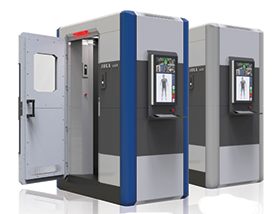
Generation 1 full-body X-ray scanners, with their horizontal platforms, moving subjects, and fixed-source geometry, were a genuine innovation when they arrived around 2000. In 2026, they are outdated and increasingly antiquated.
The challenge is not simply one of ageing hardware. It is systemic. Legacy scanners were designed as standalone screening devices, not as integrated security platforms. They generate images; they do not generate intelligence. In an era where mining operations demand seamless data integration, enterprise-wide accountability, and real-time decision support, a device that produces a grey-scale image for a human operator to interpret, under pressure, and shift after shift, represents a structural vulnerability rather than a genuine safeguard.
It is against this backdrop that Insight Systems, a specialist security technology company with nearly three decades of deep experience in the mining sector, has developed the JUKA series of full-body X-ray scanners. The company’s history is instructive: its founders were instrumental in building the software that underpinned the scanning operations of several global X-ray scanner manufacturers, giving them an unusually granular understanding of where incumbent technology falls short.
A third generation built from first principles
Insight Systems positions the JUKA scanner as the world’s first Generation 3 full-body X-ray scanner. This designation reflects a fundamental rethinking of the technology rather than an iterative upgrade. Where Generation 1 scanners moved subjects horizontally on a platform or conveyor, and Generation 2 systems advanced to vertical scanning with a stationary subject, Generation 3 takes a different approach entirely.
JUKA combines vertical scanning with a linear walkthrough capability, a combination that no other scanner currently on the market achieves. The practical implication is significant. Vertical scanning positions the X-ray source and detectors at approximately half the distance from the subject compared to Generation 1 geometry. By the Inverse Square Law, this translates into a fourfold reduction in the radiation intensity required to achieve equivalent image quality, meaning that JUKA can deliver markedly superior imaging.
The walkthrough capability matters operationally. In high-volume mining environments, where thousands of workers may pass through screening stations at shift change, the ability to process subjects in a natural linear flow with an airlock, rather than requiring them to step onto a platform and step off again, meaningfully reduces dwell time per scan and ensures single entry.
Dynamic dose adjustment and zero environmental contamination
Two additional unique technical features set the JUKA platform apart in contexts where radiation management is a regulatory and reputational consideration. The first is Dynamic Dose Adjustment, a capability that automatically measures each subject’s physical dimensions before scanning and selects the lowest clinically appropriate dose for that individual. The system is fully adjustable and, in combination with JUKA’s vertical scanning geometry, delivers a typical reduction of more than 40% in radiation exposure compared to legacy scanners. For mining security managers who operate cumulative dose tracking programmes across multiple sites and shift cycles, this is not a marginal improvement.
The second unique feature is the scanner’s fully self-contained, insulated pod design, which prevents scatter radiation from being emitted into the surrounding environment. Legacy Generation 1 scanners emit scatter radiation that requires dedicated shielded rooms, imposing significant infrastructure costs and constraining facility design.
For mining operations considering greenfield security facility design or the retrofit of existing screening infrastructure, this distinction has material capital and planning advantages.
The platform beneath the scanner: XMan3
Insight Systems is candid that hardware, however capable, is only part of the answer. The JUKA scanner runs on XMan3, the third generation of the company’s proprietary security management software, a platform that has been continuously developed and refined for nearly three decades. It traces its lineage back to the XMan2 software that powered the operations of several of the world’s largest scanner manufacturers.
XMan3 positions JUKA as an enterprise security platform rather than a standalone screening device. Capabilities include application-specific image optimisation tailored to specific detection objectives (precious metals, gemstones, or contraband differ meaningfully as detection targets), access control through positive identification and single-entry airlock management, remote monitoring and control of multiple scanners across geographically dispersed sites from a central surveillance room, and fully configurable SCADA integration. Role-based permissions, holding room management, IP camera integration with SIP intercoms, and a comprehensive audit trail are all included as standard.
For security managers overseeing multi-site precious-metals operations, the difference between a simple image-generating scanner and a platform that delivers verifiable, auditable data is immense. This distinction is critical because consistent process governance, enterprise-wide reporting, and the ability to demonstrate accountability to both regulators and corporate governance structures are absolute necessities in this sector.
DISCERN: when detection becomes classification
Perhaps the most significant capability in the JUKA ecosystem for mining security applications is DISCERN, the platform’s AI classification engine. The distinction the company draws is precise and worth understanding clearly: conventional full-body X-ray scanners detect anomalies. DISCERN classifies them.
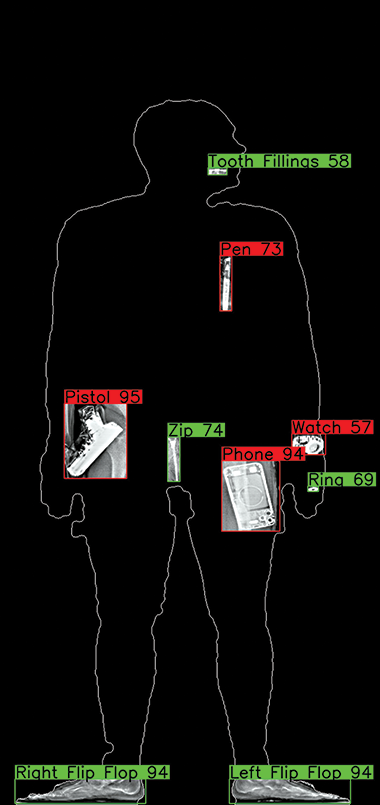
In practice, this means that where a standard scanner presents an operator with an X-ray image requiring interpretation (Is that object a personal item or contraband? Gold or a belt buckle?), DISCERN analyses the image in real time and simultaneously identifies unlimited distinct object categories, both on and inside the body. The system is trained on an extensive library of real-world objects and delivers classification results with confidence scores, mapped to a precise body-location outline visible on a clean, operator-friendly display.
The mining-specific implications are direct. A diamond mine, a gold processing facility, and a platinum operation each face different threats and operate in different cultural contexts. DISCERN is available with pre-configured market-specific detection profiles for mining, and site administrators can configure an Allow List, a defined set of object categories pre-approved for their specific environment. In the example in Figure 1, wedding rings, zippers, tooth fillings, and flip-flops were classified as standard personal items. Once classified and approved, they are automatically cleared on every subsequent scan without operator intervention. Only genuine anomalies reach the operator, mapped to an exact body location.
The operational consequences flow in several directions simultaneously. Throughput improves because operators are no longer required to manually assess every ambiguous image. Operator fatigue decreases because the cognitive load of continuous high-stakes interpretation is materially reduced. False alarm rates fall, which in turn reduces the friction and the potential for industrial relations tension that accompanies unnecessary secondary screening and subject dignity is better preserved, because flagged items are mapped to precise localised areas on a body outline rather than displaying a full anatomical image. Moreover, gender segregation requirements are eliminated.
Every cleared item is logged. Every flagged item is recorded with its classification, body location, and timestamp. The audit trail is complete and tamper-resistant. For security managers who must demonstrate to corporate governance structures, and potentially to regulators, that their screening operations meet defined standards of accountability, this matters.
DISCERN runs natively within XMan3, requires no additional hardware, no separate licence server, and no integration project. It is available on all new JUKA units and can be retrofitted to existing installations via a software update.
Mission critical by design
In mining environments, a scanner failure does not simply inconvenience operations. It creates an immediate security gap, disrupts shift-change workflows, generates operational pressure to bypass normal procedures, and can have significant financial consequences. Insight Systems has designed the JUKA platform explicitly around what it terms ‘mission critical’ performance standards.
This encompasses high availability, automated failsafe mechanisms, graceful purging protocols to ensure operational continuity during maintenance cycles, remote diagnostics and support capability, and proactive maintenance monitoring. The company offers service-level agreements with guaranteed response times through its appointed channel partners. Veracitech is the authorised channel partner and distributor for Insight Systems in southern Africa.
The scanner’s physical design reinforces operational resilience: there are no moving parts, such as conveyors or platforms, reducing points of mechanical failure. Its compact footprint, measuring 1,9 metres long and 1,1 metres wide, with a total floor area of 2,09 square metres, means it can be accommodated in constrained facility layouts.
The longer view
The security landscape for precious-metals mining is dynamic and constantly shifting. Organised crime networks are continually refining their theft techniques and adapting to counter security measures. This challenge is further complicated by the increasing size and complexity of the mining workforce, alongside evolving regulatory standards that demand both robust security accountability and the preservation of worker dignity. Consequently, the screening technology used at these operations must advance in tandem with these evolving threats and requirements.
What Insight Systems is arguing, implicitly through the JUKA platform’s design and explicitly in its market positioning, is that the era of the standalone scanner as the primary instrument of mining security at the exit gate has reached its limits. The next phase of effective precious-metals security will be characterised by the integration of superior imaging hardware with AI-powered classification intelligence, enterprise-wide data platforms, and the kind of complete auditability that modern corporate governance and regulatory environments demand.
Whether the JUKA ecosystem represents the definitive answer to that challenge is a question each security manager will need to evaluate against their specific operational context. What is clear is that it represents a different approach to a problem that has been addressed with broadly the same tools for a generation, and that the gap between what those tools can deliver and what mining security operations now require has not been narrowing.
For more information on the JUKA scanner range and DISCERN AI classification engine, contact Veracitech at www.veracitech.co.za or Insight Systems at www.insightsystemssecurity.com.
This article was prepared and released by Veracitech, the authorised channel partner and distributor for Insight Systems in Southern Africa. Veracitech is a system engineering house with over 30 years of experience, specialising in high-end security systems. Insight Systems is the OEM of the JUKA full-body X-ray scanner platform and the DISCERN AI classification engine.
| Tel: | +27 11 888 7251 |
| Email: | [email protected] |
| www: | www.veracitech.co.za |
| Articles: | More information and articles about Veracitech |






© Technews Publishing (Pty) Ltd. | All Rights Reserved.
 printer friendly version