


Cyber incidents made headlines in 2025 and remain the top concern for companies globally in 2026, according to the Allianz Risk Barometer. The past year has also been a significant one for the accelerated adoption of artificial intelligence (AI), as reflected in its ranking as the biggest riser in the annual survey, at #2, as a complex source of operational, legal, and reputational risk for businesses.
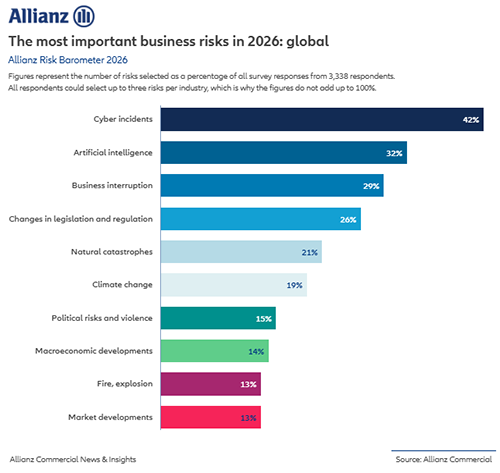
Still, nearly half of the respondents believe AI is bringing more benefits to their industry than risks. However, a fifth says the opposite. For the first time, Business Interruption is not among the top two risks, dropping to #3. Yet, this peril remains a significant concern, given that it can be a consequence of other risks in the global top 10.
Factors such as a quieter hurricane season in terms of losses during 2025 mean Natural Catastrophes drop to #5, year-on-year. Meanwhile, Political Risks and Violence rises from #9 to #7, driven by growing concerns about geopolitical volatility and conflicts worldwide.
Allianz Commercial CEO, Thomas Lillelund, comments, “Following the volatility and uncertainty of 2025, businesses continue to face interconnected and highly complex risks in 2026’s fast-changing environment. Given the continuing rise of AI across society and industry, it is unsurprising that it is the big mover in the Allianz Risk Barometer. As well as bringing huge opportunities, its transformative potential and rapid evolution and adoption are also reshaping the risk landscape, making it a standout concern for firms of all sizes worldwide, alongside other more established threats.”
Cyber risks are by far the biggest concern
In 2026, cyber incidents are the top global risk for the fifth consecutive year, with the highest-ever score (42% of responses), and by the largest margin to date (+10%). It ranks as the top corporate concern across all regions (Americas, Asia-Pacific, Europe, Africa, and the Middle East). The continued presence of cyber at the top of the Allianz Risk Barometer reflects a deepening reliance on digital technology at a time when the cyberthreat landscape, geopolitical, and regulatory environments are fast evolving.
Recent high-profile cyberattacks underscore the ongoing threat to businesses of all sizes. Smaller and mid-sized enterprises are increasingly targeted and under pressure due to a lack of cybersecurity resources.
“Large companies’ investments in cybersecurity and resilience have been paying off, ensuring they can detect and respond to attacks early. However, cyber risk continues to evolve. Organisations are increasingly reliant on third-party providers for critical data and services, while AI is supercharging threats, increasing the attack surface and adding to existing vulnerabilities,” explains Michael Bruch, global head of risk consulting advisory services, Allianz Commercial.
AI creates risks as well as opportunities
AI has surged into the top tier of global business concerns, rising to #2 (32%) in 2026 from #10 in 2025 – the biggest jump in this year’s ranking. It is a big mover in all regions – ranked #2 in the Americas, Asia Pacific, and Africa and the Middle East, and #3 in Europe – and is a growing risk for companies of all sizes too, moving into the top three for large, mid-sized and smaller firms.
As AI adoption accelerates and becomes more deeply embedded in core business operations, respondents expect AI-related risks to intensify, especially when it comes to liability concerns. The rapid spread of generative and agentic AI systems, coupled with their growing real-world use, has heightened awareness of how exposed organisations have become.
“Companies increasingly see AI not only as a powerful strategic opportunity, but also as a complex source of operational, legal and reputational risk. In many cases, adoption is moving faster than governance, regulation, and workforce readiness can keep up,” says Ludovic Subran, chief economist, Allianz. “As more firms attempt to scale in 2026, they will face greater exposure to system-reliability issues, data-quality constraints, integration hurdles, and skilled talent shortages. Meanwhile, new liability exposures are emerging around automated decision-making, biased or discriminatory models, intellectual-property misuse, and uncertainty over who is responsible when AI-generated outputs cause harm.”
Business interruption is strongly connected to geopolitical risks
2025 marked a shift toward protectionist trade policies and tariff wars, bringing uncertainty to the global economy. It was also a year of regional conflicts in the Middle East and Russia/Ukraine, as well as border disputes between India/Pakistan and Thailand/Cambodia and civil wars in Africa – a trend which continues in 2026 with the US intervention in Venezuela.
Geopolitical risks are putting supply chains under increasing pressure, but as risks rise, just 3% of Allianz Risk Barometer respondents view their supply chains as “very resilient”. In the past year alone, trade restrictions have tripled, affecting an estimated US$2,7 trillion in merchandise – nearly 20% of global imports, according to Allianz Trade – fuelling companies' exploration of trends such as friendshoring and regionalisation. These developments lead to a high-risk perception: 29% of respondents rank business interruption as a top peril, placing it at #3, although it drops one position year-on-year.
Unsurprisingly, Political Risks and Violence climb two places to #7, its highest-ever ranking. The closely linked risk of changes in legislation and regulation, including trade tariffs, ranks #4 globally, unchanged year-on-year, but with more respondents, driven by concerns about growing protectionism.
In fact, global supply chain paralysis due to a geopolitical conflict ranks as the most plausible ‘black swan’ scenario likely to materialise in the next five years, according to 51% of the respondents.
View the Allianz Risk Barometer methodology and full global and country risk rankings at https://commercial.allianz.com/news-and-insights/reports/allianz-risk-barometer.html






© Technews Publishing (Pty) Ltd. | All Rights Reserved.
 printer friendly version