


As South Africa grapples with rising substance abuse, the urgent need to combat synthetic narcotics such as Fentanyl, Fubinaca (synthetic cannabinoids), and Cathinones (also known as bath salts) has never been greater. These substances pose significant risks to public health and safety, contributing to rising mortality and addiction rates within the country and worldwide.
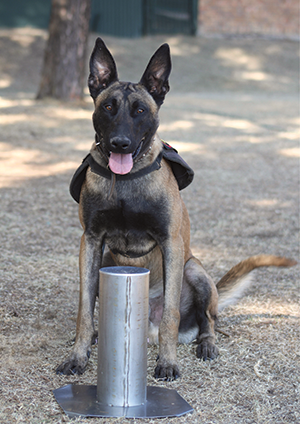
Synthetic opioids, particularly Fentanyl, are an international threat to countries and healthy family units (micro-economies). It is a deadly killer and an imminent threat to our nation and its people. It is many times more powerful and lethal than heroin. In the USA, 107 941 drug overdose deaths were reported in 2022, with 73 838 of those deaths attributed to synthetic drugs, primarily Fentanyl.
Fentanyl now has the potential to supersede all other banned narcotic substances insofar as narcotics-related deaths. It is a formidable and highly lethal substance that is highly addictive. Animals are equally under threat as a small dose of Fentanyl can kill even an elephant in minutes and has killed many substance-detection dogs in the process of detecting illicit substances.
Media attention remains side-tracked and focused on other health issues, and the imminent and dangerous threat posed by substances such as Fentanyl does not enjoy the coverage it should.
New method is safe for dogs and people
In a ground-breaking advancement in K9 training, Braveheart researchers have developed a new method revolutionising how dogs and handlers are trained to detect illicit substances, including synthetic drugs like Fentanyl, Fubinaca, and Synthetic Cathinone. This new method ensures that the dogs are more accurate in their detection capabilities without compromising their mental and physical preparedness, and ensures handler safety.
A strict scientific protocol was followed to identify the risks and ensure the safety of both dogs and humans. This process entailed clinical examinations of humans and dogs involved before and after exposure during the training process. Independent medical and veterinary professionals and senior SPCA officials also conducted and supervised blood tests.
Laboratory scientists preparing the training aids in Braveheart’s laboratory, the facilitator and assessor, and six dogs were part of the scientific protocol to assess the safety of the process. After the training, clinical evaluations were conducted on both the humans and dogs involved in the research and training process.
The analysis report, as provided by an independent laboratory, confirms the safety of researched methods in training dogs and humans.
The process
“Serum samples were tested using high-performance liquid chromatography (LC) attached to a tandem mass spectrometer (MS/MS) for the detection of AMB-Fubinaca, Fentanyl and 4-Chlorodimethylcathinone (4-CDC). The analytes of interest were extracted from the serum using a dilution approach and buffered solvents to maintain the correct pH.
The extracted samples were injected into the LC-MS/MS system to detect and quantify (if present) the analytes mentioned above. LC-MS/MS is a technique used by analytical chemists to separate, identify, and quantify specific compounds that can exist in complex mixtures. It is considered the gold standard of techniques for accurate bio-analytical-based analysis.
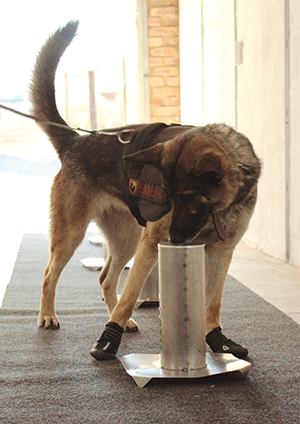
Basically, the samples will be pushed through an HPLC column by the movement of solvent, resulting in chromatographic separation. The compounds will separate on the column due to their polarity or size and then be detected by the mass spectra. Mass spectrometry is a detection method that relies on the mass-to-charge ratio of a compound. Each compound has a distinct pattern regarding its mass and charge, thus allowing the MS to be highly selective. This selectivity increases due to the additional MS (hence MS/MS), increasing ionisation capacity and accuracy.
The serum samples were spiked at a pre-defined concentration with the analytes and tested to ensure the analytes were detected. A limit of detection (lowest concentration that can be detected by the method) of 0,5 ug/L (parts per billion) was achieved. Hence, no tested samples with analytes were present above the detection limit.”
The nose knows
Developing a product that gives off exactly the same odour as an identified narcotic or explosive is not a simple task, however. It may be easy to fool humans, but dogs have an acute sense of smell that is even more sensitive than previously thought. Their millions of olfactory cells allow dogs to detect odours at molecular levels of up to one in one trillion. It would, therefore, be easy to mix incorrect chemical odours into the training substance and hamper the dogs’ ability to quickly and accurately detect the real substances.
‘Pseudo-odours’ have been available for some time, supposedly to allow dogs to be trained on harmless substances. The general result has been that the dogs become experts at identifying the pseudo-odours, but not the actual substance they should be identifying. The difference in pseudo-odour quality can also be seen when dogs trained on the actual substance under investigation show a low recognition of the pseudo-odours. The best training has therefore been using the real substance, until now.
Naturally, substances the dogs are trained to find are always among other substances with their own odours, which makes it essential to ensure the canine can detect the desired substance accurately amongst everything else, even when people try to hide the odour.
Optimal results achieved
The result of this scientific breakthrough by Braveheart Bio-Dog Academy is effective and has safe training for both humans and dogs, and can be used to train both dogs and handlers to identify synthetic narcotics accurately.
This breakthrough will make using dogs to search through cargo or any items for drugs or explosives much more accurate and effective. Criminals use many methods to disguise their illegal products, but with Braveheart’s training aids, dogs can detect a substance among whatever else may be around the target, even if only a few molecules escape.
The increased accuracy improves detection, meets regulatory requirements with ease, and allows the company to certify what a particular dog has been trained to detect – be it military or commercial explosives, narcotics, etc. PSiRA, for example, can also issue certificates with confidence, sure that it cannot be held liable for inaccurate results or endorsing people or companies using improperly trained dogs.
Moreover, while the training results in better detection, it is also safe for both dogs and handlers, as they are not exposed to dangerous and potentially harmful substances. With the training aids, dogs can undergo regular training refreshers or even be trained to find new substances in a much shorter timeframe.
With safer and better dog training and greater confidence on the part of handlers and the regulator, the science of using canines for substance detection has taken a significant leap forward. Importantly, Braveheart has not stopped tinkering in the lab with this breakthrough.
For more information, contact Braveheart Bio-Dog Academy,
| Tel: | +27 11 543 5800 |
| Email: | [email protected] |
| www: | www.technews.co.za |
| Articles: | More information and articles about Technews Publishing |
| Tel: | +27 11 543 5800 |
| Email: | [email protected] |
| www: | www.securitysa.com |
| Articles: | More information and articles about SMART Security Solutions |






© Technews Publishing (Pty) Ltd. | All Rights Reserved.
 printer friendly version