


According to the Allianz Risk Barometer, cyber incidents, such as data breaches or ransomware attacks and IT disruptions, will be the biggest worry for companies globally in 2025. Once again, business interruption is also a main concern for companies of all sizes, ranking second.

After another heavy year of natural catastrophes in 2024, this peril remains third, while the impact of a super election year, rising geopolitical tensions, and the potential for trade wars mean changes in legislation and regulation are a top five risk at number four. The biggest riser in this year’s Allianz Risk Barometer, which is based on the insights of more than 3700 risk management professionals from 100+ countries, is climate change, from seven to five, achieving its highest-ever position in 14 years of the survey.
Large, mid-size, and smaller corporations perceive cyber incidents as their primary business risk. However, there are significant differences in the rest of the ranking.
MEA risk expectations
In Africa and Middle East, the top risks are cyber incidents followed by changes in legislation and regulation. Macroeconomic developments rank third and is a higher concern for African businesses than elsewhere (ranked seventh globally, down two positions year-on-year). Theft, fraud and corruption and critical infrastructure blackouts are also bigger concerns for these firms than in other regions.
The report also explores the top risks for 14 countries of the Africa & Middle East region:
• South Africa: Cyber is the new top risk. The shortage of skilled workforce in ninth place and macroeconomic developments in tenth place are new entries in the top 10.
• Nigeria: Power blackouts are a new entry at number four, while business interruption (fifth) is also up year-on-year.
Allianz Commercial Chief Underwriting Officer, Vanessa Maxwell, comments, “2024 was an extraordinary year in terms of risk management, and the results of our annual Allianz Risk Barometer reflect the uncertainty many companies around the globe are facing right now. What stands out this year is the interconnectivity of the top risks. Climate change, emerging technology, regulation and geopolitical risks are increasingly intertwined, resulting in a complex network of cause and effect. Businesses must adopt a holistic risk management approach and consistently strive to enhance their resilience. We expect risk mitigation and building resilience to address these fast-evolving risks.”
“For many companies, cyber-risk, exacerbated by the rapid development of artificial intelligence (AI), is a big risk overriding everything else. It is likely to remain a top risk for organisations going forward, given the growing reliance on technology – the CrowdStrike incident in summer 2024 once again underlined how dependent we all are on secure and dependent IT systems,” says Rishi Baviskar, Global Head of Cyber Risk Consulting at Allianz Commercial.
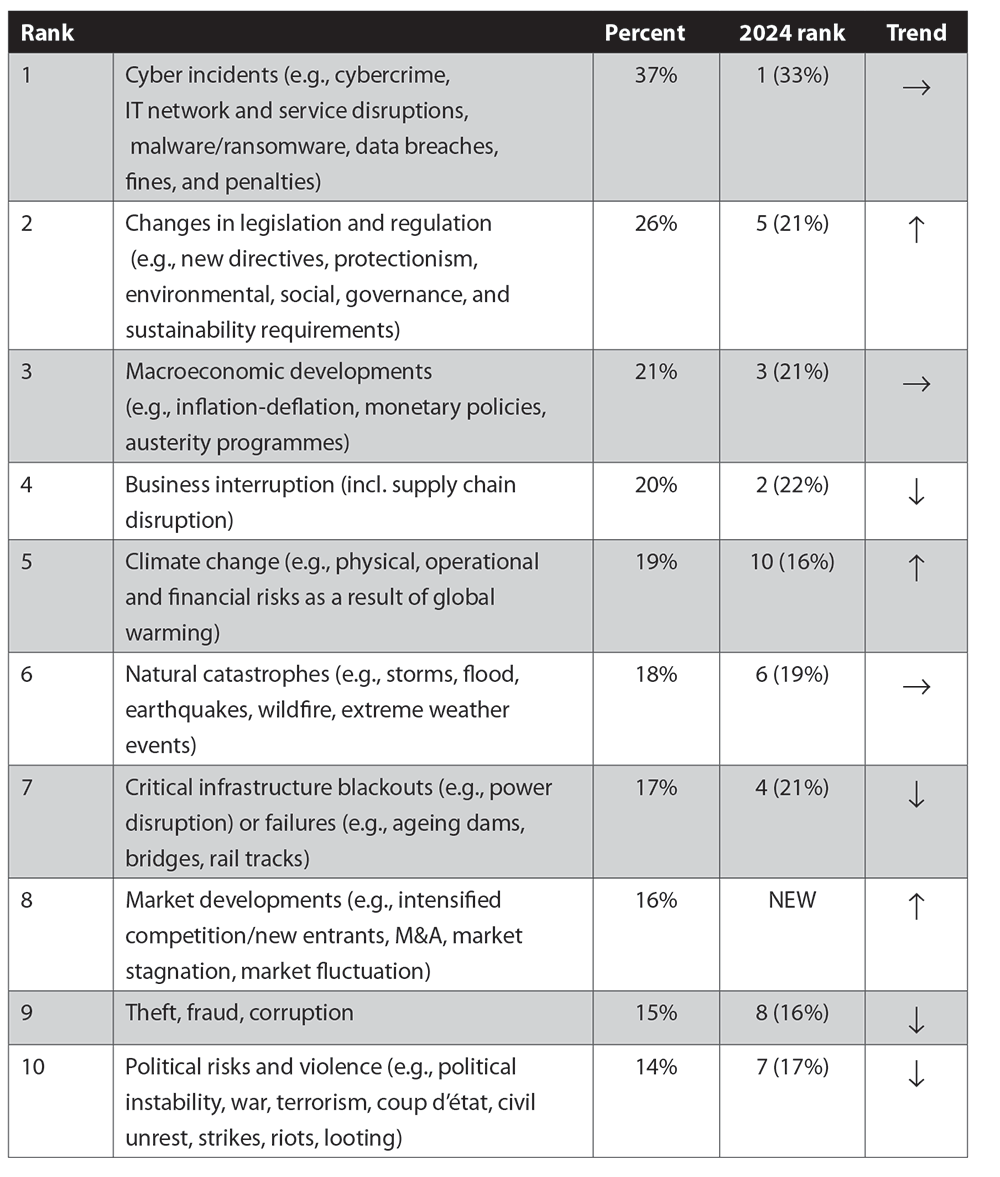 The top 10 risks in Africa & Middle East for 2025
Business interruption interlinked with other risks
Business interruption (BI) has ranked either one or two in every Allianz Risk Barometer for the past decade and retained its position in second place in 2025 with 31% of responses. BI is typically a consequence of events like a natural disaster, a cyberattack or outage, insolvency, or political risks like conflict or civil unrest, which can all affect a business’s ability to operate normally.
Several examples from 2024 highlight why companies still see BI as a major threat to their business model. Houthi attacks in the Red Sea led to supply chain disruptions due to the rerouting of container ships. At the same time, incidents such as the Francis Scott Key Bridge collapse in Baltimore also directly impacted global and local supply chains. Supply chain disruptions with global effects occur approximately every 1,4 years, and the trend is rising, according to analysis from Circular Republic, in collaboration with Allianz and others. Those disruptions cause major economic damages ranging from 5% to 10% of product costs and additional downtime impacts.
“The push for technological advancement and efficiency is affecting the resilience of supply chains. Automation and digitisation have significantly accelerated processes, which sometimes overwhelm individuals due to modern technology’s rapid pace and complexity. However, when implemented effectively, these technologies can enhance resilience by providing better data analytics, predictive insights, and more agile response capabilities. This is why building and investing in resilience is becoming critical for every company around the globe,” says Michael Bruch, Global Head of Risk Advisory Services at Allianz Commercial.
Climate change reaches new high
2024 is expected to have been the hottest year on record. It was also a year of terrible natural catastrophes with extreme hurricanes and storms in North America, devastating floods in Europe and Asia, and drought in Africa and South America. After dropping down the ranking during the pandemic years, as companies had to deal with more immediate challenges, climate change moves up to number five in 2025, its highest-ever position. It ranks as a higher risk year-on-year in countries such as Australia, Belgium, Canada, Croatia, India, Kenya, Mauritius, Malaysia, Morocco, Netherlands, Portugal, Romania, Slovenia, South Africa, Switzerland and Thailand.
The closely interlinked peril of natural catastrophes remains third with 29%, although more respondents also picked this as a top risk year-on-year. For the fifth time in 2024, insured losses surpassed US$100bn.

Geopolitics and protectionism remain on the radar
Despite ongoing geopolitical and economic uncertainty in the Middle East, Ukraine, and Southeast Asia, Political risks and violence dropped one place to nine year-on-year, albeit with the same share of respondents as 2024 (14%). However, it ranks as a more concerning risk for large companies, up to seven, while it is also a new entry into the top 10 risks for smaller companies at number 10.
The fear of trade wars and protectionism is increasing, and analysis by Allianz and others shows that export restrictions on critical raw materials increased by a factor of five within the last decade. Tariffs and protectionism may be top of the list of the new US government, but on the other hand, there is also the risk of a ‘regulatory wild west’, particularly around AI and cryptocurrencies. Meanwhile, sustainability reporting requirements will be high on the agenda in Europe in 2025.
“The effect of new tariffs will be pretty much the same as with (over)regulation: ramping up costs for all companies affected,” says Ludovic Subran, Chief Investment Officer and Chief Economist at Allianz. “However, not every regulation is inherently ‘bad’. More often than not, the implementation of rules makes corporate life difficult.
“Not only the number of rules, but also an efficient administration that makes compliance as easy as possible should be the focus. A thorough digitisation of the administration is urgently needed. However, in 2025, too, we will probably still be waiting in vain for a corresponding digital strategy. Instead, trade wars are coming. The outlook is not rosy.”
Find the full report at https://tinyurl.com/4mvn2r46






© Technews Publishing (Pty) Ltd. | All Rights Reserved.
 printer friendly version