


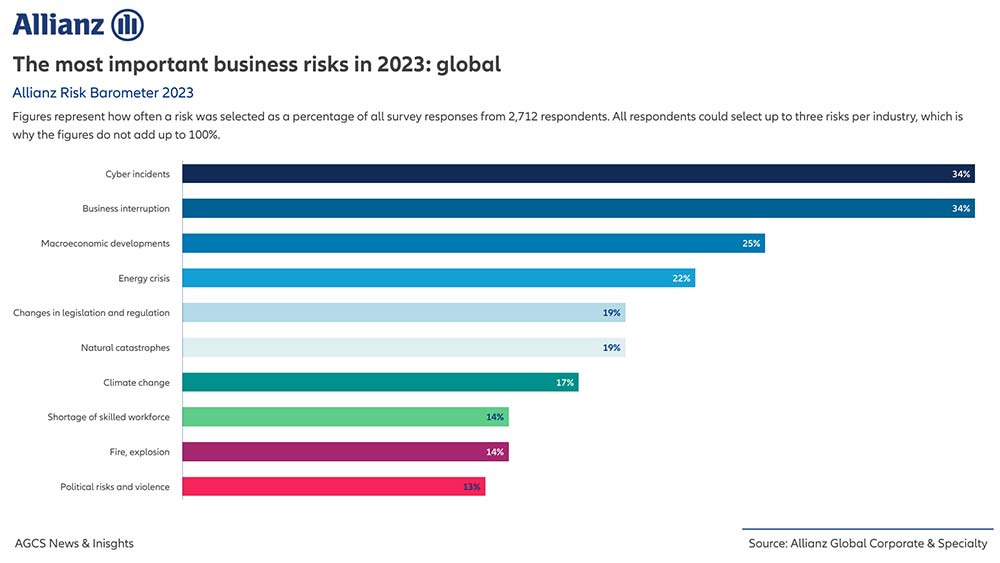
It is both stability and change in the Allianz Risk Barometer 2023. Cyber incidents and business interruption rank as the biggest company concerns for the second year in succession (both with 34% of all responses), however, it is macroeconomic developments such as inflation, financial market volatility and a looming recession (up from #10 to #3 year-on-year), as well as the impact of the energy crisis (a new entry at #4), which are the top risers in this year’s list of global business risks, as the economic and political consequences of the world in the aftermath of COVID-19 and the Ukraine war, take hold.
Such pressing concerns call for immediate action from companies, explaining why both natural catastrophes (from #3 to #6) and climate change (#6 to #7) drop in the annual rankings, as does pandemic outbreak (from #4 to #13) as vaccines have brought an end to lockdowns and restrictions. Political risks and violence is another new entry in the top 10 global risks at #10, while shortage of skilled workforce rises to #8. Changes in legislation and regulation remains a key risk at #5, while fire/explosion drops two positions to #9. View the <a href="https://www.agcs.allianz.com/content/dam/onemarketing/agcs/agcs/reports/Allianz-Risk-Barometer-2023-Appendix.pdf" target"_blank">full global and country risk rankings</a> and watch a short video here.
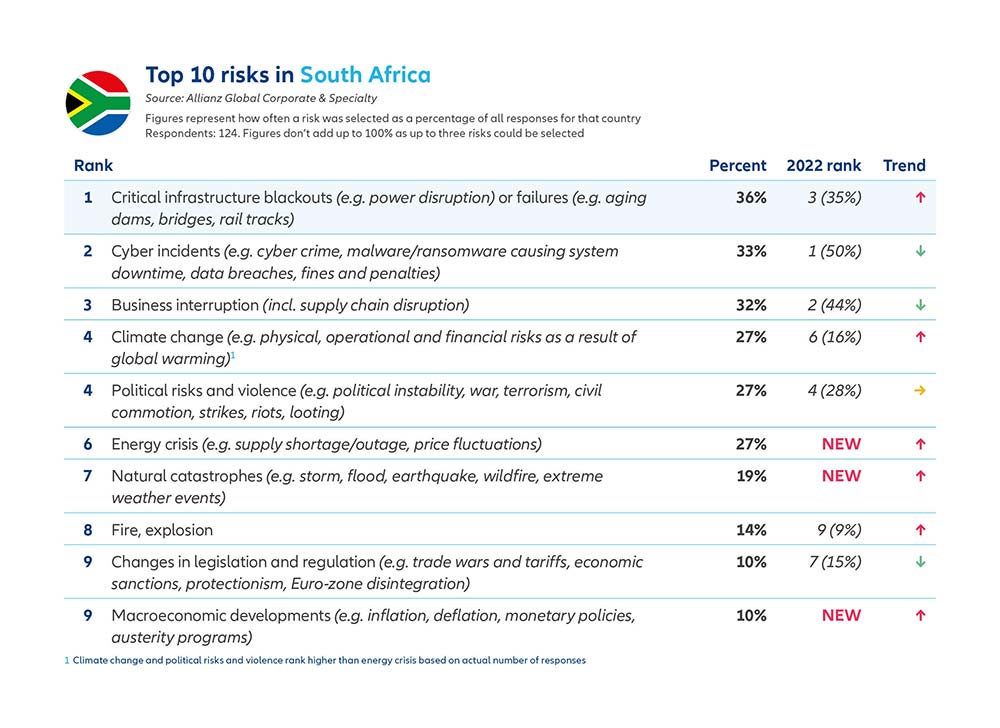
Top three risks in South Africa
Critical infrastructure blackouts such as power disruption or failures of aging dams, bridges and rail tracks are top risks in South Africa, up from #3 in 2022. Cyber incidents are second. Examples of cyber incidents include cybercrime, malware/ransomware causing system downtime, data breaches, fines and penalties. Business interruption, which includes supply chain, is #3 in 2023.
The Allianz Risk Barometer is an annual business risk ranking compiled by Allianz Group’s corporate insurer Allianz Global Corporate & Specialty (AGCS), together with other Allianz entities, which incorporates the view of 2712 risk management experts in 94 countries and territories including CEOs, risk managers, brokers and insurance experts. Respondents were questioned during October and November 2022. The survey focused on large- and small- to mid-size companies. Respondents were asked to select the industry about which they were particularly knowledgeable and to name up to three risks they believed to be most important.
AGCS’ CEO Joachim Mueller comments on the findings: “For the second year in a row the Allianz Risk Barometer shows that companies are most concerned about mounting cyber risks and business interruption. At the same time, they see inflation, an impending recession and the energy crisis as immediate threats to their business. Companies – in Europe and the US in particular – worry about the current ‘permacrisis’ resulting from the consequences of the pandemic and the economic and political impact of the ongoing war in Ukraine. It is a stress test for every company’s resilience. “
“The positive news is that as an insurer we see continuous improvement in this area among many of our clients, particularly around making supply chains more failure-proof, improving business continuity planning and strengthening cyber controls. Taking action to build resilience and de-risk is now front and centre for companies, given the events of recent years.”
In 2023, the top four risks in the Allianz Risk Barometer are broadly consistent across all company sizes globally – large, medium and small – as well as across core European economies and the US (energy crisis excepted). Risk concerns for businesses in Asia Pacific and African countries show some deviation, reflecting the different impact of the ongoing war in Ukraine and its economic and political repercussions.
Digital and disruption dangers
Cyber incidents, such as IT outages, ransomware attacks or data breaches, rank as the most important risk globally for the second year in succession – the first time this has occurred. It also ranks as the top peril in 19 different countries, among them Madagascar, Mauritius, Morocco, France, and the UK. It also ranks as a top three risk in South Africa, Kenya, Nigeria and Tanzania. It is the risk about which small companies (less than $250 million in annual revenue), are most worried.
“For many companies, the threat in cyber space is still higher than ever and cyber insurance claims remain at a high level. Targeted large companies are able to repel most attacks. Increasingly, we see more small- and mid-size businesses, who often tend to underestimate their exposure, impacted. They all need to continuously invest in strengthening their cyber controls,” says Shanil Williams, AGCS board member and Chief Underwriting Officer Corporate, responsible for cyber underwriting.
According to the Allianz Cyber Centre of Competence, the frequency of ransomware attacks remains elevated in 2023, while the average cost of a data breach is at an all-time high at $4.35 million and expected to surpass $5 million in 2023. The conflict in Ukraine, and wider geopolitical tensions, are heightening the risk of a large-scale cyber-attack by state-sponsored actors. In addition, there is also a growing shortage of cyber security professionals, which brings challenges when it comes to improving security.
For businesses in many countries, 2023 is likely to be another year of heightened risks for business interruption (BI). Many business models are vulnerable to sudden shocks and change, which in turn affects profits and revenues. Ranking #2 globally, and in Africa and the Middle East, BI is the number one risk in countries such as Cameroon, Brazil, Germany, Mexico, Netherlands, Singapore, South Korea, Sweden and the US.
The scope of disruptive sources is wide. Cyber as the cause of BI is the one companies fear most (45% of responses); the second most important cause is the energy crisis (35%), followed by natural catastrophes (31%). The skyrocketing cost of energy has forced some energy-intensive industries to use energy more efficiently, move production to alternative locations or even consider temporary shutdowns. The resulting shortages threaten to cause supply disruption across a number of critical industries, including food, agriculture, chemicals, pharmaceuticals, construction and manufacturing.
A possible global recession is another likely source of disruption in 2023, with potential for supplier failure and insolvency, which is a particular concern for companies with single or limited critical suppliers. According to Allianz Trade, global business insolvencies are likely to rise significantly in 2023 (+19%).
Macroeconomic malaise
Macroeconomic developments such as inflation or economic and financial market volatility rank as the third top risk for companies globally in 2023 (25%), up from #10 in 2022 – the first time this risk has appeared in the top three for a decade. It is also a new entrant in South Africa at #10 and features in the top three risks in Burundi, Ghana, Ivory Coast, Madagascar, Mauritius, Morocco, Namibia, Nigeria and Tanzania. All three major economic areas – the United States (US), China and Europe – are simultaneously in a crisis mode, albeit for different reasons, according to Allianz Research, which forecasts recession in Europe and the US in 2023.
Inflation is a particular concern as it is ‘eating’ into the price structure and profitability margins of many companies. Like the real economy, the financial markets are facing a difficult year, as central banks drain excess system-wide liquidity and trading volumes; even historically liquid markets are in decline.
“2023 will be a challenging year; in purely economic terms, it is likely to be a year to forget for many households and companies. Nevertheless, there is no reason to despair,” says Ludovic Subran, Chief Economist at Allianz. “For one thing, the turnaround in interest rates is helping, not least for millions of savers. The medium-term outlook is also much brighter, despite – or rather because of – the energy crisis. The consequences, beyond the expected recession in 2023, are already becoming clear: a forced transformation of the economy in the direction of decarbonisation, as well as increased risk awareness in all parts of society; strengthening social and economic resilience.”
Risk risers and fallers
The energy crisis is the biggest risk riser in the Allianz Risk Barometer appearing for the first time at #4 (22%). It ranks in the top three in Burundi and came in as a new entrant in South Africa, and Nigeria. Some industries, such as chemical, fertilizer, glass, and aluminium manufacturing, can be reliant on a single source of energy – Russian gas in the case of many European countries – and are therefore vulnerable to disruption to energy supply or price increases. If such base industries struggle, repercussions are felt further down the value chain in other sectors.
According to Allianz Trade, the energy crisis will remain the largest profitability shock, for European countries in particular. At current levels, energy prices would wipe out the profits of most non-financial corporates as pricing power is diminishing amid slowing demand.
Driven by 2022 being another year of turmoil, with conflict and civil unrest dominating the news, political risks and violence is a new entry at #10 (13%). Aside from war, companies are also concerned about increasing disruption from strikes, riots and civil commotion activity as the cost-of-living crisis bites in many countries. It remains fourth in South Africa at 27% of responses.
In Africa and the Middle East, political risks and violence fell two places to sixth but it is still in the top three in Burundi, Madagascar, and Nigeria. Recent years have shown the huge impact a coordinated violent SRCC event can have on economy and politics. Examples are the Black Lives Matter protests in the US and the July 2021 riots in South Africa. In 2023, the rising cost of living could also bring an increased risk of disruption from such events.
Despite dropping in the ranking year-on-year, natural catastrophes (19%) and climate change (17%) remain major concerns for businesses. In a year that included Hurricane Ian, one of the most powerful storms recorded in the US, record-breaking heatwaves, droughts and winter storms around the world, and $100+ billion of insured losses, they still rank in the top seven global risks.
Natural catastrophes came in as a new entrant in South Africa at #7, and can be linked with the April 2022 floods that had a devastating impact on KwaZulu-Natal. In Africa and the Middle East, climate change is one of the biggest risers from #10 to #4, highlighting the risks it poses to the region. It also ranks in the top three in Kenya, Mauritius, Namibia and Tanzania. Climate change rises from #6 to #4 in South Africa.
Download the full report at https://www.agcs.allianz.com/news-and-insights/reports/allianz-risk-barometer.html.






© Technews Publishing (Pty) Ltd. | All Rights Reserved.
 printer friendly version