

Off-grid with a second life

Issue 7 2021 Security Services & Risk Management

Revov is a local company specialising in selling batteries into various verticals, from industrial to residential. The batteries it sells are not the usual lead-acid batteries, but lithium iron phosphate (LFP) batteries.

Lance Dickerson, one of the founders of Revov, has many years of experience in the telecoms industry in various African countries where he learned the value of reliable batteries in areas where the electricity supply could not be relied upon to keep communications going 24x7.


Lance Dickerson.

On his return to South Africa, Revov was started as a distributor for BYD batteries. BYD is the largest manufacturer of electric vehicles and accessories in the world. These LFP batteries are used in a variety of vehicles, but reach the end of their working life (specifically their working life in vehicles, not the batteries overall working life) after between 1500 and 1800 cycles. Since the batteries are designed for between 5000 and 7000 cycles, Dickerson saw an opportunity to sell what Revov calls second-life batteries into the local market. (The company also supplies new LFP batteries when required.)

Revov imports these batteries from BYD, tests and refurbished them, placing them into more usable enclosures for the verticals it serves (mostly in 5 kWh or 10 kWh packages and can build configurations with up to 20 000 batteries) and distributes them through its channel partners. Batteries can be built into containers, which can be linked to provide up to 7200 kWh for more high-voltage applications.

Dickerson says the batteries should last for 10 years (or more), depending on use. If they complete a full cycle each day, that would be about 3650 cycles over 10 years, which they can easily handle.
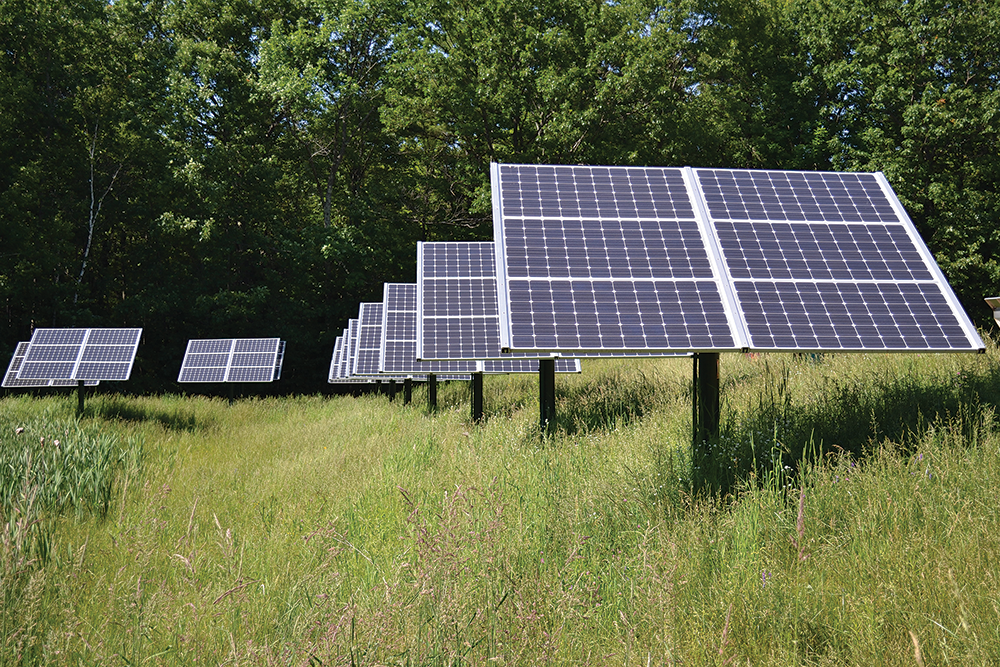
Revov works with its resellers to make sure the batteries are installed correctly and deliver the best service when used with solar panels and other off-grid solutions – and it has the skills onboard to provide additional support if required. Naturally, the batteries don’t need to be used with solar or other renewable sources, but can be used during peak electricity hours and charged in off-peak hours. And of course, they are invaluable when Eskom breaks its toys and we end up with load shedding.

Currently the cost of a solution is only slightly more than Eskom’s fees, but once the next round of increases occurs, the solution will actually be cheaper. With a return on the infrastructure investment in about five years, Dickerson says the number speak for themselves. With a 0.01% return rate over the past 42 months during which it has supplied around 110 MWh in total. Each battery has a warranty for 10 years or 3500 cycles

Why LFP?

When asked why Revov’s LFP batteries would be a better choice than traditional lead-acid batteries, Dickerson offers a number of benefits. The first is temperature. While Revov’s batteries and lead-acid batteries cost about the same, the LFP systems operate at a higher ambient temperature (between 33 and 35-degrees Celsius without degradation) as opposed to 25-degrees of lead-acid batteries.

This makes the 12 V options suited for outdoor perimeter security around farms and other remote areas, for example. The outdoor heat will reduce the lifespan of lead-acid batteries far faster than LFPs, making your battery investment last longer.

In addition, while discharging lead-acid batteries to less than 50% of their capacity can reduce the battery’s full lifespan faster, LFP batteries can use almost 100% of their capacity without such deterioration. Finally, LFP batteries are also smaller and weigh less.

Revov has a direct presence in Cape Town, Durban and Johannesburg from where it supports its South African partners and customers and it has partners in Namibia, Zimbabwe and Botswana.


Credit(s)


Share this article:
Share via emailShare via LinkedInPrint this page


Further reading:

From the Editor's desk: Security goes mainstream
Technews Publishing News & Events
      Welcome to SMART Security’s SMART Mining & Industrial Security Handbook 2026. While the world is focused on cybersecurity and AI, physical security has become a board-level concern across South Africa’s ...

Read more...
Global security in 2026
Editor's Choice News & Events Security Services & Risk Management Industrial (Industry) Mining (Industry)
The World Security Report 2026 states: “In a world of increasing volatility, physical security has evolved. It is no longer just a defensive measure; it is a critical driver of corporate value.”

Read more...
Who is to blame for autonomous mistakes?
Editor's Choice Security Services & Risk Management Industrial (Industry) Mining (Industry)
Most supply agreements for AI-integrated equipment still closely resemble plant hire contracts from ten years ago: bilateral, human-focused, and silent on who bears the risk when a machine makes a decision on its own.

Read more...
Industry perspective on industrial cybersecurity
Technews Publishing News & Events Infrastructure Industrial (Industry)
The Industrial Security Harmonization Group has released a joint industry perspective highlighting a critical truth in industrial cybersecurity: secure communication is not determined by protocols alone, but by how they are deployed and managed in real-world environments.

Read more...
Cyber resilience is the real defence
Security Services & Risk Management Information Security Infrastructure
Cyber resilience has evolved into a form of strategic agility, ensuring that when an interruption occurs, the business does not just survive; it snaps back into place before the market even notices a pause.

Read more...
The control room problem that nobody wants to talk about
Technews Publishing Editor's Choice
WhatsApp has become the unofficial backbone of security communications across the mining and industrial sectors, but it was never designed to be a security tool.

Read more...
Controlling access for people and vehicles
IDEMIA STid Security Technews Publishing Editor's Choice Access Control & Identity Management Asset Management Industrial (Industry) Mining (Industry)
When it comes to access control, the security requirements of mines and the industrial sector are similar, requiring a layered approach that combines physical barriers, digital authentication, and continuous monitoring to protect personnel, assets, and operational continuity.

Read more...
Employees are SA’s biggest cyber threat
Security Services & Risk Management Information Security
South Africa experienced a 46% increase in insider cyber risk in 2026, surpassing the global average of 44%. What is more, 63% of South African companies surveyed expect insider-driven data losses to increase.

Read more...
The post-Q1 security checklist
Asset Management Security Services & Risk Management
By this time of year, employees have changed jobs or roles, suppliers may have changed, and devices have moved between offices, homes, and sites. This is the right time for businesses to run a practical post-Q1 security check.

Read more...
PoPIA turns its attention to gated access
News & Events Security Services & Risk Management
The Information Regulator has gazetted its proposed Code of Conduct for the processing of personal information at gated access points. At 65 pages long, the code signals a significant shift in how personal information is collected and managed at entry points.

Read more...


While every effort has been made to ensure the accuracy of the information contained herein, the publisher and its agents cannot be held responsible for any errors contained, or any loss incurred as a result. Articles published do not necessarily reflect the views of the publishers. The editor reserves the right to alter or cut copy. Articles submitted are deemed to have been cleared for publication. Advertisements and company contact details are published as provided by the advertiser. Technews Publishing (Pty) Ltd cannot be held responsible for the accuracy or veracity of supplied material.


© Technews Publishing (Pty) Ltd. | All Rights Reserved.

