IoT connectivity is everywhere, from routers to sensors and applications. Companies use different mobile network connectivity types depending on their needs. Choosing which is the right one for your project can be tricky. Should you choose a managed APN, a business-grade prepaid service or rely on roaming? In this article, we walk you through these three options.
What is IoT connectivity?
IoT connectivity refers to the connection between all the points in an IoT network. This includes sensors, gateways, routers, applications and platforms. Available network solutions may vary according to bandwidth consumption, range and power. Thus, IoT projects have different requirements and require different connectivity options.
There are currently over 30 billion connected IoT devices and according to research, the number is expected to more than double, reaching over 75 billion devices by 2025. Many of these devices will use data connectivity provided by GSM mobile networks. This exponential growth makes securing the connection between those devices and with the Internet a priority. One of the ways of achieving this is by managing the Access Point Name, or APN.
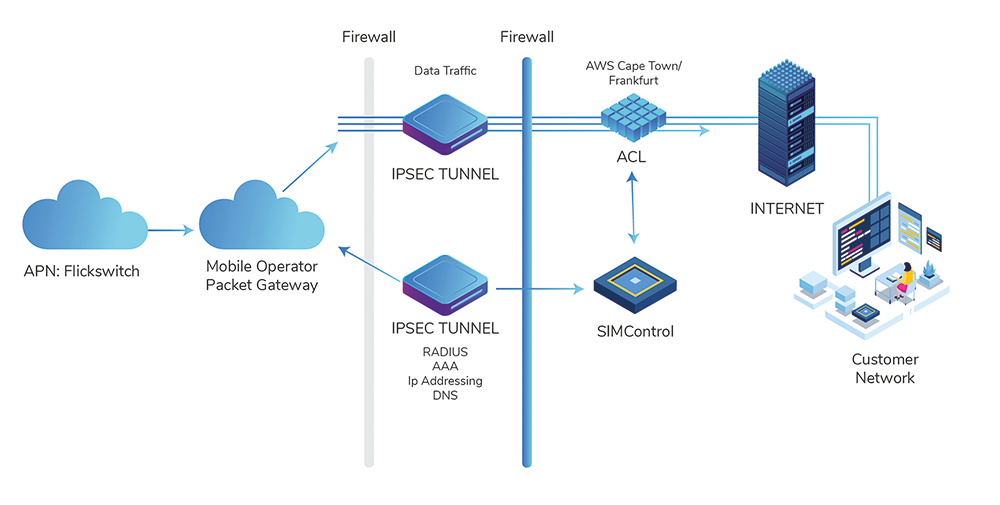
An APN is created to provide a connection between a mobile network and the Internet, separating traffic from other Internet traffic. Companies looking to manage Internet connectivity must choose between a Managed Private APN, a Prepaid or a Global Roaming option.
What is a Managed Private APN?
An APN is a gateway between two networks, one of them being a mobile network. Companies use APNs to manage SIM connections to networks. An APN can be public or private. All mobile networks have public APN offers, with a basic set of configurations that allow users to connect to the Internet.
A private APN is a superior solution in terms of customisation options. Private APN SIMs need to be managed from both an IP and a firewall and data routing perspective. Organisations use managed APNs to customise the way devices safely connect to their network. With a private APN, you can basically build your virtual mobile network without needing to invest in physical infrastructure.
Other benefits of Managed Private APNs include:
• An alternative to public Internet APN: With a managed APN, the corporate infrastructure is not exposed to the entire Internet but only to the devices provisioned by network management. This makes it harder for threats like malware rootkits to bypass the APN, which adds an extra layer of security, especially for devices that don’t have other forms of security.
• Allows you to configure your own firewalls: A managed network lets you customise the system, configuring your own firewall rules. There’s no need to use the system’s defaults, which allows you to manage data flow when necessary.
• Customise your IP address space: You can restrict access to devices and if you add a VPN link, it serves as a tunnel connecting the APN with the public Internet. It forms a tunnel that permits your private network to connect with your server through the public Internet.
• Outbound data routing: If you need to restrict where your devices can connect to, you can use the managed APN as an outbound routing. Managed APNs also allow you to restrict the amount of data each SIM can use, which means no billing surprises.
What is Business Prepaid?
Business Prepaid provides the flexibility to quickly and easily load or suspend SIMs across multiple mobile networks, which in turn saves money. Companies can easily recharge or top-up device SIMs, keeping the costs under control. Other benefits include:
• You can easily control SIM costs because there are no contracts. Prepaid often comes without a contract. It doesn’t require a setup or monthly payments.
• SIMs are monitored and automatically recharged when needed. Managed Prepaid gives users the ability to automate and customise recharge packages.
• It is cost-effective. Prepaid allows you to control the costs since they are fixed, unlike monthly bills.
• It is flexible and scalable. You can scale the number of SIMs up or down according to requirements. Add more if necessary and recharge or top up existing ones.
What Is Global Roaming?
IoT roaming is different from consumer roaming in that data traffic management is critical. Therefore, connectivity is essential to be able to monitor, measure and monetise the traffic. Roaming also has the additional risk of having to manage data SIMs across the world. Therefore, it is typically the most expensive of options. Companies opting for Global Roaming are those for whom controlling the data packages is critical. Benefits of Global Roaming include:
• Scalable and easy deployment to different locations. With managed data roaming, companies can add and manage SIMs abroad with the same flexibility as a local SIM.
• Gives you control, ensuring reliable connectivity. An online platform allows monitoring the SIM spending and controlling costs.
• Roaming can be extremely expensive. With Managed Global Roaming, you can manage your costs without data commitments, contracts or bill shock.
Simplify your IoT data connectivity
SIMcontrol is a solution for companies that need reliable mobile network connectivity. For businesses that need to manage connected devices at scale, controlling the costs and risks can be a challenge. SIMcontrol has the advantage of being network- and SIM-type agnostic, which allows customers to manage multiple networks without issue. The platform is designed for enhancing IoT, M2M or mobile workforce connectivity. The system simplifies managing the SIM base for multiple networks from a single online platform.
It is flexible, allowing management of multiple mobile networks on one platform and it’s cost-effective with a see-what-you-spend approach, reducing dreaded data connectivity bill surprises. Since you can add and manage SIMs according to your needs, SIMcontrol provides scalability, benefiting companies of all sizes and across industries. Moreover, the automated management activities and API integration options make SIM administration much easier.
| Tel: | +27 87 943 7222 |
| Email: | [email protected] |
| www: | www.simcontrol.co.za |
| Articles: | More information and articles about SIMcontrol |






© Technews Publishing (Pty) Ltd. | All Rights Reserved.
 printer friendly version