


Today, more and more businesses are foregoing the traditional design setup of cubicles and closed-off offices for an open floor plan. Open office layouts are designed to be collaborative, inviting workspaces. These open workspaces, typically for 10 or more people, are suitable for activities that demand frequent communication or for routine activities that need relatively little concentration. While these layouts allow for flexibility, they also create some risks when it comes to security.
Open office spaces have essentially made office cubicles redundant in favour of a more collaborative and creatively engaging workspace environment. Co-working spaces commonly adopt open plan office layouts for increased productivity, flexibility and networking opportunities.
One thing is certain, having an open floor plan tips the balance between private and public and this shift affects how a company protects and safeguards personnel as well as proprietary and sensitive company information. This raises the question: what security threats does the open floor plan expose and how can security professionals manage this potential data security headache?
Access control systems are designed to protect buildings and to safeguard the equipment inside. They keep unwanted people out and give access to authorised individuals. While network and cybersecurity are important, preventing physical security breaches and threats is key to keeping technology and data safe, as well as any staff or visitors who have access to the building. Without physical security plans in place, offices or buildings are left open to criminal activity, physical security threats including theft, vandalism, fraud and even accidents.
Access starts at the front door
An effective access control system for any office, open or traditional, starts at the front door. Is the door locked? Is there a guard or are lobby personnel present? How do authorised personnel gain access? Once inside, how are movements and locations tracked? These are important questions and the requirements of an access control system depend on the answers.
Many open office plans do not have a traditional lobby and may not have a ‘front desk’, so securing the main entrance becomes particularly challenging. Traditional access control that relies on physical credentials (ID card, key fob, even a mobile phone) can solve the main entrance question, but what about once inside the building. A physical credential does little to limit access if there are no other doors or partitions to pass through.
The trend today is to include on an access control list a system that relies on biometrics for both multi-factor authentication and single-factor authentication. Historically, access control used the most reliable biometric measures (fingerprints, eye scans) almost exclusively. Over the last five years the accuracy of facial image extraction has improved and the use of stable biometric templates has elevated facial recognition beyond crowd control. Face recognition has achieved parity with the accuracy of the traditional biometric authentication systems and now meets the requirements of access control applications.
Face-as-a-Credential technology
Facial recognition is a biometric software application capable of uniquely identifying or verifying a person by comparing and analysing patterns based on the person’s facial contours. Facial recognition is considered the most natural of all biometric measurements. Facial biometrics are the preferred benchmark because the technology is easy to deploy and implement. The interaction with a facial recognition system is contactless, frictionless and extremely fast.
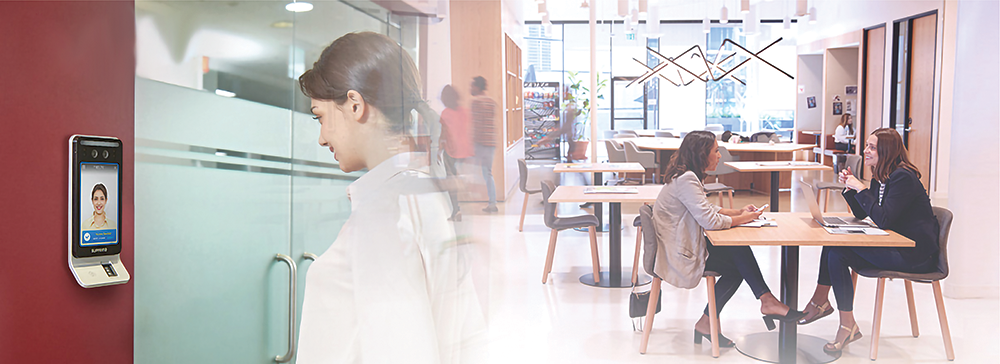
Detecting and capturing a face is the first task of a contactless access control system. The next and most crucial step is granting access to authorised personnel. Face-as-a-Credential technology integrates surveillance cameras, facial recognition algorithms and access control points into a powerful and completely contactless access control system. Face-as-a-Credential technology not only offers secure points of entry, but can also track the movement and locations of employees and visitors within the building. Plus, many Face-as-a-Credential systems allow for remote user registration, where visitors, contractors and delivery people can request access from their computer or phone.
While the primary goal of any access control system is the protection of people, protecting data and personal information from prying eyes, hackers is a close second. In many offices, biometrics are being used – via iris or fingerprint scanners – to protect important information from would-be hackers. This way, only authorised users have access to the information. Additionally, IT departments within these facilities are working closely with security leaders to ensure that networks are as secure as possible to protect from ransomware attacks.
Access control and physical security can go a long way to protect sensitive information, but company policies and procedures should dictate what information can be accessed where and when. Employees need to be trained effectively when they start employment and have regular refresher sessions. Communication should be encouraged and proper adherence to the rules should be rewarded. The larger the company, the greater the chance employees will find themselves working alongside different individuals on a daily basis. Physical security and data security need to be complete to mitigate the possible security risks of the open office environment.
One vendor that meets the challenge of securing an open office is Suprema, an innovator in proximity and contactless access control security. It all starts with BioStar 2, a web-based, open and integrated security platform that provides comprehensive functionality for access control. Featuring a modular, flexible framework, the platform provides a customised system depending on system scale, number of users and system structure that was used. The addition of Suprema FaceStation F2, an advanced facial recognition terminal, provides true contactless access control with the added benefits of time and attendance management, offering unrivalled matching speed, accuracy and levels of security.
Source: Suprema blog, Bringing Down Walls in a Corporate World Using Access Control, found at https://www.securitysa.com/*suprema1
| Tel: | +27 11 784 3952 |
| Email: | enquiry@suprema.co.za |
| www: | www.suprema.co.za |
| Articles: | More information and articles about Suprema |






© Technews Publishing (Pty) Ltd. | All Rights Reserved.
 printer friendly version