

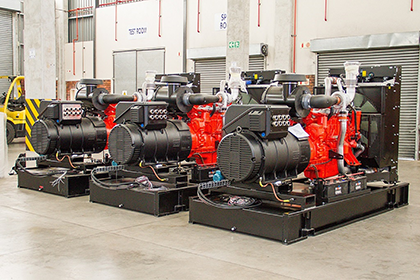
Genset failure can cost dearly

Residential Security Handbook 2021: SMART Estate Living Security Services & Risk Management

Backup power supplies such as gensets are critical to reduce overall electricity demand during load shedding. However, it is vital that such important equipment is maintained properly and serviced regularly to be able to cope with such outages.

Genset failure due to a lack of proper maintenance poses a significant business risk. Here you are not only looking at protecting the value of your assets, but what this genset actually supports and protects, argues ASP Fire CEO, Michael van Niekerk.

The first issue is fuel supply. This can range from an integral tank at the base of the genset to a 2200 litre Bulk To Farm (BTF) tank or a 210 litre drum. Here the apparent danger is the presence of flammable liquids, especially in terms of refuelling and any spillages.

Another issue is vegetation or combustible material encroaching on a genset, which can often be tucked away somewhere as an afterthought. The genset itself is a potential source of fire ignition due to the high temperatures of the manifold. If the genset is indoors, these temperatures can be considerable, especially if the ventilation is inadequate.

Proper maintenance is therefore essential. If an oil filter has not been screwed on tightly enough, for example, it can result in an oil leak. If oil sprays onto a hot manifold as a result of this, a fire will ignite. Thereafter the temperature will build quickly to a point where entrance into such a room is well-nigh impossible.

Companies and individuals often lack the correct firefighting equipment to deal with genset fires. For example, a dry-chemical fire extinguisher will douse the flames, but not cool down any hot surfaces. A carbon dioxide fire extinguisher, on the other hand, might cool down the overheated genset itself, but this can damage the equipment due to thermal shock. Gensets not only supply standby power, but are essential to day-to-day operations.

ASP Fire recommends an automatic fire suppression system for such environments. A genset is unmonitored equipment, with a high fire hazard due to the presence of both flammable liquids and combustible products, as well as electricity. “The probability of something going wrong may be slim in the mind of the end user, but in the likelihood that it does, the consequences can be potentially disastrous and even fatal,” warns van Niekerk.

In terms of fixed fire suppression systems, a range of options is available. Sprinklers are an obvious choice, but this depends on whether or not such a system has been installed already. If not, the cost can be prohibitive, as sufficient hydraulic capacity has to be guaranteed, which means that cheaper and more effective alternatives need to be investigated.


Michael van Niekerk.

The next best option is a clean-gas fire suppression system. “The problem with gensets and the heat they produce is that the rooms they are located in are normally ventilated, which compromises the integrity of the enclosure. If you discharge a gas system in this environment, it is therefore not possible to maintain the concentration of that gas for a sufficient period to suppress the fire. This means that clean-gas systems are not ideal in these scenarios,” explains van Niekerk.

The third option is a water- or foam-mist fire suppression system that only uses a minimal quantity of water. It is also far more cost-effective. This supresses a fire rapidly, cooling any remaining hot spots down to below the automatic ignition temperature.

A standalone water-mist fire suppression system with mechanical activation should be inspected monthly. Gensets should, by rights, be started up at least once a week to ensure the batteries are charged adequately. A cursory visual inspection will also reveal any potential problems or issues.

In terms of regulations and specifications related to gensets, such enclosures are classified as D4 for certain minimum fireproof requirements, including a specific fire rating for the walls. If the gensets in a building are not located in a purpose-built room and are stuck away in a basement next to parked cars, for example, this is a clear violation of the regulations, concludes van Niekerk.




Share this article:
Share via emailShare via LinkedInPrint this page


Further reading:

Understanding the Shared Responsibility Model
Infrastructure Security Services & Risk Management
While the cloud can certainly be a growth enabler in many ways, it can also introduce new security risks. Companies want to have a clear understanding of where their security duties end and where their cloud service provider’s begin.

Read more...
“This Is Theft!” SASA slams Mafoko Security
News & Events Security Services & Risk Management Associations
The Security Association of South Africa (SASA) has issued a stark warning that the long-running Mafoko Security Patrols scandal is no longer an isolated case of employer misconduct, but evidence of a systemic failure in South Africa’s regulatory and governance structures.

Read more...
Making a mesh for security
Information Security Security Services & Risk Management
Credential-based attacks have reached epidemic levels. For African CISOs in particular, the message is clear: identity is now the perimeter, and defences must reflect that reality with coherence and context.

Read more...
Privacy by design or by accident
Security Services & Risk Management Infrastructure
Africa’s data future depends on getting it right at the start. If privacy controls do not withstand real-world conditions, such as unstable power, fragile last-mile connectivity, shared devices, and decentralised branch environments, then privacy exists only on paper.

Read more...
From friction to trust
Information Security Security Services & Risk Management Financial (Industry)
Historically, fraud prevention has been viewed as a trade-off between robust security and a seamless customer journey, with security often prevailing. However, this can impair business functionality or complicate the customer journey with multiple logins and authentication steps.

Read more...
Security ready to move out of the basement
AI & Data Analytics Security Services & Risk Management
Panaseer believes that in 2026, a board member at a major corporation will lose their job amid rising breaches and legal scrutiny, as organisations recognise that cyber risk is a business risk that CISOs cannot shoulder alone.

Read more...
Cyber remains top business risk, but AI fastest riser at #2
News & Events Security Services & Risk Management
The Allianz Risk Barometer 2026 ranks cybersecurity, especially ransomware attacks, as the #1 risk, while AI is the biggest riser and jumps from #10 to #2, highlighting the emerging risks for companies in almost all industry sectors.

Read more...
OT calculator to align cyber investments with business goals
Industrial (Industry) Information Security Security Services & Risk Management
The OT Calculator has been developed specifically for industrial organisations to assess the potential costs of insufficient operational technology (OT) security. By offering detailed financial forecasts, the calculator empowers senior management to make well-informed decisions.

Read more...
From digital transformation to digital sovereignty
Security Services & Risk Management IoT & Automation
As cyberthreats grow, data regulations tighten, and AI becomes central to economic competitiveness, countries are recognising the need to control and protect their own digital assets.

Read more...
The age of Lean 4.0: Orchestrating intelligence and efficiency
Security Services & Risk Management
The convergence of Lean principles and AI (what we now call Lean 4.0) is no longer a theoretical exercise; it is the defining operational paradigm for survival and growth in a complex, data-intensive economy.

Read more...


While every effort has been made to ensure the accuracy of the information contained herein, the publisher and its agents cannot be held responsible for any errors contained, or any loss incurred as a result. Articles published do not necessarily reflect the views of the publishers. The editor reserves the right to alter or cut copy. Articles submitted are deemed to have been cleared for publication. Advertisements and company contact details are published as provided by the advertiser. Technews Publishing (Pty) Ltd cannot be held responsible for the accuracy or veracity of supplied material.


© Technews Publishing (Pty) Ltd. | All Rights Reserved.