

Coping with COVID-19

Issue 9 2020 News & Events

Memoori’s 12th annual world report on the physical security business estimates that the total value of physical security products at factory gate prices in 2020 was $31,7 billion, a decline of over 7% on 2019. Sales declined over all four quarters as a result of the COVID-19 pandemic. This has ended eleven consecutive years of growth in the industry.

In June 2020, the World Bank published a baseline forecast envisioning a 5,2% contraction in global GDP in 2020. Against this backdrop, the report delivers a best estimate of the global market for physical security products going forward to 2025 based on two scenarios. At the time of writing, COVID-19 has seen a second surge and several countries are experiencing rolling lockdowns. Memoori believes its second scenario looks most feasible, where global markets take around a year to return to some normality and mass global adoption of a vaccine is achieved within 18 months. It estimates this has a probability of 65%.

Counteracting these macroeconomic forces, the pandemic has also created demand for new solutions to help control the spread of the virus. Physical security products have risen to the challenge, helping to implement social distancing protocols through existing access and video systems with AI-powered analytics. Thermal cameras have also been deployed to measure people’s temperature, with demand being strong. However, their usefulness has been questioned, with the World Health Organisation saying that, on its own, temperature screening 'may not be very effective.'
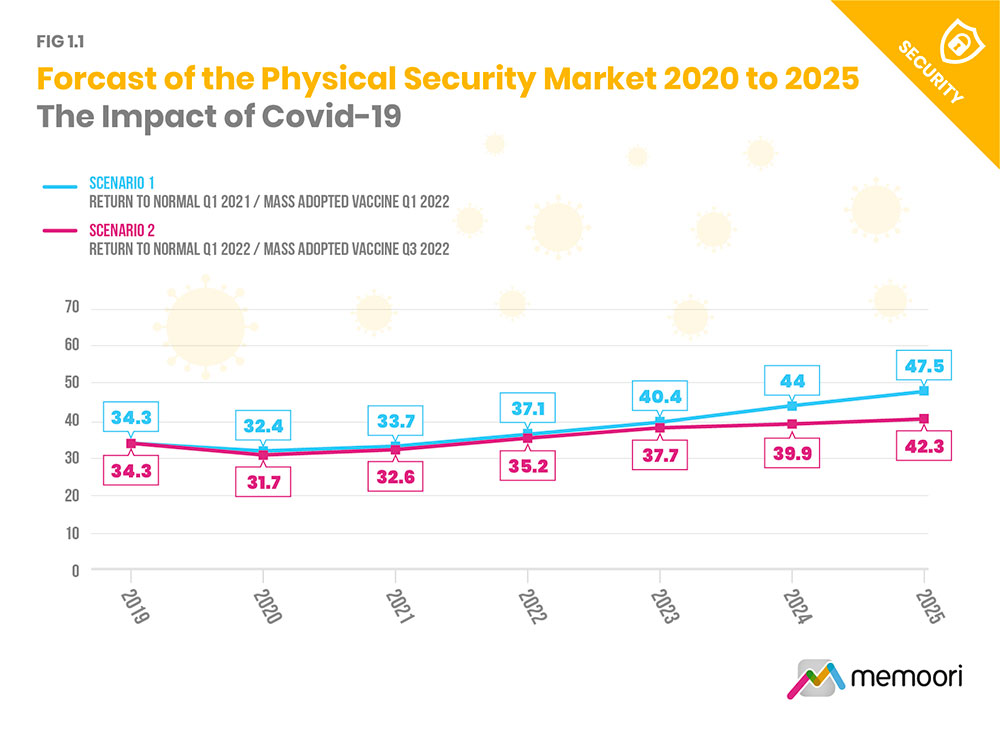
Despite all this, Memoori is still confident of the industry’s robustness and prospects for growth over the medium to long term. Market drivers like the threat from terrorism and crime are unlikely to abate, while urbanisation and smart infrastructure will further drive demand for more and better security systems.

Above all, the COVID-19 outbreak will force suppliers to radically rethink how they operate their business, in particular resilience to externalities. In parallel, there will be lessons to learn on having a more coordinated and resilient supply chain. The video surveillance business is too dependent on Chinese OEMs and component manufacturers. With many of these factories closed for the first two months of 2020, it caused temporary supply chain issues.

As we move forward post-COVID, vendors will need to investigate customers’ requirements thoroughly, particularly those businesses that have been severely damaged by COVID-19. It will be more difficult for these customers to find the budget to invest and therefore they have to be convinced of a return on their investment. ACaaS and VSaaS can provide a solution to this problem and there is evidence of significant accelerating growth in cloud services.

Source: http://memoori.com/coping-with-covid19-its-impact-on-the-physical-security-business-to-2025/




Share this article:
Share via emailShare via LinkedInPrint this page


Further reading:

Woolworths attack raises bomb preparedness questions
News & Events
Two explosions have been reported at Woolworths stores in South Africa over the past week. SMART Security Solutions asked Jimmy Roodt, an experienced and accredited explosive ordnance disposal specialist from Gauntlet Security Solutions, for his insight into the events.

Read more...
Growing adoption of AI at work
News & Events AI & Data Analytics
AI adoption accelerates worldwide, with South Africa making gains amid uneven diffusion. Locally, South Africa ranks 46th of 147 economies measured, and its AI usage increased to 23,1% in Q1 2026.

Read more...
Enterprise AI hits the wall
News & Events AI & Data Analytics
Demands for AI privacy and sovereignty expose the limits of architectures built for centralised and borderless data flows. Organisations that redesign early are gaining a measurable edge in AI readiness and scale.

Read more...
71% of organisations suffered an identity breach
News & Events Information Security
The State of Identity Security 2026 report from Sophos finds human error and poor non-human identity management are the root causes of most attacks, as agentic AI accelerates the risk.

Read more...
From the Editor's desk: Security goes mainstream
Technews Publishing News & Events
      Welcome to SMART Security’s SMART Mining & Industrial Security Handbook 2026. While the world is focused on cybersecurity and AI, physical security has become a board-level concern across South Africa’s ...

Read more...
Global security in 2026
Editor's Choice News & Events Security Services & Risk Management Industrial (Industry) Mining (Industry)
The World Security Report 2026 states: “In a world of increasing volatility, physical security has evolved. It is no longer just a defensive measure; it is a critical driver of corporate value.”

Read more...
Industry perspective on industrial cybersecurity
Technews Publishing News & Events Infrastructure Industrial (Industry)
The Industrial Security Harmonization Group has released a joint industry perspective highlighting a critical truth in industrial cybersecurity: secure communication is not determined by protocols alone, but by how they are deployed and managed in real-world environments.

Read more...
Aerial firefighter training revolution
Fire & Safety News & Events
Sophisticated new flight simulation software capable of accurately modelling the performance of firefighting helicopters could help train pilots to tackle wildfires more effectively and safely in the future.

Read more...
PoPIA turns its attention to gated access
News & Events Security Services & Risk Management
The Information Regulator has gazetted its proposed Code of Conduct for the processing of personal information at gated access points. At 65 pages long, the code signals a significant shift in how personal information is collected and managed at entry points.

Read more...
Surge in AI-enabled cybercrime and a 389% increase in ransomware
News & Events Information Security
Cybercrime no longer functions as a series of isolated campaigns; it operates as a system, with malicious hackers operating across an end-to-end life cycle and compressing the attack life cycle with shadow agents.

Read more...


While every effort has been made to ensure the accuracy of the information contained herein, the publisher and its agents cannot be held responsible for any errors contained, or any loss incurred as a result. Articles published do not necessarily reflect the views of the publishers. The editor reserves the right to alter or cut copy. Articles submitted are deemed to have been cleared for publication. Advertisements and company contact details are published as provided by the advertiser. Technews Publishing (Pty) Ltd cannot be held responsible for the accuracy or veracity of supplied material.


© Technews Publishing (Pty) Ltd. | All Rights Reserved.