

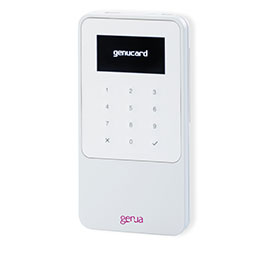
Encrypted communication in compact cellphone format

1 November 2019 Information Security

The German system developer embedded brains has developed the hardware, mechanical components and power management strategy for the compact personal security device, genucard 3 from genucard GmbH, a German IT security specialist. With the device, mobile users can securely connect to and access the company network while on the road or from the home office.

The compact device can be easily connected via USB to any laptop or workstation and enables access to sensitive data in classified networks via a virtual private network (VPN). Compared to the previous version, the genucard 3 offers these advantages:

• Dual-band Wi-Fi for high-performance WLAN connection.

• Authentication via PIN entry directly on the device.

• Compact cellphone format.

High-performance WLAN connection

With genucard 3, employees can easily access government or company networks from their home office or while travelling: genucard can be connected to any laptop or PC and creates an encrypted connection (VPN) to the remote station configured in the network. Possible connection routes to choose from are WLAN including public hotspots, mobile telephony, and Ethernet. If multiple overlapping WLANs threaten to interfere with data transmission, genucard 3 uses dual-band Wi-Fi to switch to other frequency ranges.

User-friendly two-factor authentication

Users authenticate themselves for access to sensitive networks on the device by using a smartcard and entering a PIN. This makes two-factor authentication – a security requirement of the BSI – a user-friendly solution. An additional security feature of genucard is its standalone capability, since the solution runs on autonomous hardware with its own operating system. This way, genucard retains its functionality and protects the classified network, even in the event that the connected computer is compromised as a result of careless handling.

Central management means low outlay

Administration of genucards in use is carried out by a central management station. As a result, a large number of employees can be connected to classified networks with minimal effort. The German armed forces, government agencies, and security authorities, as well as companies operating in the security sector, have been using the previous version of genucard 3 on a large scale for several years.


Share this article:
Share via emailShare via LinkedInPrint this page


Further reading:

Compressing cyberattack timelines and targeting ungoverned AI identities
Information Security News & Events
Sophos AI Security 2026 report finds attackers are moving beyond experimentation and operationalising AI for attacks using identity as the primary initial access vector, rather than inventing new attack types.

Read more...
Zero-touch automation certificate life cycle management loop
Products & Solutions Information Security Security Services & Risk Management
ManageEngine completes the certificate life cycle management loop with CA-agnostic, zero-touch automation. New post-deployment automation in Key Manager Plus removes the last manual step in certificate renewal as lifespans gradually shrink to 47 days

Read more...
Sophos launches AI-native cybersecurity defence system
News & Events Information Security Security Services & Risk Management
Built for a threat landscape reshaped by AI, Sophos Fusion unites security operations, endpoint, network security, identity, email, and cloud into one defence system that prevents, detects, investigates, and responds at AI speed.

Read more...
Ungoverned AI agents and deepfakes pose critical threats
Information Security Security Services & Risk Management
Global study reveals 64% of South African organisations already deploy autonomous AI agents with little to no governance, while 63% of employees admit they are unlikely to be able to spot attacks such as deepfakes

Read more...
How ‘TikTok Brain’ is breaking legacy security training
Training & Education Information Security
Between doomscrolling, rapid-fire Slack notifications, and algorithmic video feeds, the average employee is trapped in an aggressive, highly engineered dopamine loop that automatically shuts down in traditional training situations.

Read more...
Quantum is coming
Infrastructure Information Security
The global cybersecurity landscape is approaching a turning point as quantum computing accelerates faster than most organisations realise; the shift is not a distant, theoretical concern, but a present-day business risk that demands immediate action.

Read more...
Outpacing cyberthreats in the age of AI
SMART Security Solutions Technews Publishing News & Events Information Security
SMARTpod talks to Fred Streefland, Global Field CISO for EMEA at Check Point Software Technologies, about framing modern cyber defence around adaptability, rapid decision-making, and the OODA loop adapted for cybersecurity.

Read more...
Prompt injection is the new phishing
Information Security Security Services & Risk Management
AI security is heading in an uncomfortable direction following Microsoft’s research showing how prompt injection can be chained to remote code execution vulnerabilities in AI agent frameworks, including work involving Semantic Kernel

Read more...
Cybersecurity needs actual intelligence before artificial intelligence
Information Security AI & Data Analytics
Cybersecurity depends on interpretation. A tool can tell you that something unusual has happened, but people need to determine whether it is a genuine risk, the business impact, and how to respond without causing unnecessary disruption.

Read more...
Duxbury Cybersecurity sharpens reseller offering
Duxbury Networking Information Security News & Events
Duxbury Networking has strengthened its Duxbury Cybersecurity business unit by adding WatchGuard and Cynet, giving South African resellers broader, more integrated coverage for the security risks customers are now asking them to address.

Read more...


While every effort has been made to ensure the accuracy of the information contained herein, the publisher and its agents cannot be held responsible for any errors contained, or any loss incurred as a result. Articles published do not necessarily reflect the views of the publishers. The editor reserves the right to alter or cut copy. Articles submitted are deemed to have been cleared for publication. Advertisements and company contact details are published as provided by the advertiser. Technews Publishing (Pty) Ltd cannot be held responsible for the accuracy or veracity of supplied material.


© Technews Publishing (Pty) Ltd. | All Rights Reserved.

