


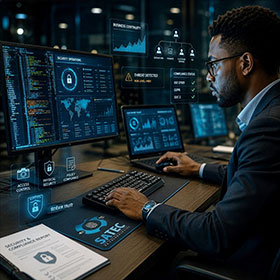
Cybersecurity is no longer only a concern for IT departments. It has become a critical part of business operations, physical security, legal compliance, and customer trust.
As more organisations move towards digital visitor management, cloud-based access control, mobile applications, biometric verification, and connected security platforms, cybersecurity must be viewed as part of the full security environment.
In the past, access control was largely physical. A visitor signed a book, a guard opened a boom, or a resident used a remote. Today, the process is far more connected. Visitors may be pre-registered through a mobile app, scanned at a gate, validated against access rules, and recorded on a cloud-based portal for reporting and compliance purposes. This creates major benefits for estates, office parks, mines, logistics sites, manufacturing facilities, and corporate environments, but it also creates new cyber risks.
Every connected device, user account, application, and database becomes part of the organisation’s digital security landscape.
The merging of physical and cybersecurity
One of the biggest cybersecurity trends is the growing overlap between physical security and cybersecurity. A gate reader, handheld scanner, visitor management platform, or mobile access control app is no longer just a physical security tool. They all process data, communicate with servers, store records, and give authorised users access to sensitive information.
This means that access control providers and their clients need to think beyond whether a system controls entry effectively. They also need to consider and ask themselves the following questions:
- How is information captured?
- How is it transmitted?
- Where is it stored?
- Who can access it?
- How long is it retained?
For example, a visitor management system may collect names, ID numbers, contact details, driver’s licence information, vehicle details, images, signatures, and access history. If this information is not properly secured, it can create privacy, compliance, and reputational risks for the organisation using the system.
Increased focus on privacy and data protection
Another major trend is the increased focus on data privacy. In South Africa, the Protection of Personal Information Act, commonly known as POPIA, requires organisations to process personal information:
- Lawfully.
- Responsibly.
- Securely.
This is especially relevant to the security industry because many access control and visitor management systems capture personal information as part of daily operations. Businesses can no longer afford to treat data protection as an afterthought.
These 5 things must be considered from the start:
- Consent.
- Data storage.
- System access.
- Retention periods.
- Deletion processes.
Digital systems can support better privacy practices when implemented correctly. For example, they can replace paper visitor books, where one visitor may be able to see another visitor’s personal details. They can also include consent prompts, controlled user permissions, audit trails, and defined data retention processes.
The rise of AI-enabled cyberthreats
Artificial intelligence is also changing the cybersecurity landscape. While AI can be used to strengthen security, it is also being used by cybercriminals to make attacks faster, more convincing, and more difficult to detect.
AI can help attackers generate realistic phishing emails, impersonate trusted individuals, test system vulnerabilities, automate attacks, and analyse stolen information more efficiently. This means businesses need to take a more proactive approach to cybersecurity.
Basic protection is no longer enough. Organisations need layered security that includes:
- Strong passwords.
- Access controls.
- Encryption.
- Software updates.
- User training.
- Monitoring.
- Incident response planning.
Cloud-based systems and shared responsibility
Cloud-based systems have become an important part of modern business and security technology. They allow organisations to access information remotely, manage multiple sites, generate reports, and respond more quickly to operational needs.
However, cloud-based systems also require shared responsibility between the technology provider and the client. The provider must ensure that the platform is secure, maintained, up to date, and properly protected. The client must ensure that users are trained, access rights are managed, and internal processes are followed.
This shared responsibility is becoming one of the most important topics of conversation in cybersecurity. A system can be technically secure, but if users share passwords, leave access open to former employees, or fail to follow proper procedures, the organisation remains at risk.
Cybersecurity as a trust factor
Cybersecurity is ultimately about trust. Clients, residents, visitors, contractors, and employees need to know that their personal information is handled responsibly. They need confidence that systems are secure, access is controlled, and data is protected.
Modern access control and visitor management should support both physical security and digital responsibility. Solutions such as VisitMe, OpSync and IntelliGuard are designed to help organisations move away from outdated manual processes and towards smarter, more controlled, and more accountable access management.
For organisations in South Africa, the message is clear: “Cybersecurity is no longer separate from access control; it is part of the foundation of responsible security management.”
| Tel: | +27 11 592 1900 |
| Email: | [email protected] |
| www: | www.satechnologies.co.za |
| Articles: | More information and articles about SA Technologies |






© Technews Publishing (Pty) Ltd. | All Rights Reserved.
 printer friendly version