



According to the Association of Residential Communities (ARC), South Africa has 3000 home owners’ associations (HOAs), with a staggering 5 million people residing in organised communities in 1,9 million homes. Previously just a nice-to-have, security has become an essential value-add for residential estates. As risk profiles change, so too does the way HOAs approach their security stance.
Louis de Jager and Terry Keller from Val de Vie Estate in the Western Cape say that they believe it’s important to emphasise that no matter how large or prestigious an estate may be, there will always be a role for physical guarding in the security equation. This strategic and symbiotic mix of technology, monitoring and manpower allows estates to be both proactive and reactive in preventing crime.
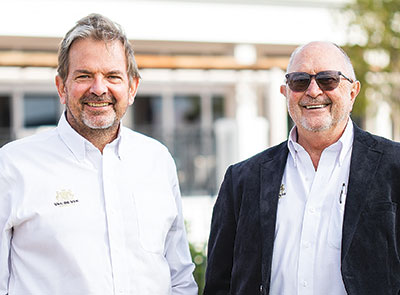
“We also believe that the security function is best handled by a combination of internal HOA employees and external security specialists. Our internal security technical manager, Danie Bosman, works very closely with our service providers – Thorburn – to ensure that security levels are maximised. Thorburn is responsible for supplying all the technical labour and resources, while Bosman manages the entire process. Our security is hosted on an entirely separate and autonomous network from the estate’s other network requirements, with separate firewalls and links that can be accessed only by authorised people within our team,” says De Jager.
The estate’s main security operations are hosted offsite with a remote third-party company responsible for the monitoring of the estate’s 400 cameras. This is supplemented by a small control room onsite at Val de Vie where after-hours reports on security issues are received by the onsite security personnel and relayed to the correct people within the HOA and the reaction teams. “This onsite control room also serves as a backup should the links to the offsite control room go offline. In this instance, as per our SLA, the offsite monitoring company deploys the necessary people to the estate to man our onsite control room,” De Jager says.
“Based on input from the whole team, we draw up an annual capex budget for planned replacement of security equipment – cameras, access control readers and electric fencing – which is about to reach the end of its useful life. Danie is responsible for managing this process as he has the up-to-date information to hand,” says Keller.

10-year plan
Shantelle Walters of Cotswold Downs in KwaZulu-Natal says that the estate has a 10-year security maintenance programme in place, which is reviewed every year. This includes preventative maintenance and its scope is dependent on the funds available within the specific financial year.
“The security budget is carefully pre-planned and reviewed in conjunction with the overall estate maintenance plan. The process is a collaborative one, with the HOA management and our service providers working closely together to highlight critical triggers. This ensures that we evaluate technology which is almost at the end of its warranty period and then take the necessary remedial action. In addition, it gives us an opportunity to phase out security software and equipment that has become limited in terms of its capacity and functionality.”
Walters says that every three years the HOA employs an independent consultant to perform an audit in conjunction with a SWOT analysis. The goal here is to find optimal ways of successfully executing security management in the future and determining which hardware and software are required to provide for sustainable integration in a product-agnostic manner.
“We have an onsite control room which handles daily security monitoring, with a third-party security company that provides us with offsite monitoring in the event of civil unrest. I would definitely consider our onsite control room to be the nerve centre of the estate. Not only do our control room operators manage the controls and cameras, but they are also the source that our residents turn to for all other estate-related queries,” says Walters.
Service-driven HOA
While security is a major component in the HOA portfolio of responsibilities, there are obviously other elements that make for a happy resident. How then, do HOAs work together with local municipalities to ensure the supply of vital resources and the upkeep of maintenance of these services?
Security forms part of the annual Val de Vie budget review, together with other general estate maintenance elements. Keller explains that involvement in road repairs outside the estate’s boundaries, as well as the administration of basic utilities like water, sewage and electricity supply, together with refuse removal, would be totally dependent on each individual estate’s HOA mandate.
“The Val de Vie HOA manages the roads within the estate, while the roads outside the fence line are the responsibility of the Drakenstein municipality and the Western Cape province. A private supplier, in collaboration with Drakenstein municipality, supplies us with bulk electricity. The municipality also provides use with bulk water as well as refuse removal. The HOA is responsible for billing each resident for usage, but if maintenance is needed, we simply convey the message to the service provider,” says Keller.
Cotswold takes a similar approach, with all roads within the fence line falling under the control of the HOA. “However, the municipality signed over ownership of the 500-metre long stretch of road leading off the main road to the entrance of the estate, to Cotswold and two other entities. As such, we are now jointly responsible for the maintenance of that road.”
The Cotswold developer previously established an outside sewage plant which sells greywater back to the estate for the irrigation of the golf course and common areas. “We do pay refuse rates but because of the issues we have had with intermittent service delivery, we are in the process of instituting a Plan B protocol whereby we handle refuse and recycling independently. We have bulk meters for all utilities and we recover costs from the homeowners by means of individual meters installed at their homes and monitored by a third-party utility management company. We are currently investigating the conversion to automated meters,” says Walters.
Similarly, the estate has seen its HOA become active in areas typically reserved for other standalone entities to assist in generating additional revenue streams, such as rentals. “We are a family-run middle to higher LSM estate and while we haven’t seen a gap in the market for facilitating short-term rentals, we do formulate long-term lease agreements on the estate. In addition, we charge a small monthly fee to maintain any vacant land and we apply a small annual fee for the personal post boxes on site,” says Walters.
Estate management – increasing automation
As technology development accelerates and the IoT becomes a part of daily life, what is in store for the management of residential estates? Keller believes that from a general management perspective, operational aspects are becoming more system-driven. “Our maintenance management and communications systems are becoming more automated and app-based, and the COVID-19 lockdown has made it common practice to conduct meetings remotely. However, it’s important to ensure that we still maintain personal contact between our homeowners and the HOA.”
Walters concurs and says that the HOA is driving increased automation for the future, with self-management of residents’ data on a central database being one area of focus. Electronic meetings with residents, which began during lockdown, will also result in increased interaction between the HOA and residents.
Walters says that they have experienced greater demands and expectations from their homeowners in recent years, with homeowners relying on the HOA for guidance in a number of areas. “Although this has been highlighted with the lockdown, a developing trend is that people no longer want to travel far from their homes to enjoy amenities and facilities. This means that we will need to focus more on making common areas more usable in the future.”
She adds that the Cotswold Downs resident demographic is very varied in terms of both age and socio-economic status. “This means that, in the future, the HOA will need to be more flexible and aware that they are not just serving a single type of resident. We will also need to become more self-sustainable. We foresee that ‘greening’ of the estate and sustainability of resources will become increasingly important, with the need to provide our own backup water supply using water tanks, and alternative energy through the implementation of sources such as solar panels.”
An issue which has already reared its head is how one sustains a golf course-based residential estate into the future since it is space-greedy and expensive to maintain. Walters says that this will be a major topic of discussion going forward and has already resulted in the estate investigating the development of a mountain bike/running trail on the estate.
More internal capabilities
With specific regard to security, De Jager anticipates that estates could be moving towards having their own investigative capacity. This would mitigate the current backlog as official channels battle numerous cases. He also predicts that drone technology will become an essential element in the estate security portfolio.
“It’s important to note that the risk manager’s strategic plans must be intelligence driven. This is our ability to leverage the specific intelligence that we have around the whole estate in terms of being able to determine where criminals are going to be and what they are planning to do. We also have a medical response company on retainer, with preferential reaction times guaranteed for our tactical teams and residents,” says De Jager.
Walters emphasises that security management at Cotswold has evolved from the militaristic style common in the early days of estate security to one that fulfils a PR role, with security personnel being able to effectively communicate with homeowners.
“We have found that unprecedented levels of open and honest communications between our own HOA and those of other estates has been prompted by the lockdown. We hold regular Zoom meetings to interpret the rules and regulations of lockdown. This has brought everybody’s unique styles to the table and enabled us to work together in a unified manner, thereby reducing silo-itis,” says Walters.






© Technews Publishing (Pty) Ltd. | All Rights Reserved.
 printer friendly version