

Securing the lifestyle

January 2014 Access Control & Identity Management, Residential Estate (Industry)

Powell Tronics has been involved with a number of residential estates and has developed an understanding of the critical factors in specifying and providing solutions. According to Mike Austen of Powell Tronics, the success of secure estate developments is evident.

“A secure lifestyle is the major reason that people choose these estates and this then means that people without any reason for being on the estate must be kept out. It also means that residents must take charge of their own security by abiding by the rules.

“This is especially pertinent with regard to securing access for their visitors. I believe that the primary fears of any homeowner are hijacking, robbery and being able to use open/public/common spaces/areas with peace of mind. The basic solutions are the same but estates have needs that require customised solutions, with added functionality and special reports,” he continued.
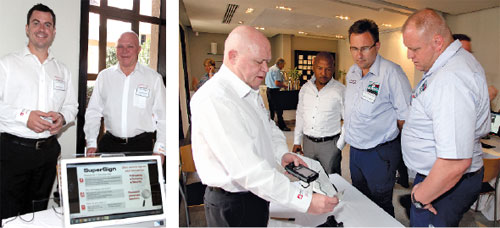
Powell Tronics in action at the Hi-Tech Security Solutions’ Residential Estate Security Breakfast.

The initial problem facing the setting up of a security system is the buy in of the community and the allocation of finances for the job. The major challenge facing estates with respect to managing access and egress is finding a balance that works for all parties: the owners/tenants require speedy and efficient access control for entry and exit, which is fairly easily achieved; their visitors need to feel welcome, but they need to be screened proficiently; and their contractors would require registration and verification before being allowing access.

“One needs to find a solution that does not cause tailbacks, delays that lead to frustration and the ability to deliver management reports with data that is legible. Most estates do not have an integrated access control solution that addresses both visitors and tenants. That is, a system that combines the visitor management and the residents’ access control systems. This causes confusion and frustration and creates the impression that the system does not work. Some visitor enrolment systems linked to third-party databases can result in long queues and can cause a lot of frustration,” Austen added.

Having a dedicated security manager on an estate, employed directly by the estate, will only work if they are prepared to spend money on employing a qualified person. This security manager will then develop a working relationship with security installation and guarding companies, as well as the people living on the estate. He/she will have an intimate knowledge of the issues of security affecting the estate.

It is important that the electronic systems are integrated and do not rely on manual input by a security guard. Most estates are moving towards biometric control for homeowners/tenants, staff and long-term third-party contractors. For visitor control, a driver’s licence scanning system, integrated with the resident’s access control system, with access PAC codes that are sent to visitors by the home owners/tenants to assist with verifying visitors speedily, are becoming popular. Running two or three systems independently is a recipe for disaster as there will always be the issue of accountability.

“We have found that a strict control on both resident and visitor access to the estate automatically brings down insider threat. If the ability to make decisions about who can and cannot enter the estate does not reside entirely with the guard at the gate, the system will be more secure. The system should ideally make the homeowner accountable for their own visitors. This can be achieved by using an online visitor management system whereby the homeowner enters the visitor’s details into the system and is issued with a personal access code (PAC), valid for one entry and exit only,” said Austen.

For more information contact Powell Tronics, +27 (0)861 787 2537, [email protected], www.p-tron.com


Share this article:
Share via emailShare via LinkedInPrint this page


Further reading:

The line between locking residents out and restricting their access
News & Events Security Services & Risk Management Residential Estate (Industry)
A June 2026 High Court judgment has clarified one of the most contested issues in modern estate governance: when an HOA's digital access restrictions amount to unlawful self-help or spoliation, and when they do not.

Read more...
AI agents become ‘First Class Identities’
Access Control & Identity Management
AI agents are now approving transactions, accessing systems, triggering workflows, and making decisions autonomously. But uncontrolled AI agents are becoming one of the largest security gaps in modern enterprises.

Read more...
Balancing secure access control and fire safety
Editor's Choice Access Control & Identity Management Fire & Safety
In modern building management, few topics create as much tension as the intersection between security access control and fire evacuation safety. Nichola Allen of G2 Fire sheds light on this delicate balance.

Read more...
Securing water infrastructure for industry and community
Access Control & Identity Management Fire & Safety Government and Parastatal (Industry)
The Badirammogo Water User Association needed a solution that could secure remote sites, reduce reliance on physical guards, and ensure uninterrupted service delivery while remaining aligned with its values and long-term strategy.

Read more...
Disconnect between confidence in identity security and operational reality
Access Control & Identity Management News & Events
New FIDO Alliance and HID study reveals gap between identity security confidence and reality; 94% of enterprises claim they can revoke employee access within 24 hours, yet 35% experienced delays or failures in the past two years.

Read more...
Paxton Solo training available to security installers
Paxton Access Control & Identity Management News & Events
Following the launch of Solo, Paxton’s brand-new access control system, the security manufacturer is rolling out dedicated Solo training sessions across South Africa to support security installers working with the system.

Read more...
Free POPIA Action List for gated access
ATG Digital News & Events Residential Estate (Industry) Training & Education Commercial (Industry)
ATG Digital, in partnership with CIVITAS, released the POPIA Responsible Party Action List. It is a free, practical guide for HOAs, body corporates, managing agents, landlords, employers and institutions. It helps them move from assuming compliance with the Protection of Personal Information Act (POPIA) to proving it.

Read more...
Controlling access for people and vehicles
IDEMIA STid Security Technews Publishing Editor's Choice Access Control & Identity Management Asset Management Industrial (Industry) Mining (Industry)
When it comes to access control, the security requirements of mines and the industrial sector are similar, requiring a layered approach that combines physical barriers, digital authentication, and continuous monitoring to protect personnel, assets, and operational continuity.

Read more...
Paxton launches new phone-based security system: Solo
Paxton News & Events Access Control & Identity Management
Paxton has officially unveiled Solo, a phone-based, cloud-hosted access control system. As part of the launch, installers can claim a free Solo starter kit from Paxton, allowing them to trial the system and see how it can work for their business.

Read more...
Taking control of IAM in the AI era
Access Control & Identity Management AI & Data Analytics
AI and Shadow AI are proliferating, creating a series of new risks for organisations. To gain control over who and what has access to corporate data, organisations need unified control over their entire environment.

Read more...


While every effort has been made to ensure the accuracy of the information contained herein, the publisher and its agents cannot be held responsible for any errors contained, or any loss incurred as a result. Articles published do not necessarily reflect the views of the publishers. The editor reserves the right to alter or cut copy. Articles submitted are deemed to have been cleared for publication. Advertisements and company contact details are published as provided by the advertiser. Technews Publishing (Pty) Ltd cannot be held responsible for the accuracy or veracity of supplied material.


© Technews Publishing (Pty) Ltd. | All Rights Reserved.

