

Putting a finger on multifactor authentication

August 2001 Access Control & Identity Management

Most major organisations employing some type of security access control employ badges. In the majority of cases, that badge is a passive proximity card. With it, employees can get through the front gate or door and into other rooms throughout the facility that do not rely on a high degree of security.

However, to gain access to more sensitive areas, such as the server room, laboratories or warehouses, these same organisations employ multifactor authentication, typically including biometrics. Such dual identify verification systems are also important for conducting important work on the computer system, such as making high value financial transactions and accessing confidential medical records.

Heightened security applications

Using a combination of authentication methods provides a stronger assurance that users are who they say they are. First of all, it is much harder for hackers to steal or intercept more than one authentication method, such as a card and a password. More importantly, while many authentication methods, such as cards and passwords, can be passed from one to another to breach a system, it is more than difficult to loan someone your finger.

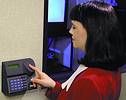
Thus, in heightened security applications already using passive proximity throughout the organisation, site administrators configure their systems to require users to use both their proximity card and a fingerscan to enter these special areas or gain access to the computer or exclusive files. The proximity card reader is simply integrated into the fingerscan reader so that the card and finger are read simultaneously, resulting in a one-touch-and-you-are-in operation.

If the organisation is using active RFID or smartcards, the operation is equivalent with one major difference. Instead of the template for the fingerscan residing in the reader, it can be kept on the card as a travelling database, one that needs no administration or memory. Upon reaching the reader, the template is transmitted into the fingerscan unit for comparison.

Smartcards

When using contact smartcards, the user inserts the smartcard into the unit and the template is transferred. The user then places a finger and the comparison is made. If the fingerscan matches the template on the card, then, and only then, the employee gains access.

If the system employs contactless smartcards, the ID number and template are transferred as the user approaches the reader, eliminating the need and time to insert a card. The authorised user simply has to touch the fingerscan reader to gain access.

For further details contact Hi-Tec Laboratory, (011) 958 0703.


Share this article:
Share via emailShare via LinkedInPrint this page


Further reading:

Balancing secure access control and fire safety
Editor's Choice Access Control & Identity Management Fire & Safety
In modern building management, few topics create as much tension as the intersection between security access control and fire evacuation safety. Nichola Allen of G2 Fire sheds light on this delicate balance.

Read more...
Securing water infrastructure for industry and community
Access Control & Identity Management Fire & Safety Government and Parastatal (Industry)
The Badirammogo Water User Association needed a solution that could secure remote sites, reduce reliance on physical guards, and ensure uninterrupted service delivery while remaining aligned with its values and long-term strategy.

Read more...
Disconnect between confidence in identity security and operational reality
Access Control & Identity Management News & Events
New FIDO Alliance and HID study reveals gap between identity security confidence and reality; 94% of enterprises claim they can revoke employee access within 24 hours, yet 35% experienced delays or failures in the past two years.

Read more...
Paxton Solo training available to security installers
Paxton Access Control & Identity Management News & Events
Following the launch of Solo, Paxton’s brand-new access control system, the security manufacturer is rolling out dedicated Solo training sessions across South Africa to support security installers working with the system.

Read more...
Controlling access for people and vehicles
IDEMIA STid Security Technews Publishing Editor's Choice Access Control & Identity Management Asset Management Industrial (Industry) Mining (Industry)
When it comes to access control, the security requirements of mines and the industrial sector are similar, requiring a layered approach that combines physical barriers, digital authentication, and continuous monitoring to protect personnel, assets, and operational continuity.

Read more...
Paxton launches new phone-based security system: Solo
Paxton News & Events Access Control & Identity Management
Paxton has officially unveiled Solo, a phone-based, cloud-hosted access control system. As part of the launch, installers can claim a free Solo starter kit from Paxton, allowing them to trial the system and see how it can work for their business.

Read more...
Taking control of IAM in the AI era
Access Control & Identity Management AI & Data Analytics
AI and Shadow AI are proliferating, creating a series of new risks for organisations. To gain control over who and what has access to corporate data, organisations need unified control over their entire environment.

Read more...
Impro announces Primo update
News & Events Access Control & Identity Management Integrated Solutions
Impro Technologies recently held a launch event in which it introduced a series of new products, from new readers through to its updated Primo access management software.

Read more...
If you cannot prove identity, you cannot claim security
Access Control & Identity Management Information Security
Cybersecurity planning for 2026 is a structural change in how attacks are executed and how trust is exploited, demanding that companies stop layering tools on top of infrastructure and instead prioritise intelligence and identity.

Read more...
Paxton set to launch game-changing new system
Paxton Access Control & Identity Management News & Events
Access control is evolving fast. Installers and end users are looking for systems that are simple to install, easy to manage remotely, and flexible enough to scale. In response, Paxton is exploring how emerging technologies can reshape access control.

Read more...


While every effort has been made to ensure the accuracy of the information contained herein, the publisher and its agents cannot be held responsible for any errors contained, or any loss incurred as a result. Articles published do not necessarily reflect the views of the publishers. The editor reserves the right to alter or cut copy. Articles submitted are deemed to have been cleared for publication. Advertisements and company contact details are published as provided by the advertiser. Technews Publishing (Pty) Ltd cannot be held responsible for the accuracy or veracity of supplied material.


© Technews Publishing (Pty) Ltd. | All Rights Reserved.

