

Ending theft of power cables

August 2009 Infrastructure, Industrial (Industry)

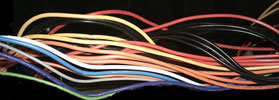
Cable thieves, who cost the South African economy a reported R5,5-billion a year, are about to be stopped in their tracks thanks to the local design, development and production of an economic, easily applied cable theft protection system now being brought to market. Transnet, Telkom, Eskom and the Gauteng Municipality each reported losing amounts varying between R863-million and R900-million a year to cable theft. Most municipalities in South Africa experience serious cable theft problems.

In a move that will make it nigh impossible to steal long lengths of underground cable, power cable manufacturer Aberdare Cables has sealed an agreement with the product developer, Bert Gruber and the inventor, Alan Goldring to distribute the Cable Guard product in South Africa and sub-Saharan countries where Aberdare is represented.

“Larger underground cables are complex to manufacture and prices have been driven by the high cost of the metals involved, primarily copper, and to a much lesser extent aluminium, to the point where cable costs can be as much as R1000 per linear metre,” says electrical consultant to Aberdare, Dick Hardie. “Hence it is an attractive proposition for thieves who frequently use powerful vehicles to pull long lengths of cable out of the ground. Cable Guard makes this extremely difficult, in fact, nearly impossible.”

Lengths of cable fitted with Cable Guard were subjected to continuous full-throttle pulling and deliberate jerking in a number of tests to simulate cable theft. In one case a 185-square millimetre multicore PILC electrical cable, typically used for a mains supply ring feed, was conventionally laid in deep trenches, and compacted to the required 93% MOD (ASHTO) standard. An 8-ton truck, an 8-ton double differential mechanical horse, and a Model 428 Caterpillar 4-wheel drive backactor excavator all failed to remove the cable.

The Cable Guard system components are injection moulded from reinforced engineering polymers, resulting in both strength and corrosion resistance. The system is simple, quick, and easy to apply. It initially clamps securely around the cable outer serving. The outer shield is then fitted, which also interlocks with the clamping system. Gruber says computer-aided design and finite element analysis (FEA) were employed to ensure optimum product performance.

“The system tests also demonstrated that Cable Guard will fully resist in-line mechanical pull-out, reverse pull-out and perpendicular pull-out of cable,” said Gruber. “The Cable Guard system is available to fit five outer cable diameter sizes, ranging from 46-86 mm.”

For more information contact Annelene Sivalingum, Aberdare Cables, +27 (0)11 456 4200, [email protected]


Share this article:
Share via emailShare via LinkedInPrint this page


Further reading:

A risk-based approach to fire safety
Fire & Safety Security Services & Risk Management Industrial (Industry) Agriculture (Industry)
A report by fire engineering consultancy ASP Fire is challenging blanket assumptions around combustible-core sandwich panels, arguing instead for a rational, risk-based approach that balances fire safety requirements with commercial realities in sectors such as agriculture, manufacturing and industrial processing.

Read more...
Quantum is coming
Infrastructure Information Security
The global cybersecurity landscape is approaching a turning point as quantum computing accelerates faster than most organisations realise; the shift is not a distant, theoretical concern, but a present-day business risk that demands immediate action.

Read more...
Cloud-ready BMS is reshaping building operations
Facilities & Building Management Infrastructure
Buildings may be getting smarter, but too many control rooms are still anchored to yesterday’s technology, such as on-site servers, rigid architectures and a patchwork of interfaces that are expensive to run and slow to evolve.

Read more...
While OT security is maturing, risk is not slowing down
Infrastructure Industrial (Industry)
Industrial organisations now rely on interconnected systems, remote access, cloud-based analytics, and unified IT and OT environments to maintain production. Fortinet’s 2026 State of OT and Cybersecurity Report illustrates why visibility, segmentation, and integrated security are essential.

Read more...
Increase in cyberattacks on the manufacturing sector
Security Services & Risk Management News & Events Industrial (Industry)
According to a new Kaspersky ICS CERT report, in the first quarter of 2026, the percentage of industrial control systems (ICS) on which malicious objects were blocked reached 19,6% globally.

Read more...
From drone market growth to application-level commercialisation
IoT & Automation Infrastructure
After years of pilot projects and technology validation, the question for the market is shifting from whether drones can fly safely and collect data, to where they can deliver repeatable operational value at scale.

Read more...
AI-enabled NVR for Milestone XProtect
Surveillance Infrastructure Products & Solutions
As surveillance environments continue to grow in scale and complexity, organisations need infrastructure that is easy to deploy, simple to manage, and ready for AI-driven workloads.

Read more...
Global security in 2026
Editor's Choice News & Events Security Services & Risk Management Industrial (Industry) Mining (Industry)
The World Security Report 2026 states: “In a world of increasing volatility, physical security has evolved. It is no longer just a defensive measure; it is a critical driver of corporate value.”

Read more...
Who is to blame for autonomous mistakes?
Editor's Choice Security Services & Risk Management Industrial (Industry) Mining (Industry)
Most supply agreements for AI-integrated equipment still closely resemble plant hire contracts from ten years ago: bilateral, human-focused, and silent on who bears the risk when a machine makes a decision on its own.

Read more...
Industry perspective on industrial cybersecurity
Technews Publishing News & Events Infrastructure Industrial (Industry)
The Industrial Security Harmonization Group has released a joint industry perspective highlighting a critical truth in industrial cybersecurity: secure communication is not determined by protocols alone, but by how they are deployed and managed in real-world environments.

Read more...


While every effort has been made to ensure the accuracy of the information contained herein, the publisher and its agents cannot be held responsible for any errors contained, or any loss incurred as a result. Articles published do not necessarily reflect the views of the publishers. The editor reserves the right to alter or cut copy. Articles submitted are deemed to have been cleared for publication. Advertisements and company contact details are published as provided by the advertiser. Technews Publishing (Pty) Ltd cannot be held responsible for the accuracy or veracity of supplied material.


© Technews Publishing (Pty) Ltd. | All Rights Reserved.

