

Networked visualisation

December 2007 Infrastructure

Security and the protection and monitoring of civilians and critical infrastructure is becoming increasingly important. Existing security and public services (police, fire, ambulance and road surveillance) generally operate independently and in isolation of each other.

To effectively integrate and network these services requires prohibitively expensive technology and may not necessarily be achievable.

A fully integrated, networked solution when applied to public security, will allow the various surveillance and control centres that serve the public to exchange information with each other. The benefits will primarily be better co-ordination of responses and efficient use of resources. For example, in cases where police jurisdictional boundaries cross a densely populated area, it would be good to have exchange of information between the two organisations so that tracking of suspects are not lost or to better co-ordinate traffic routing. Extending this to different service branches (eg police, fire, ambulance), an exchange of information can easily determine which sub-set of services are most required when an emergency happens in a specific location to save deploying important highly skilled resources (eg send the fire brigade if there is actually a fire not just a heart attack). Last but not least, in cases of emergencies (eg natural or man-made disasters), networked visualisation solutions allows the local control centre to communicate and exchange visual information with a higher level province or national entity (see diagram below).
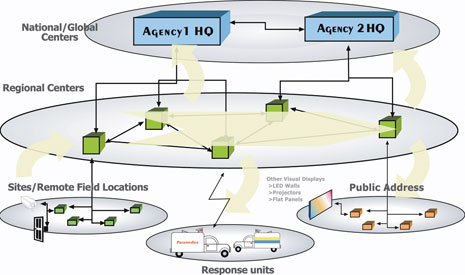
Without such a solution, it is a difficult challenge to achieve such exchange especially if the two jurisdictions did not invest in the same technologies or suppliers.

Questek's Advanced Technologies' Networked Visualisation solution is able to provide such flexibility because it is based on standardised data communications via IP technology and it achieves its integration at the graphical (visual) level rather than the application level.

This solution has been developed primarily for military command centres where information from different security class applications as well as different command sectors are visually composed and then re-broadcasted to enable a common operational picture for all command staff.

Questek's Networked Visualisation solutions represents a collection of tools and capabilities that allow users to share video information, visual data outputs, be able to compose new views or contexts consisting of video and data inputs, simple correlation or logic engine, and integrated graphical monitoring tools and last but not least, the ability to display in proper rendered form at any point where the network is available. The following diagram provides a graphical illustration of the above.
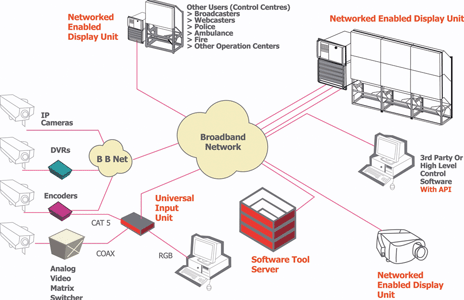
Networked Visualisation solutions from Questek provide a large set of integrated graphical and visual processing tools for all visual inputs - from video to computer inputs. This flexible visualisation platform for input and outputs is completely modular and distributed. Finally, this platform utilises standard IP networks for interconnection for maximum cost effectiveness and interoperability. The combination of the above all together in one platform forms a unique ability that allows the most cost effective way of quickly co-ordinating across multiple entities and boundaries that is scalable.

For more information contact Questek Advanced Technologies, +27 (0)11 706 0405, [email protected], www.questekadvanced.co.za


Credit(s)


Share this article:
Share via emailShare via LinkedInPrint this page


Further reading:

Quantum is coming
Infrastructure Information Security
The global cybersecurity landscape is approaching a turning point as quantum computing accelerates faster than most organisations realise; the shift is not a distant, theoretical concern, but a present-day business risk that demands immediate action.

Read more...
Cloud-ready BMS is reshaping building operations
Facilities & Building Management Infrastructure
Buildings may be getting smarter, but too many control rooms are still anchored to yesterday’s technology, such as on-site servers, rigid architectures and a patchwork of interfaces that are expensive to run and slow to evolve.

Read more...
While OT security is maturing, risk is not slowing down
Infrastructure Industrial (Industry)
Industrial organisations now rely on interconnected systems, remote access, cloud-based analytics, and unified IT and OT environments to maintain production. Fortinet’s 2026 State of OT and Cybersecurity Report illustrates why visibility, segmentation, and integrated security are essential.

Read more...
From drone market growth to application-level commercialisation
IoT & Automation Infrastructure
After years of pilot projects and technology validation, the question for the market is shifting from whether drones can fly safely and collect data, to where they can deliver repeatable operational value at scale.

Read more...
AI-enabled NVR for Milestone XProtect
Surveillance Infrastructure Products & Solutions
As surveillance environments continue to grow in scale and complexity, organisations need infrastructure that is easy to deploy, simple to manage, and ready for AI-driven workloads.

Read more...
Industry perspective on industrial cybersecurity
Technews Publishing News & Events Infrastructure Industrial (Industry)
The Industrial Security Harmonization Group has released a joint industry perspective highlighting a critical truth in industrial cybersecurity: secure communication is not determined by protocols alone, but by how they are deployed and managed in real-world environments.

Read more...
Cyber resilience is the real defence
Security Services & Risk Management Information Security Infrastructure
Cyber resilience has evolved into a form of strategic agility, ensuring that when an interruption occurs, the business does not just survive; it snaps back into place before the market even notices a pause.

Read more...
Power, performance and profit
Power Management Infrastructure
Electricity remains the single largest operating cost for most data centres. In many African markets, power infrastructure is ageing or inconsistent, forcing operators to rely on backup generation to keep facilities online.

Read more...
Five signs your storage is holding you back
Infrastructure Surveillance
In the drive for business growth, organisations across South Africa are investing heavily in talent, applications, and strategy. Yet the foundational technology that underpins every digital interaction - data storage - is often overlooked.

Read more...
Service robot technology for residential complexes
Suprema AI & Data Analytics Infrastructure Residential Estate (Industry)
Suprema has signed a three-party memorandum of understanding (MOU) with Hyundai Motor Group Robotics LAB and Hyundai Engineering & Construction (Hyundai E&C) to collaborate on advancing residential complexes through service robot technology.

Read more...


While every effort has been made to ensure the accuracy of the information contained herein, the publisher and its agents cannot be held responsible for any errors contained, or any loss incurred as a result. Articles published do not necessarily reflect the views of the publishers. The editor reserves the right to alter or cut copy. Articles submitted are deemed to have been cleared for publication. Advertisements and company contact details are published as provided by the advertiser. Technews Publishing (Pty) Ltd cannot be held responsible for the accuracy or veracity of supplied material.


© Technews Publishing (Pty) Ltd. | All Rights Reserved.

