


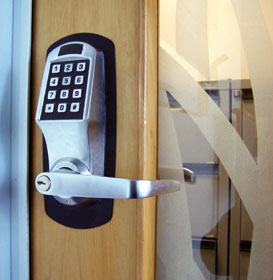
Government institutions are notoriously difficult to secure. They require a specialised system that will ensure the safety and security of employees and the back office while accommodating a constant flow of visitors in and out of the premises – without hindering public access or infringing on people’s privacy, says Ingo Mutinelli, national sales manager for Elvey Security Technologies.
“It is a challenge for even the most technologically advanced security system, especially since public spaces and staff areas require different levels of access control. And to further complicate matters, the access policy during working hours is not the same as after hours.”
An impossible challenge? “Not for the Nedap AEOS access control and security management system,” he says. “In the security industry, where many suppliers put growth above the best interests of their customers, Nedap distinguishes itself through continuous innovation and by building long-term relationships. The result of this dedication is the AEOS system, a software-based, user-friendly solution based on smart network technology that is used around the world by a wide range of business entities.”
He adds: “What really impresses me about Nedap is their ability to overcome the major failures of conventional security systems, which often fall short when it comes to satisfying a growing need for total functionality. AEOS has brought the future into the present as a result of its ability to combine critical features such as access control, intrusion detection and IP video management into a single, user-friendly and affordable controller.”
The AEOS system boasts a range of features. Integrated alarm systems and video links make it possible for remote monitoring of premises, while its central management system allows for the implementation of uniform security policies in the various buildings and even satellite locations.
Another plus, notes Mutinelli, is the cost-effectiveness of the management system, which, because it is IP-based, requires no additional cabling. “The hardware’s behaviour is determined by the software, thereby creating a freely configurable and flexible system. The AEOS behaviour components are used to configure essential functionalities such as anti pass back and intrusion detection. This software-based approach makes it simple to put changing requirements into effect incrementally. Best of all, the system can grow without slowing down so one can keep adding doors, people, locations and badges.”
Access control
Biometric identification or verification has become a mature technology, widely used in access control systems to improve security and convenience, says Mutinelli. Nedap, working closely with major suppliers in pursuit of a seamless integration into AEOS, has created a highly integrated system with a biometric component as well as a user platform for the enrolment and verification of biometric parameters.
The result is that security personnel are able to verify people’s identities with a high degree of certainty, he says. “Accordingly, when it was launched, its first clients included high security environments such as military installations, power stations, water purification plants and airports.”
Many government departments need to be able to prevent unauthorised personnel from accessing areas such as filing rooms, medication storage rooms in hospitals and police docket rooms. Traditional access control systems have their limitations when it comes to providing alternatives for ID cards, enhancing convenience or upholding people’s rights to privacy. These are the reasons behind the move to AEOS access control technology, which uses biometric parameters such as fingerprints to recognise people.
When additional security is required, typically in police stations where dockets go missing on a regular basis, and government buildings, which house citizens’ records, biometric verification is once again the answer. “The verification process is extremely thorough yet incredibly quick. It begins by checking ID cards against users. Once the legitimacy of the user has been established, the biometric component of the system will check the user’s finger, hand, face or iris. A positive match will see the person being given access to the facility.
“What is more,“ he points out, “being able to identify people accessing high-security areas will enable internal investigators to root out corrupt and dishonest employees.”
Mobility embracing
In addition, the AEOS system enhances service levels through its support of staff and visitor mobility. The Nedap AVI allows for long-range identification, which promotes the free movement of people through doors that can open from a distance of several metres. The value of this can be witnessed in hospitals, where medical personnel often have their hands full of patient records, medication and other stock. Doors that automatically open as authorised nurses, doctors and other staff approach, can optimise patient and staff security while simultaneously improving service levels.
Further to this, he points out the advantages of the system for people with disabilities. “People with physical handicaps or in wheelchairs often struggle to open doors. Despite the existence of laws and regulations supporting the mobility of this group of people, many of the security systems currently in use in government and other institutions disregard their needs. The Nedap AVI technology, which is easy to integrate into any type of access control system and supports all common security industry standards, allows for long-range reading and access control, which in turn allows the ease of passage of disabled users.”
Storage, vehicle and people proficient
In storage buildings and other situations where reliable long-range read is essential, Nedap again rises to the challenge, avers Mutinelli. Using Transit Entry, a robust long range reader that reads semi-active Nedap Compact Tags, operators can enjoy reading distances of up to four metres. Encased in slim, weatherproof housing, the reader fits perfectly onto warehouse and loading dock doors.
The combination of building access control and vehicle identification allows security personal to stipulate driver-based vehicle access, he notes further. This is particularly important on high security sites, when the driver, the vehicle or even a combination of the two require authorisation to enter restricted areas.
While acknowledging that access control systems are invariably installed in unstable environments, Mutinelli says Nedap’s hands-free access solutions allow for the ultimate possible control. “And what is more,” he adds, “control levels can be increased when the need arises to upscale security levels.”
Suitable for indoor and outdoor use, Nedap AVI readers support all common security industry standards for communication with access control systems (RS-232, RS-422, RS-485, Wiegand and IP). The systems are also integrated with the latest card technology such as HID, Legic, EM, NXP (Mifare) and Nedap. “By choosing AEOS you are getting a reliable system that will take care of all your security needs,” he concludes. “It is easily integrated into any IT infrastructure, quickly adapted to accommodate future security requirements and it works with virtually any security device on the market. With AEOS you have a direct view over all the sensors, so when there is an alarm, you can be sure it is real. And because AEOS is web-based, it works on virtually all mobile devices. This means that no matter where in the building the security manager is, he can immediately start handling the situation.”
For more information contact Elvey Security Technologies, +27 (0)11 401 6700, [email protected], www.elvey.co.za
| Tel: | +27 11 401 6700 |
| Email: | [email protected] |
| www: | www.elvey.co.za |
| Articles: | More information and articles about Elvey Security Technologies |






© Technews Publishing (Pty) Ltd. | All Rights Reserved.
 printer friendly version