


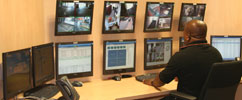
The international nature of business and communication facilities logically leads to the creation of security systems operated and facilitated across countries and continents.
In line with this, security has also shifted beyond the immediate operation to a national and, in turn, international operation. The original definition of CCTV as a closed system is increasingly being redefined as the access to the system becomes increasingly broadened and more extensive as integration with other systems occurs.
With operations in Ghana, Mali, Guinea, Tanzania, South Africa, South America and Australia among others, AngloGold Ashanti is a truly international company and provides an example of how security and CCTV systems are transcending traditional borders. The fact that it deals in one of the most valuable commodities in the world only enhances its relevance.
Given the rural nature of many of the mining operations in Africa, facilitating security from Johannesburg requires a fairly complex system with sophisticated transmission. Each mine has its own CCTV monitoring capacity and control room, but AngloGold Ashanti personnel in South Africa work closely with mines and contractors to ensure effective system operation. Satellite is used to transmit images from countries like Ghana and Mali to base stations in Holland and Canada. From there, data is transmitted through the standard telecommunications infrastructure to South Africa.
While ongoing live monitoring would technically be possible in Johannesburg thousands of kilometres from site, the need to minimise transmission cost means that live monitoring or review of on-site video is done on a need basis. Viewing live video or local recordings, while not as effective as on site quality, is feasible. Indeed, some incident conditions that were not initially seen on site, have been picked up on review and investigation from Johannesburg.
South African mines form part of a national network where transmission is far easier, and important sites such as executive accommodation is protected through streamed video to the central control room.
Developing and coordinating an international system requires a well thought through, comprehensive systems approach, says Peter van Vuuren, asset protection manager (technology), of AngloGold Ashanti. The African countries where the mining operations are based use European electricity standards and this makes installing equipment easier.
AngloGold Ashanti runs security within a virtual network on the IT infrastructure backbone to facilitate implementation. The mining house has also implemented group standards for security systems and practices where possible. This ensures consistency, makes it easier to move people around, allows for bulk purchases of equipment, and ensures that support and system integration and development is easier across the board.
This level of system integration has not occurred with South American operations where initial equipment was different from that in the African mining operations. Technical system monitoring for African countries is done in conjunction with the supplier Cathexis, who provides full remote monitoring and testing of security systems and operate out of Durban.
AngloGold Ashanti has a programme to develop skills in countries it works in, but Cathexis is in a position to conduct pre-emptive diagnosis of system issues, conduct diagnostics, monitor power issues, track server operation, and reboot systems remotely when necessary. This offers a virtual 'hands' on level of assistance, and the proactive monitoring tracks issues like potential hard drive failure before it happens to ensure steady and consistent system uptime. AngloGold Ashanti also looks at planning ahead for redundancy, with a strategic system development focus that anticipates when system and equipment updates will need to be made.
Only in Africa
African conditions provide some tough challenges for equipment and maintenance. Operating temperatures can be quite high and there is a need for comprehensive testing of equipment. Environmental issues range from very fine dust in places such as Mali to high humidity in a country like Ghana. As a result, equipment rooms, for example, are sealed and pressurised to maintain a suitable environment for equipment and protect components.
Notably, many of the African countries where AngloGold Ashanti operates have strict laws against use of pesticides and herbicides, affecting things like clearance of vegetation from perimeter areas which can cause false alarms. A video motion detection simulator software package allows the simulation of events so the system can learn acceptable conditions in VMD spread, lighting, and change in velocity and distance moved. This has had a huge impact on reducing a false alarm rate that was initially about 20 000 in one month for an operation to between one and two thousand.
Optic fibre is used not just for the transmission capability, but also to avoid the degradation of more traditional cabling due to weather conditions. The redundancy planning also feeds into the management of system performance and avoidance of costly and disruptive breakdowns where getting equipment and resources for repairs are difficult.
Throughout AngloGold Ashanti the CCTV surveillance operates on a tier basis, covering aspects such as general access control and monitoring areas, to intensive surveillance of high-risk areas. While South Africans tend to expect crime to occur, this is not necessarily shared across other countries. Incidents have, however, been detected at various operations internationally, and this is seen to provide a greater crime focus across the board.
The identification of suitable manpower to operate the systems has been a key part of the security strategy. There is a recognition in the company that people need to be able to effectively drive the systems. Personnel in various locations go through a selection process for CCTV, which includes identifying candidates with good observation skills by using SAMAE. Nationally, there has been a comprehensive training approach in detection and body language covering various sites including the head office.
From a strategy point of view, integration is seen by Van Vuuren to be a critical part of having successful security systems - the different security facilities should complement each other.
Current systems combine CCTV, alarms, access control, audio, metal detectors at search points and logs into the system. For example, metal detectors are wired into the security system and a detection event will be logged and one can retrieve the video to inspect the process more clearly. Even whether the detector is switched on is registered so an audit of security practices is made that much more effective. Vehicles including helicopters, high-risk vehicles and executives are also covered through extensive use of GPRS, SMS, two-way radio and other technologies, with incidents being reported through to a central control room. Portable monitors for guards at special locations are also GPRS-enabled, and tags can be incorporated into patrol routes to ensure regular feedback of patrol efficiency. Panic alarms and 'please call me' functions that only specific phone numbers can call are available to guards with these monitors. In this way not only are guards better able to do their jobs, but they are more protected.
From a strategy point of view, Eskom's fiasco has had implications like most security departments. For example, reduction of power becomes not just an issue around the lighting of risk areas, but camera operation and other security practices within those areas as well. Van Vuuren recognises the company will have to get creative to find solutions that will not only be low-cost, but will help to address the critical issues as well. Ironically as lowered production capability due to power restrictions reduces profits and affects operations, the increased price of gold creates even stronger incentives for criminals to target the company and its operations. As new solutions emerge that are cost-effective and address the threats to the company, they can become part of the ongoing strategy to ensure that AngloGold Ashanti products, property and personnel are effectively protected in the future.

Dr Craig Donald is a human factors specialist in security and CCTV. He is a director of Leaderware, which provides instruments for the selection of CCTV operators, X-ray screeners and other security personnel in major operations around the world. He also runs CCTV Surveillance Skills and Body Language, and Advanced Surveillance Body Language courses for CCTV operators, supervisors and managers internationally, and consults on CCTV management. He can be contacted on +27 (0)11 787 7811 or [email protected]
| Email: | [email protected] |
| www: | www.leaderware.com |
| Articles: | More information and articles about Leaderware |






© Technews Publishing (Pty) Ltd. | All Rights Reserved.
 printer friendly version