


Safety at the workplace and saving human lives in emergency situations has always been of the highest priority in all civilised countries.
The tragic events on 9/11 at the World Trade Centre were a grim example of how fast an incident of catastrophic proportions can develop when disaster strikes. Relatives had to wait for hours in agony, not knowing if loved ones were safe or still inside the doomed buildings. It was also starkly illustrated how little time there is to make emergency decisions that will mean life or death to those involved. How many people are still left in which part of the affected building? Should we send in more emergency staff to very hazardous areas, risking their lives, or have all people working in those parts of the building already been evacuated?
Fast and efficient evacuation of building complexes, and keeping account of all involved in chaotic circumstances with hundreds or even thousands of people fleeing from danger zones, is an essential component of any emergency system that hopes to account for personnel at a time when they will need it most. The implication is that the emergency evacuation system must be able to keep track of who is entering and leaving the system on a hands-free basis, covering all entrances/exits and handling people on a one-by-one basis or when rushing through in numbers, when no-one had time to think in which pocket a personnel card may have been left.
What is needed is a system that will automatically keep track of the whereabouts of all people using or visiting a building, in all conditions and on 24/7 basis, without interfering with other building systems - and more specifically to know exactly who has entered and if those who entered are still inside...
The role for RFID in building safety
Against this background a technology is needed that can be integrated with standard personnel (or visitors) cards, that can be installed at all entrances and emergency exists of buildings, and that will detect the presence of a tag with unique ID carried by a human being that passes through any of these doorways, even in groups moving at speed. RFID seems to be an obvious choice.
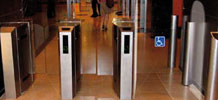
With suitable RFID tags integrated into personnel and visitors cards, and matching RFID readers at entrances and exits, it will be possible for the building management system to keep track of who is inside a building in realtime. The system can go even further: by linking the people tracking system to the lighting and airconditioning systems of the building, an office can be pre-heated or pre-cooled by the time that the entrant gets to the 64th floor, without wastage of energy. And by placing further readers at critical points within the building, the whereabouts of any person can be pinpointed much more accurately, which will be helpful not only for safety but also for productivity purposes, eliminating time wasted in searching for people. The possibilities are literally endless, if the right RFID technology can be found.
The use of proximity read RFID systems for access control has become common practice in most commercial buildings. Previous generation low frequency (LF) and high frequency (HF) systems, of which the well-known Mifare standard is possibly the most common, are however limited either in terms of the maximum read range, or in terms of the speed at which large numbers of tags can be read or both, making them unsuitable for hands-free tracking of people.
New generation UHF RFID (including products based on the so-called EPC Gen 2 standard) is widely punted as solution that will overcome these limitations for supply chain applications, combining long read range with fast multiread protocols. There is however one snag limiting its applicability for tracking people through buildings: UHF cannot read through the human body, hence still requiring the presentation of a tag to guarantee a read. Even if line-of-sight between tag and reader can be guaranteed, virtually all read range is lost for UHF tags carried close to the human body, eg, in a pocket or wallet, making a hands-free solution again impossible.
Active RFID is widely used as hands-free technology for tracking people, eg, in mines and other hazardous areas. This is however a very expensive solution, tags are bulky as it must contain a battery, and batteries must be maintained. Most importantly: due to the long read range of active RFID systems (up to 100 m or more) people that have left the building may still be detected is being inside, defeating the very objective of an emergency evacuation system.
Another variation on the theme is so-called semi-active RFID. The latter is a technology that uses thin battery technology to keep the tag alive when away from readers, but that will only try to communicate once entering a reader field. As the reader does not have to charge up the tag, it can work in weaker fields, effectively translating to longer read ranges. The potential problem is still that with no guaranteed line-of-sight between reader and tag reliable the reading of a tag carried on a human body cannot be guaranteed.
Ipico detected this gap in the market for RFID products, and developed a revolutionary new technology that meets all the needs for bulk free-flow tracking of people: dual frequency passive RFID. Dual frequency, or DF, combines the best features of low frequency (LF) and high frequency (HF) technology, to combine fast multiread with long read ranges that are not affected at all by the presence of the human body. This allows a DF-based tag to be read through a double doorway when carried anywhere on the person. Even if 50 or more tagged people should move through the doorway at the same time, all tags will still be read.
DF technology has now been integrated into standard sized credit cards, allowing DF tags to be combined with bank cards, loyalty cards or any other type of membership cards. The same plastic token can contain both a DF tag and a magnetic stripe card, a smartcard or a Mifare card. It is furthermore possible to design DF readers to read cards at either close or long ranges, allowing proximity-read-based access control to be combined with hands-free tracking to enable an extended concept for access and presence management. DF is the only RFID technology in the world today that can support this combination of capabilities.
The first practical emergency evacuation system (EES) implementing this concept is currently being deployed in Manhattan, New York City. This system helps to ensure that the incident command staff know the exact number and identity of personnel working in the building at the time of an incident, and whether they are in distress.
The automated system concept is based on a 'hands-off' approach and requires no user intervention upon entry, exit or at the assembly areas. In the event that an emergency responder is injured or otherwise incapacitated on the scene of an emergency, the system will assist rescuers to locate the personnel in trouble and get them to safety quickly.
To account for personnel building residents use an ID card, badge or other device with an embedded RFID tag that can be read by the DF readers. Visitors to the building are issued with a temporary card so that they can also be accounted for within the system. The EES duplicates accountability data at a remote site so that the possible damage to equipment at the emergency location does not render the overall accountability system inoperable.
Once an evacuation operation is initiated, facility managers and first responders are able to track the evacuation progress on PDAs or laptop computers.
The software displays either the number of personnel left in the building or the names of those not yet accounted for, and is updated in realtime. This allows first responders to know where to target their search and rescue efforts.
The future of RFID in emergency evacuation systems
In any civilised society there will and should be an insistence to implement whatever measures possible to effectively manage safety of people at their place of work. The trend for business activities to be concentrated in large metro-poles, and the high-density outlay of city centres, imply that an increasing percentage of the global population will be working from skyscrapers where thousands of people share common entrances to their work areas. Even if the threat of international terrorism is discounted, the normal hazards caused by fire, power blackouts and natural catastrophes have a significant impact on the work safety of these people.
For more information contact Ipico, +27 (0)12 349 0442, [email protected], www.ipico.co.za






© Technews Publishing (Pty) Ltd. | All Rights Reserved.
 printer friendly version