


When all is said and done, one’s baseline defence is at the door. Not only must you be able to keep the bad guys out, you need a locking system that easily lets the good guys in. The options are innumerable.
For instance, we would probably create a different locking system for a 12-door medical facility with its patient records and pharmaceutical cabinets than we would for a 12-door leasing office. A small local airport requires different locking systems than a major international airport hub.
Do not forget, doors swing both ways. While it is important to determine what will be on the front of the door, allowing people in, these same people must also be able to get out. There are multiple options here, too, including both electrified and electronic exit devices. Exit devices also will operate hard-wired or battery powered.
Whatever the organisation, the decision rests by compromising between four major elements: security, convenience, price and design. With almost any system offering a range of architecturally complementing designs and finishes, let us leave those decisions for another day and concentrate on the remaining three issues that security professionals need to understand.
Electronic locking systems can range in cost. Between the strictly mechanical system and the totally networked systems exists a full range of electronic locking solutions that should not be overlooked. They provide economical solutions for those needing increased security and convenience with designer touches.
Convenience can range from keypads to biometrics. Security falls between the simply acceptable (for the office) to extremely high (at the major airport access to the tarmac). The trade-offs are many. From an organisational perspective, let us look at them from a cost standpoint and discuss the ramifications of each.
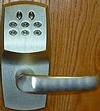
Programmable electronic locks
Programmable electronic locks are a solid choice for facilities with a limited number of users and access points. A step above the traditional generations-old strictly mechanical pushbutton lock, programmable electronic locks are standalone, microprocessor-based, battery-powered locks that one can program up to 100 individual user codes, right at the keypad. Facilities managers or the office manager can add or delete users in seconds. Users' codes are typically kept between three to seven digits and entered via the keypad by the user to gain entry. There is no external wiring required and the locks will provide 80 000-plus activations or two to three years of use with common AA batteries.
The choice of lever should not be taken for granted. It is highly recommended that the exterior lever should swing freely in case intruders attempt to break the door handle. The lever should only clutch when the electronic lock is provided a correct user code.
Such programmable locks are now priced comparably with older mechanical and electrical keycode locks but can store many more codes. The significance of so many multiple codes should not be overlooked.
If the lock has only one or a few codes, people must share codes. When an individual leaves the organisation and you need to change the code, all others sharing that code much also learn a new code. With nobody to notify, eliminating that ex-employee with the new breed of programmable electronic lock can be less than a ten-second procedure.
Computer-managed locking systems benefits without a wired network
These standalone locking systems are the new workhorses of the security industry, providing features found previously only with online, networked systems. Whatever the credential used, one intuitive, user-friendly software programs all-the locks, access trim, strikes and magnets-from a laptop or PDA. New users, access points and access privileges can be entered into the system in seconds.
With such computer-managed locking systems, security professionals can become very creative. These systems facilitate simplified, uniform access control administration. Multiple openings in an organisation can be managed with a variety of standalone locking systems that share common software. Without any network wires, users have the benefits of a networked system without the costs involved. Access and profile management is substantially improved without adding any extra software. Users and installing dealers can mix and match the best type of front-end solution for each opening without adding complexity to the system.
The system operator can easily control both users and access points based on time of day, day of week, credential needed and/or period of time. Reports show audit trails retrieved, access privileges granted and time functions established by either the user or door. With a laptop or PDA, the administrator goes to a door, plugs in the interface to the locking system right at the door, adds or delete users, determines which users can have access to specific doors at specific times throughout the day, and downloads audit trails of who has been through the door and when.
Such a locking system offers new flexibilities in designing the right level of security for each door without sacrificing convenience. Multiple credentials can be easily employed within the facility. They can include codes, i-Buttons, magnetic stripe cards proximity cards. Facilities managers can also easily gain increased security by introducing biometrics into an existing installation. Since the user's hand is the key, the hand geometry reader positively identifies people themselves, not their keys, cards or codes. Facilities managers are not burdened by the cost of a card system nor need they worry about lost or stolen credentials.
Increased choices
The locking systems world is not one of feast or famine, a choice between strictly mechanical or only networked alternatives. Although electronic locking systems that fill the chasm between the two extremes have been around for some time, the new generation of programmable electronic locks and electronic locking systems offers new features, advantages and benefits to security professionals and their users.
For further details contact IR Locknetics at [email protected]
About the author
Jeff Koziol is marketing director, Computer Managed Systems at IR Locknetics. Locknetics Security Engineering, founded in 1969, offers products for, healthcare, retail, office, industrial, airport and government facility applications.






© Technews Publishing (Pty) Ltd. | All Rights Reserved.
 printer friendly version