


We live in an age where technologies are brought to market faster than ever before. Until recently, a conventional CCTV system has been one of the most effective surveillance and security measures possibly applied.
It has been proven time and time again: when the extra electronic `eye' is in place, people tend to think twice before attempting to commit a criminal offence.
Urban surveillance systems in cities like Johannesburg, Durban and Cape Town have a proven track record. Evidence of theft, hijackings and accidents, to name but a few, has been captured by these low-light cameras - in some cases without the offender even being aware that his or her actions were being monitored.
But, CCD cameras are not the perfect solution. In order to see with a visual optic camera, light is required. The image, and the quality thereof, depends upon the amount of reflected light, from the object, received by the CCD chip. During the day and with sufficient light it is seldom a problem, but complete darkness, smoke, fog or dust create a completely different situation and play a role in determining the quality of the signal or the crispness of the image.
Thermal imaging cameras are an option in cases where visual cameras may fail to perform optimally. The human eye and the CCD chip needs light, white light specifically, to be able to 'see'.
When white light passes through a prism, it breaks up into various colours. The so-called visual part of the electromagnetic spectrum is from around 400 nm to 750 nm, a very small portion.
The thermal range used in commercial cameras ranges between 7 and 13 micro metres. In order to 'see' within this part of the spectrum, specialised equipment is needed. The thermal camera is just that. It takes the thermal energy emitted from a body and converts it electronically into an image that is displayed on a monitor. The thermal image is portrayed as a thermograph (a picture of heat). Through analysis techniques, that thermal image can tell a story never before told.
Thermal imagers are now available for the first time outside the military and within the commercial industrial market. With a thermal camera, no illumination is required. Shadows, which intruders often use to hide or move within, are thus eliminated.
The thermal camera detects temperature differences and a crisp, high-definition image of the person or object is delivered. With detector sensitivity levels of 0,08°C, subtle differences in temperature will form the defined image of the object.
Thermal imagers provide images, and have the ability to see in pitch darkness, penetrate fog and dust, and it is now a reality. With the correct optics on a thermal camera, human size figures can be detected from as far as 30 kilometres.
Sometimes, it is quite expensive to introduce new technologies into a market, but once the early adaptors have had a chance to buy the product and once it can go into mass production, prices rapidly go down and the product sometimes even almost becomes a commodity. Just one example is the mobile phone. Bulky and expensive at first, it has rapidly become a product that fits in the palm of the hand and is being used daily by millions.
Although thermal imaging cameras have always been used by the military, it took until the introduction of the microbolometer before it started making its way into commercial industrial applications.
The microbolometer
A microbolometer is a specific type of bolometer used as a detector in a thermal camera. It is a tiny vanadium oxide or amorphous silicon resistor with a large temperature coefficient. On a silicon element with a large surface area, low heat capacity and good thermal isolation. Infrared radiation from a specific range of wavelengths strikes the vanadium oxide and changes its electrical resistance. Changes in scene temperature causes changes in the bolometer temperature, which are converted to electrical signals and processed into an image.
Digital detailed enhancement
Flir Systems has developed a powerful algorithm that helps the user overcome the problem of finding low contract targets in high dynamic range scenes. This algorithm is called digital detailed enhancement (DDE). DDE is an advanced non-linear image-processing algorithm that preserves details in high dynamic range imagery. This detailed image is enhanced so that it matches the total dynamic range of the original image, thus making the details visible to the operator even in scenes with extreme temperature dynamics.
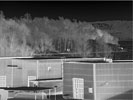
Coastal estates, such as golf estates, have implemented thermal cameras as a solution to their concerns of creating a secure environment for the investors and residents.
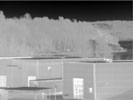
There is a range of thermal cameras available for various applications, but they all share the same quality and benefits - they all 'see' heat.
Thermal cameras will never replace conventional CCTV cameras for everyday applications, but are becoming increasingly popular in applications such as border security; high value site protection; industrial security; perimeter security; force protection; coastal surveillance; deployable security; asset surveillance; port security; airport security; and urban surveillance.
The future of thermal imaging
Undoubtedly, thermal imaging cameras will follow the same path as other products followed before. The equipment will become even more compact, image quality will improve and more features will be implemented in the cameras.
As thermal imaging cameras are finding their way into more and more consumer orientated applications like driver vision enhancement and home security, the interest for the product will rise, production volumes will go up and prices will come down.
Where this will lead to, nobody knows, but chances are high that within a very short timeframe, every policeman, firefighter, security guard etc will have his or her own thermal camera. In addition, cars, trucks, trains and other vehicles might be equipped with thermal imaging technology.
For more information contact Timeless Technologies, +27 0861 846 383, [email protected], www.timetech.co.za






© Technews Publishing (Pty) Ltd. | All Rights Reserved.
 printer friendly version