

High security mandate

Access & Identity Management Handbook 2007 Access Control & Identity Management

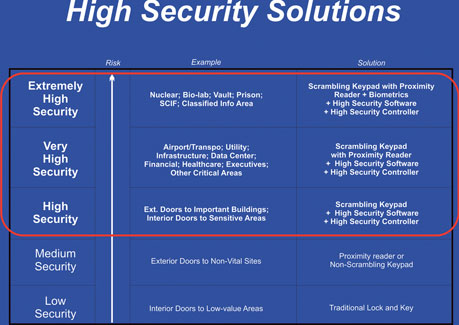
What is ‘high’ security, and who should have it? Certain building types, such as data centres, utilities, healthcare and governmental offices, of course require an industrial-grade, high security, access control system.

Many more organisations - for example financial institutions, schools, retail stores and companies with sensitive documents, executive suites, multitenant space, warehouses or manufacturing - are finding it necessary and desirable to ensure their buildings are not just secure, but highly secure. Not only is it a practical matter, but it also offers employees piece of mind and tells the world 'this company takes security seriously'.

In choosing a security system vendor, look for a manufacturer that specialises in high security. Avoid the low-price lure of companies that offer low-end security or residential systems and be cautious of the conglomerates that make toasters in addition to security systems. Also, look for a manufacturer that utilises in-house development and a proprietary motherboard, rather than a vendor that purchases the identical OEM board shared by many other manufacturers.

A security system should offer, 'off-the-shelf', the features and flexibility to enable customers to meet the unique requirements of their facility, without forcing them to pay for expensive custom development. Buyers should demand the following high security features:

Reliability: you cannot have high security unless you have high reliability. Ask about the system's mean-time-between-failure rating, and ensure the system continually monitors its own status and condition from end to end.

Distributed processing and distributed features: your personnel database, access privilege settings, system features etc, should be resident in the access control panels, not just the computer. The security system should operate non-degraded even if the IT network or server communication is interrupted.

Threat levels and lock downs: when national or local threat levels change, you should be able to alter your system's behaviour and access paths with a single mouse click.

Advanced readers: utilise scrambling keypads or keypad-prox reader combination devices to deliver high security right at the door. For highest security areas, consider biometrics combined with a scrambling keypad.

Visitor management: know who is in your building. Scan their ID information into the security database, badge them, and then ensure they left the building.

Additional features: UL certifications (294, 1076AA), SCIF-approved, end-to-end encryption, duress, anti-passback, two-person rule, door interlock applications such as man traps, tagging, deadman timer, 2% line supervision to detect tampering, redundancy and interoperability with other systems are all features required for high security.

If your company-type is a perceived target or if you want to avoid incidents, comply with regulations, reduce liability and ensure the safety of your people and property, choose an access control system that offers the built-in features and reliability that ensure a highly secure organisation.




Share this article:
Share via emailShare via LinkedInPrint this page


Further reading:

Disconnect between confidence in identity security and operational reality
Access Control & Identity Management News & Events
New FIDO Alliance and HID study reveals gap between identity security confidence and reality; 94% of enterprises claim they can revoke employee access within 24 hours, yet 35% experienced delays or failures in the past two years.

Read more...
Paxton Solo training available to security installers
Paxton Access Control & Identity Management News & Events
Following the launch of Solo, Paxton’s brand-new access control system, the security manufacturer is rolling out dedicated Solo training sessions across South Africa to support security installers working with the system.

Read more...
Controlling access for people and vehicles
IDEMIA STid Security Technews Publishing Editor's Choice Access Control & Identity Management Asset Management Industrial (Industry) Mining (Industry)
When it comes to access control, the security requirements of mines and the industrial sector are similar, requiring a layered approach that combines physical barriers, digital authentication, and continuous monitoring to protect personnel, assets, and operational continuity.

Read more...
Paxton launches new phone-based security system: Solo
Paxton News & Events Access Control & Identity Management
Paxton has officially unveiled Solo, a phone-based, cloud-hosted access control system. As part of the launch, installers can claim a free Solo starter kit from Paxton, allowing them to trial the system and see how it can work for their business.

Read more...
Taking control of IAM in the AI era
Access Control & Identity Management AI & Data Analytics
AI and Shadow AI are proliferating, creating a series of new risks for organisations. To gain control over who and what has access to corporate data, organisations need unified control over their entire environment.

Read more...
Impro announces Primo update
News & Events Access Control & Identity Management Integrated Solutions
Impro Technologies recently held a launch event in which it introduced a series of new products, from new readers through to its updated Primo access management software.

Read more...
If you cannot prove identity, you cannot claim security
Access Control & Identity Management Information Security
Cybersecurity planning for 2026 is a structural change in how attacks are executed and how trust is exploited, demanding that companies stop layering tools on top of infrastructure and instead prioritise intelligence and identity.

Read more...
Paxton set to launch game-changing new system
Paxton Access Control & Identity Management News & Events
Access control is evolving fast. Installers and end users are looking for systems that are simple to install, easy to manage remotely, and flexible enough to scale. In response, Paxton is exploring how emerging technologies can reshape access control.

Read more...
NEC XON secures mobile provider’s hybrid identities
NEC XON Access Control & Identity Management Information Security Commercial (Industry)
For a leading South African telecommunications operator, identity protection has become a strategic priority as identity-centric attacks proliferate across the industry. The company faced mounting pressure to secure both human and non-human identities across complex hybrid environments.

Read more...
Cloud security in visitor management and access control
SA Technologies Access Control & Identity Management Infrastructure Residential Estate (Industry) Commercial (Industry)
Cloud has become the default platform for modern security operations, from visitor management portals and remote access control to incident logging, reporting, analytics, and integrations. But “in the cloud” does not mean “someone else is securing it for us”.

Read more...


While every effort has been made to ensure the accuracy of the information contained herein, the publisher and its agents cannot be held responsible for any errors contained, or any loss incurred as a result. Articles published do not necessarily reflect the views of the publishers. The editor reserves the right to alter or cut copy. Articles submitted are deemed to have been cleared for publication. Advertisements and company contact details are published as provided by the advertiser. Technews Publishing (Pty) Ltd cannot be held responsible for the accuracy or veracity of supplied material.


© Technews Publishing (Pty) Ltd. | All Rights Reserved.