

Facebook Hacker – a dangerous tool

August 2010 Information Security

Phishing is known to be the weapon of choice for all cybercriminals that are after login credentials. However, a new attack tool – Facebook Hacker - has drawn attention to the criminals in need of passwords and usernames that are not theirs. This do-it-yourself kit helps the wrongdoer steal login credentials from whoever was targeted without the user even having to type in any of these details.
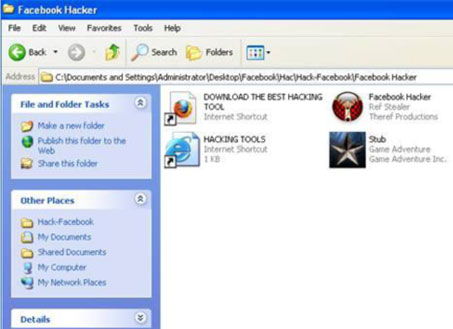
Figure 1. The extracted archive of the Facebook Hacker

The kit is intuitive, thus extremely easy to configure, just like any do-it yourself hack tool designed with the 'skiddie' in mind. There are only two fields that need filling in: a disposable e-mail and a password that will eventually constitute the location where the stolen information is to be delivered to.

Figure 2. Configuration panel

 After clicking the 'build' button, a server.exe file is created and deposited into the facebook Hacker folder along with the initial files. This server.exe file is to be sent to the intended victims.
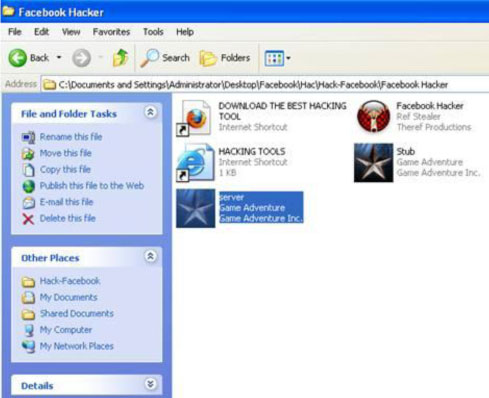
Figure 3. The server file to be sent to the victims is ready for distribution

Once run, the malicious tool will snatch the victim’s Facebook account credentials, along with all the usernames and passwords that we carelessly ask the browser to remember for us. Facebook Hacker also targets the Internet browser and Instant Messaging clients to pick up the user’s 'remembered' identification data.

In order to successfully collect passwords, the malicious binary includes applications able to squeeze data out of the most popular browsers on the market, as well as of almost all instant messaging clients available. To add insult to injury, the application also enumerates all dialup/VPN entries on the computer and displays their logon details: user name, password, and domain.

To avoid detection, the facebook Hacker will also look for all the processes related to a security suite and kill them upon detection. It is important to mention that it is accessorised with a hard-coded list of processes associated with AV solutions that are to be checked and stopped, if found.

Last but not at all the least, the piece of malware looks for network monitoring applications and terminates them. This is a safety measure that will prevent curious users from seeing their passwords leave the system.
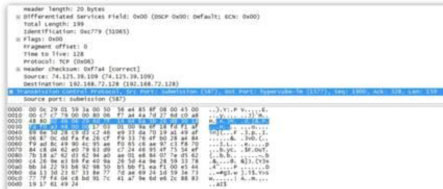
Figure 4. TCP dump of the information sent by the application. Since the SMTP server uses TLS encryption, sniffed traffic will not reveal much of what is going on

As can be seen, the author took a lot of time to think of various elements that could interfere with the smooth operation of this tool and to eliminate them one by one.

All product and company names mentioned herein are for identification purposes only and are the property and may be trademarks of their respective owners.
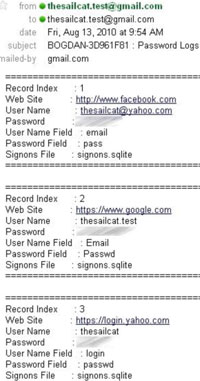
Figure 5. The stolen credentials of our test accounts are e-mailed to the specified address

BitDefender identifies this threat as Trojan.Generic.3576478. In order to stay safe, please ensure that you are running a frequently updated antivirus utility. Also, remember not to run files you may receive as attachments or via IM, or at least, to scan them beforehand. 


Share this article:
Share via emailShare via LinkedInPrint this page


Further reading:

71% of organisations suffered an identity breach
News & Events Information Security
The State of Identity Security 2026 report from Sophos finds human error and poor non-human identity management are the root causes of most attacks, as agentic AI accelerates the risk.

Read more...
Cyber resilience is the real defence
Security Services & Risk Management Information Security Infrastructure
Cyber resilience has evolved into a form of strategic agility, ensuring that when an interruption occurs, the business does not just survive; it snaps back into place before the market even notices a pause.

Read more...
You will not get your files back with VECT
Information Security
If the newbie to the ransomware scene, VECT, comes knocking at your organisation’s door, do not pay the ransom! The decryption keys simply do not exist. They were discarded at the moment of encryption by the malware itself.

Read more...
Industrial sector is a primary cyber target
Information Security
Threats in industrial environments are distributed with striking uniformity: APT-driven incidents constitute 17,8%, malware 14,9% and social engineering 13,9%. This pattern suggests that industrial organisations attract a broad range of adversaries with different capabilities and objectives.

Read more...
Key attributes of an effective cybersecurity leader
BlueVision Information Security
In an evolving technology landscape, an effective cyber leader must combine technical acumen, foresight, and adaptive leadership to mitigate risks, and risks can only be mitigated once accurately identified and remedial processes are in place.

Read more...
Employees are SA’s biggest cyber threat
Security Services & Risk Management Information Security
South Africa experienced a 46% increase in insider cyber risk in 2026, surpassing the global average of 44%. What is more, 63% of South African companies surveyed expect insider-driven data losses to increase.

Read more...
Surge in AI-enabled cybercrime and a 389% increase in ransomware
News & Events Information Security
Cybercrime no longer functions as a series of isolated campaigns; it operates as a system, with malicious hackers operating across an end-to-end life cycle and compressing the attack life cycle with shadow agents.

Read more...
Tackling enterprise security ‘tool sprawl’
NEC XON Information Security
South African ICT solutions provider NEC XON is advocating a shift away from fragmented cybersecurity toolsets towards unified platforms, arguing that ‘tool sprawl’ is undermining the effectiveness of enterprise security operations.

Read more...
SilverFox campaign targeting companies in South Africa
Information Security News & Events
The APT campaign involved disguising malicious files as documents related to tax violations. Upon infection, attackers could gain remote access to affected devices and exfiltrate sensitive organisational data.

Read more...
Q-Day is closer than you think
Information Security
The accelerated 2029 quantum computing deadline turns current encryption into a looming crisis as Google brings its internal post-quantum cryptography migration deadline forward to 2029.

Read more...


While every effort has been made to ensure the accuracy of the information contained herein, the publisher and its agents cannot be held responsible for any errors contained, or any loss incurred as a result. Articles published do not necessarily reflect the views of the publishers. The editor reserves the right to alter or cut copy. Articles submitted are deemed to have been cleared for publication. Advertisements and company contact details are published as provided by the advertiser. Technews Publishing (Pty) Ltd cannot be held responsible for the accuracy or veracity of supplied material.


© Technews Publishing (Pty) Ltd. | All Rights Reserved.

