


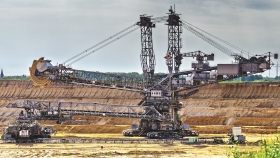
The vast areas covered by mining operations present several security challenges that are not necessarily faced by most other environments - chief among them the ability to provide effective perimeter protection and surveillance, while maintaining reliable communications between remote areas and control rooms. We asked Stefan Amman from Dallmeier Electronic, and Alvin Flaum, director at Veracitech, to delve a bit deeper into these challenges and the solutions their companies provide.
Hi-Tech Security Solutions: How would you suggest mines gear up in terms of technology and people to keep an eye over large areas where there may not always be activity? What about areas of activity (like open pits)?
Stefan Amann: In particular for mines it is important to use a monitoring solution that can be operated economically. Our South African customers consistently tell us that with our patented Panomera multifocal sensor systems they can monitor vast areas (such as open pits) with a defined minimum resolution from a single installation point. As a result, the same number of operators can monitor a larger area.
As multifocal sensor technology requires multiple times fewer camera systems, Panomera allows mine operators to save a large part of the infrastructure costs compared to conventional solutions consisting of megapixel and PTZ cameras. Furthermore, our Panomera systems support intelligent object recognition. This allows for the verification of motion detection-based alarms so that, for example, only persons or vehicles trigger an alarm while an animal wouldn’t.
Alvin Flaum: My recommendation for those large environments would typically be to use either a radar tracking-type solution or a long-range thermal camera with moving target identification analytics.
There are many factors that come into deciding what the ideal solution is for a particular environment. Cost is obviously always an issue, and another one is the lay of the land. Thermal cameras can’t see through trees (at least not very well), or over hills, and there’s the same issue with radar. So it’s not one solution for all – it depends on what is being surveyed, how big the area is, and what the topography looks like.
We see a lot of interest in aerial solutions like drones and blimps with thermal cameras, but the problem is many people watch too many movies and think that’s all feasible. The reality is that it’s very difficult to cover these large areas at an affordable price. Drones, for example, only have very short flight times – once their battery runs out (which is often after just 30 minutes) they have to come back to base, so they’re good for patrolling or responding to situations, but are not practical for continuous surveillance.
Hi-Tech Security Solutions: Can your solutions be integrated with other security solutions, such as cameras and commonly used management platforms? Is there an API customers can use for integration projects or does your company do integration work?
Stefan Amann: Yes, absolutely. Dallmeier cameras support the ONVIF standard, which allows them to be integrated into common management platforms (such as VMS or PSIM solutions). For customers who have already standardised on Dallmeier video and data management systems, Dallmeier cooperates with leading manufacturers such as Genetec and others.
Furthermore, the Dallmeier API enables easy integration of Dallmeier IP cameras and recorders. Dallmeier CCTV/IP solutions are designed as open platforms for integration into third-party systems. This means that Dallmeier security systems remain adaptable and expandable in the long term and therefore offer long-term investment sustainability.
Of course, third-party systems or individual components can also be integrated into existing Dallmeier solutions. Integration takes place either via standard or adapted communication protocols, so-called ‘Open Platform Tools’, or via tools specially developed for the customer. The latter are then part of a customer-specific integration solution that can be easily realised by our development teams.
Alvin Flaum: Veracitech’s area of expertise lies in doing the integration into our clients’ control room systems, in addition to being able to provide the hardware for the projects we work on. As an integration partner, we’re able to take various third-party systems that are divorced from one another and create a front-end user system for the client that brings it into their existing VMS (video management system), for example, or their existing alarm system and control room infrastructure.
One powerful tool at our disposal is XMP-Babylon, a management and automation platform which sits at the heart of our clients’ control room and security systems. Not only can it control access and the movement of people around the area, it’s also getting all the alarm information and controls the alarm queue and allows the operators to respond to alarms and give feedback to alarms and events. These alarms could be coming from a multitude of different systems or sensors –radar, video, motion detection, analytics, etc.
Hi-Tech Security Solutions: Do your solutions offer remote surveillance options to customers? Do you provide these services?
Stefan Amann: Dallmeier DMVC offers a mobile app for iOS and Android devices which enables mobile access to the pictures and videos of the Dallmeier video security system even when on the move. For bandwidth-constraint environments – often the case in the mining industry – Dallmeier has developed PRemote-HD. PRemote-HD uses a special transcoding to enable the transmission of HD and megapixel streams even at low bandwidths.
Alvin Flaum: Veracitech doesn’t provide any security monitoring or response services as such, but we can ensure that third-party systems can integrate into our clients’ control rooms so they can remotely monitor those areas themselves, and don’t have to have dedicated staff for those third-party systems. Staff is a big cost, and often what people forget is they put in these systems and then realise they need an extra two people in the control, room because these systems are no longer integrated into the main control room systems. That’s where we find a lot of opportunity to do software and hardware integration for clients.
Hi-Tech Security Solutions: Does your solution include some form of intelligence or analytics that can provide more information than simply a notice that something is moving?
Stefan Amann: Yes, as mentioned before, in addition to pure object detection, Dallmeier solutions are also capable of performing AI-based object classification, be it at the perimeter or in the mine environment. We see AI as an assistance system for the human behind the screen (e.g. for an operator of a video security system).
The analytics take care of the verification of the many alarm events in a given system and only forward alarms if it has detected or identified a certain object class with a certain probability. In this way, false alarms can be reduced to almost zero and personnel can carry out other tasks.
Alvin Flaum: We work with various video analytics and smart tracking solutions that we do system integration of, so we can recommend different ones for different situations, depending on the type of camera and the topography. Without some form of intelligence, meeting the needs of modern mines is not really feasible.
For the most part, we don’t rely on the VMS to perform the necessary analytics, such as motion detection, but rather have it done on the edge, at the cameras. This works well for a static camera, but when you’re using a PTZ camera and the scene is changing, most cameras can’t perform the advanced analytics required. In such a case we have the option to employ a dedicated analytics processing unit, essentially a single PC that can handle moving-scene analytics on several video channels at once.
Hi-Tech Security Solutions: What can be done to facilitate communications over these large areas, and what are some of the challenges in this regard?
Alvin Flaum: Veracitech is a one-stop projects house so we can provide the fibre and wireless networking infrastructure a client needs. Reliable communication is certainly one of the big challenges because you’re talking about remote cameras, getting a wireless signal sometimes from quite a remote area where you might not have line of sight. This might necessitate the use of repeaters, for example, which often adds quite a lot of cost to the infrastructure.
These big open areas are not always static, they move, so the areas where digging is active can move from month to month. A mobile solution is often therefore ideal. We can build and supply mobile wireless repeaters on trailers to service movable remote monitoring cameras. Fibre could also be an option, depending on the distance – it’s not that expensive per metre but it is expensive to dig three kilometres of trenches and bury it and so on. So again, it all depends on the lay of the land and each client’s situation.
For more information contact:
• Dallmeier Electronic, Riaan Kruger, +27 83 460 8015, [email protected], www.dallmeier.com
• Veracitech, Alvim Flaum, +27 11 888 7251, [email protected], www.veracitech.co.za
| Tel: | +27 11 888 7251 |
| Email: | [email protected] |
| www: | www.veracitech.co.za |
| Articles: | More information and articles about Veracitech |
| Tel: | +27 11 543 5800 |
| Email: | [email protected] |
| www: | www.technews.co.za |
| Articles: | More information and articles about Technews Publishing |
| Tel: | +49 941 870 0111 |
| Email: | [email protected] |
| www: | www.dallmeier.com |
| Articles: | More information and articles about Dallmeier Electronic Southern Africa |






© Technews Publishing (Pty) Ltd. | All Rights Reserved.
 printer friendly version