


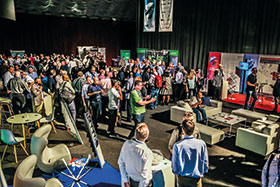
NEC XON held its seventh annual summit at Sun City in October this year in which it focused on the Fourth Industrial Revolution (IR4) and how it would disrupt the status quo. Carel Coetzee, CEO of NEC XON launched the conference noting that IR4 will touch us all in various ways while delivering a variety of benefits – as well as threats for the unprepared. IR4 will transform economies, jobs and nations throughout the world and is set to have a significant impact in Africa especially.

The potential for the future in Africa is great, but the costs for countries that are not ready will be immense. Like the previous industrial revolutions, IR4 will take jobs, but will also create new jobs that don’t exist today. Key to the changes we will face is technology, specifically the processing power and algorithms we are developing to make sense of all the data we are drowning in today. Humans are simply not able to keep up and hence we are seeing the steep growth of artificial intelligence (AI), or non-biological intelligence.
AI and biometrics
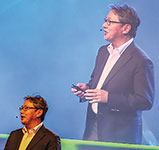
Hironobu Kurosaki, president and CEO of NEC Europe was up next and he provided the attendees with insights into the global company as well as its activity in Africa. He also highlighted how NEC was effecting change by making cities all over the world smarter and safer. While communications is crucial in the safe and smart city concept, Kurosaki noted that other technologies are set to change the way smart cities function in future.
The Internet of Things (IoT) and AI will be crucial to the future of our cities and nations. The IoT will provide data from innumerable devices from simple sensors to more complex technology, like surveillance cameras. The amount of data collected will be enormous and AI will be required to analyse all this data and deliver useful information that can be actioned.
One of the technologies Kurosaki mentioned specifically was biometric identification, which will be integrated with other AI tools to facilitate safer and smarter cities. In particular, he referred to facial recognition, which NEC has already rolled out with success in various environments, even launching a ‘Crime Prediction System’. This system uses past crime data to predict where and when new crimes will occur.
As an example, an airport in Africa uses NEC’s facial recognition system with great success. It recently caught a visitor who had a habit of coming into the country each year to conduct some illegal deals. Even though the authorities only had an old photograph of the individual, the facial recognition system was able to identify him as he arrived at the airport, leading to his arrest after many years of nefarious activities. It would have been easy for customs and security personnel to miss the individual, or not to recognise him at all, but NEC’s facial recognition was able to identify him instantly.
Referring to safety and security in general, Kurosaki noted that no security means no economic growth. There is a definite relationship between GDP per capita and security. He used the country of Colombia as an example of how a significant increase in GDP results from an increase in citizens’ safety and security.
Kurosaki ended by mentioning that the tie-up with XON was producing excellent results as XON offers respected integration services throughout Africa where technology is now playing an increasing role in the advancement of the continent, and this will only continue as IR4 advances.
Intelligences and us
Stafford Masie delivered the keynote presentation of the day. He also focused on AI as well as the importance of collecting and making use of data as we move from a material world to an intelligence/information world.
Currently, 87% of the activity on the Internet is giving (putting information out there) as opposed to receiving information and intelligence. This is changing as we move into the IR4 era where we will see an increase in collecting, collating and analysing data through the combined intelligences of AI as well as humans. This combination will deliver the optimal solutions and innovations this new world requires. As Masie noted: “AI is combinatorial experience [combining humans and technology delivers the best results]”.
This does not mean things will get more technical and complex for everyone. We will move into a services world instead of the current ownership model. Technology in the future will be defined by what it means and what it delivers (i.e. the service it provides). In Masie’s words, things will go away and we will engage “consequentially” to get what we want.
He provided an example of a pharmacy which ran a proof of concept to ensure it has an up-to-date view of what is on its shelves at any point in time, as well as analytics that measure what shoppers do when in various locations within the shop. Video is collected and analysed by a camera attached to the shelf which invisibly monitors people’s actions. The result is the retailer can see which demographic is most interested in specific products and what makes them stop at that shelf – among other intelligence that can be gathered.
The importance of real-time and relevant data can’t be underestimated as these innovations can’t happen with last week’s data, or even yesterday’s data. He equates using outdated data to trying to cross the road blindfolded with 30-seconds old data.
In addition to current data, his advice to companies in this new age is to make sure you don’t only rely on data, but to ensure you include human understanding into your decisions as well. The fall of Kodak is an example of a company betting on data without seeing the human changes happening in the real world.
Masie ended with a comment that all businesses should take note of if they intend to be innovative and relevant in the IR4 age. The benchmark of innovation (showing that your company is innovative and won’t fall behind) is if 75% of your current revenue comes from business activities that began in the past three years. As impossible as it seems in the real world, this is what the constant state of disruption in business and markets will require in future.
Digital transformation leads to Identity 4.0

Walter Lee, NEC evangelist and government relations leader was up next with additional insights into IR4 and digital transformation. One of the issues he focused on is public safety and he coined the phrase Identity 4.0 when referring to big data, AI, behavioural and facial biometrics and so forth. Biometrics will form a key portion of the new world where authenticated identity will be critical to the services and solutions offered.
Once again, Lee mentioned that data is key to attaining an intelligent future. Data, analysed correctly, will solve problems for us and help us (people, companies, cities, countries) in achieving targets and goals in the IR4 era. It will also, in collaboration with biometric identities and AI, make transacting safer and enable proactive security services.
Speaking to Hi-Tech Security Solutions later in the day, Lee stressed that a reliable way to authenticate identity and match identity with actions (or transactions, whether financial or even something as simple as messaging) is critical in the digital world. This is why biometrics is critical to the future, although Lee says multi-factor authentication will support biometrics and the overall acceptance of digital identity.
Bertus Marais, divisional GM of XON Safety & Security explained to Hi-Tech Security Solutions that the advances in biometrics will soon lead to the traditional AFIS (Automatic Fingerprint Identification System) systems being replaced by ABIS (Automatic Biometric Identification Systems). ABIS will consist of fingerprints, iris, facial and other biometric identification solutions (including, in the near future, a sonar biometric reading from the inner ear).
Along with this, Marais echoed other speakers in highlighting the potential of facial recognition and AI in surveillance to remove many of the tasks we assign to operators today to streamline border control, immigration, safe city initiatives and many other operational areas. This is not some future technology, but there are currently customers in Africa (including South Africa) that are already using NEC facial recognition in airports and cities with success. He also says NEC’s behavioural biometrics will deliver more useful information for better decision making and proactive security services, echoing comments by Lee.
To support digital identities and the ability to accurately link identity and activity, Lee says Blockchain will play a crucial role, especially as it is a dispersed system. One’s identity is embedded in the Blockchain along with your activity – such as sending a message, making a payment etc. – and can’t be changed without actually breaking the Blockchain. If someone changes one item in a Blockchain, the other imprints will no longer match, clearly indicating a problem.
We are accustomed to thinking about Blockchain in terms of financial transactions, but it is already growing beyond that. One example Lee provided was the “AI Blockchain for cows”. This is an application that allows people to sell cows (or part of a cow) to one or multiple people – almost like timeshare for cows, but with an unbreakable record of all transactions. [If that doesn’t make sense, all we can say is, you had to be there. – Ed]
Following Lee, the conference split into two streams where six of the sponsors delivered presentations on what they offer in the new IR4 world. All the sponsors were present in the exhibition area where they had displays and people on hand to discuss their market offerings. Sponsors of the summit included: Juniper Networks, Fortinet, Symantec, ADVA Optical, Trend Micro, Raytheon, Schneider Electric, Veritas, Apache Optics, Red Hat and Force Point.
3.2 degrees of separation
The final keynote of the day was from Craig Wing, a partner at FutureWorld International. Wing told the audience that disruption is the new normal today. To thrive in this new normal one needs to continually relearn and adapt. He also noted that it’s important to realise that knowledge is not understanding and we need to recognise and understand our biases in every decision we make and transform our knowledge into understanding and action.

As part of this process we need to realise that intelligence will not be not measured as it was in the past. Today your digital IQ is very important, probably more important than your ‘traditional’ IQ, because the world has and is transforming itself to into a digital world. Success in the future is going to depend on understanding and applying the six Ds to your business: Digitised, Deceptive, Disruptive, Demonetises, Dematerialised and Democratised. Like many other speakers, he mentioned Uber and Airbnb as the first examples of this new normal. Uber, as an example, does not own its cars (although this may change when driverless cars are the norm), its drivers are (mostly) not permanent employees, it hides the financial transaction (you simply tap to order a ride and get out on the other end), and as we have seen in South Africa, it causes great disruption to traditional industries.
During his presentation, Wing also noted that the old idea of all people being separated by six degrees is no longer relevant. Today, we are separated from any other human by only 3.2 degrees thanks to social media connections.
The conference was wrapped up by Eugene le Roux, chief executive of NEC XON Africa, who summarised the day’s events and highlighted the areas in which NEC XON excels in the African continent.
For more information contact Mark Harris, NEC XON, +27 11 237 4500, [email protected], www.nec.xon.co.za
| Tel: | +27 11 543 5800 |
| Email: | [email protected] |
| www: | www.technews.co.za |
| Articles: | More information and articles about Technews Publishing |






© Technews Publishing (Pty) Ltd. | All Rights Reserved.
 printer friendly version