

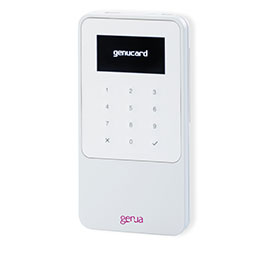
Encrypted communication in compact cellphone format

1 November 2019 Information Security

The German system developer embedded brains has developed the hardware, mechanical components and power management strategy for the compact personal security device, genucard 3 from genucard GmbH, a German IT security specialist. With the device, mobile users can securely connect to and access the company network while on the road or from the home office.

The compact device can be easily connected via USB to any laptop or workstation and enables access to sensitive data in classified networks via a virtual private network (VPN). Compared to the previous version, the genucard 3 offers these advantages:

• Dual-band Wi-Fi for high-performance WLAN connection.

• Authentication via PIN entry directly on the device.

• Compact cellphone format.

High-performance WLAN connection

With genucard 3, employees can easily access government or company networks from their home office or while travelling: genucard can be connected to any laptop or PC and creates an encrypted connection (VPN) to the remote station configured in the network. Possible connection routes to choose from are WLAN including public hotspots, mobile telephony, and Ethernet. If multiple overlapping WLANs threaten to interfere with data transmission, genucard 3 uses dual-band Wi-Fi to switch to other frequency ranges.

User-friendly two-factor authentication

Users authenticate themselves for access to sensitive networks on the device by using a smartcard and entering a PIN. This makes two-factor authentication – a security requirement of the BSI – a user-friendly solution. An additional security feature of genucard is its standalone capability, since the solution runs on autonomous hardware with its own operating system. This way, genucard retains its functionality and protects the classified network, even in the event that the connected computer is compromised as a result of careless handling.

Central management means low outlay

Administration of genucards in use is carried out by a central management station. As a result, a large number of employees can be connected to classified networks with minimal effort. The German armed forces, government agencies, and security authorities, as well as companies operating in the security sector, have been using the previous version of genucard 3 on a large scale for several years.


Share this article:
Share via emailShare via LinkedInPrint this page


Further reading:

Africa’s largest Zero Trust platform
NEC XON Information Security Commercial (Industry)
Africa has reached a significant cybersecurity milestone with the successful deployment of the continent’s largest Palo Alto Networks Prisma Access and Prisma Access Browser Zero Trust environment, supporting secure remote access for more than 40 000 users for a large enterprise in Africa.

Read more...
Supply chain attacks top threat over 12 months
Information Security
Supply chain attacks have become the most prevalent cyberthreat confronting businesses over the past year, according to a new Kaspersky global study, with nearly one-third of companies worldwide experiencing a supply chain threat in the past year.

Read more...
From vibe hacking to flat-pack malware
Information Security AI & Data Analytics
HP issued its latest Threat Insights Report, with strong indications that attackers are using AI to scale and accelerate campaigns, and that many are prioritising cost, effort, and efficiency over quality.

Read more...
NEC XON secures mobile provider’s hybrid identities
NEC XON Access Control & Identity Management Information Security Commercial (Industry)
For a leading South African telecommunications operator, identity protection has become a strategic priority as identity-centric attacks proliferate across the industry. The company faced mounting pressure to secure both human and non-human identities across complex hybrid environments.

Read more...
Microsoft 365 security is a ticking time bomb
Information Security
Across boardrooms and IT departments, a dangerous assumption persists that because data is stored in Microsoft 365 and Azure, it is automatically secure. This belief is fundamentally flawed and fosters a false sense of protection.

Read more...
Rise in malicious insider threat reports
News & Events Information Security
Mimecast Study finds 46% of SA organisations report a rise in malicious insider threat reports over the past year: reveals disconnect between security awareness and technical controls as AI-powered attacks accelerate.

Read more...
New campaign exploiting Google Tasks notifications
News & Events Information Security
New phishing scheme abuses legitimate Google Tasks notifications to trick corporate users into revealing corporate login credentials, which can then be used to gain unauthorised access to company systems, steal data, or launch further attacks.

Read more...
Making a mesh for security
Information Security Security Services & Risk Management
Credential-based attacks have reached epidemic levels. For African CISOs in particular, the message is clear: identity is now the perimeter, and defences must reflect that reality with coherence and context.

Read more...
What’s in store for PAM and IAM?
Access Control & Identity Management Information Security
Leostream predicts changes in Identity and Access Management (IAM) and Privileged Access Management (PAM) in the coming year, driven by evolving cybersecurity realities, hybridisation, AI, and more.

Read more...
The challenges of cybersecurity in access control
Technews Publishing SMART Security Solutions Access Control & Identity Management Information Security
SMART Security Solutions summarises the key points dealing with modern cyber risks facing access control systems, from Mercury Security’s white paper “Meeting the Challenges of Cybersecurity in Access Control: A Future-Ready Approach.”

Read more...


While every effort has been made to ensure the accuracy of the information contained herein, the publisher and its agents cannot be held responsible for any errors contained, or any loss incurred as a result. Articles published do not necessarily reflect the views of the publishers. The editor reserves the right to alter or cut copy. Articles submitted are deemed to have been cleared for publication. Advertisements and company contact details are published as provided by the advertiser. Technews Publishing (Pty) Ltd cannot be held responsible for the accuracy or veracity of supplied material.


© Technews Publishing (Pty) Ltd. | All Rights Reserved.

