


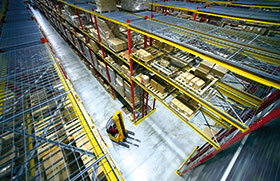
Warehouses can be a fire-fighter’s nightmare. Although warehouse fires usually result in few bodily injuries or even deaths, the lack of early fire detection technologies and the immense fire loads in warehouses do often result in fire-fighters arriving on the scene just to see that it's too late – the fire has already become too hazardous and too large to risk entering the warehouse. Total loss of the building is the typical result.
Video based fire detection technologies promise faster and more accurate detection of such potentially devastating fires, allowing fire-fighters to limit the damage.
Most warehouses are characterised by high ceilings and very large areas, also resulting in huge volumes of air inside, which is a major challenge for traditional fire detection technologies. Usually, such technologies have been developed to discover the presence of smoke, heat or flames. In warehouse environments, heat detection by means of sprinklers is a commonly used technology, but even fully compliant sprinkler systems may not be able to extinguish the fire they detected. Using sprinklers also bears the potential of the water doing more harm than the fire itself. They are designed to save the building, not the commodities inside.
Smoke detection is considered to be a reliable option for early fire detection. Smoke is usually produced way before any flames become visible. However, traditional point smoke detectors need the smoke to migrate to their location, which is a challenge in large warehouses. Mounted at ceiling level, the detectors are usually far away from the source of the smoke. Further, given the large volume of a warehouse, the smoke is being heavily diluted. A starting fire may thus not produce enough smoke to be detected or not enough buoyancy to drive the smoke upwards to the ceiling where the detectors are located. The only smoke detection technology that does not need the smoke to migrate to the sensor is video.
Video-based smoke detection is basically a set of algorithms in an intelligent camera. These algorithms process the camera image to determine whether smoke is present, and they can detect a fire as soon as the smoke enters their field of view. This way they can cover larger areas and volumes than point, beam or aspiration detectors, making them a much more affordable solution for warehouse environments. Further, in such environments video is much faster than conventional smoke detection. It can detect a starting fire within 10 to 30 seconds while other technologies will need minutes due to the slow smoke migration – minutes that can make the difference between a nuisance and a disaster.
Detect smoke and flames
But video can do more than just smoke detection. If you use one set of algorithms to identify smoke, you can just as well implement another set to deal with flames. Flame characteristics of different fires are well understood, and thus flame detection through intelligent algorithms is just as reliable as smoke detection. Using video to detect flames adds additional value by way of full video visualisation of the scene. The operator can therefore precisely locate the seat of the fire as well as involved commodities, potentially providing valuable time for fire fighting. The video image can also be used to verify alarms in the first place, avoiding costly false alarms.
However, video-based fire detection (VFD) is by itself highly immune against such false alarms. Intelligent algorithms within the camera allows for very precise differentiation between a real fire and disturbing values such as movement, reflections or changing lighting conditions. In internal tests, Bosch Security Systems has therefore achieved highest detection reliability in all test fires (TF1 through TF8) as specified in EN54.
Video-based fire detection systems scale well from a single camera to a networked system of distributed cameras with a central console and management system. They can transmit alarms via Ethernet to the monitoring centre or even a mobile device, but can just as well relay it to an existing fire alarm panel. Cameras cover broad areas, need little maintenance and do not even require individual power supplies. With Power over Ethernet (PoE), power and video signals use the same cable, even allowing the camera to benefit from the uninterruptable power supplies (UPS) in the Ethernet switches. Video-based solutions thus come with a very affordable cost of ownership.
Video combines safety and security
While video-based fire detection can be more reliable and more affordable than other technologies in most warehouse scenarios, it offers an additional benefit that no other option can. It allows the combination of safety and security.
Having installed a video-based fire detection system, the operator of a warehouse can use the very same cameras for video surveillance. There are lots of reasons to monitor the warehouse, avoiding theft being the most obvious one. But just as intelligent algorithms can identify smoke or flames, others can detect unusual movements as well as blocked aisles or emergency exits, thus increasing safety and operational efficiency. And finally, a lot of fires in warehouses are actually induced by intentional arson, and here video surveillance can be a very efficient means of prevention.
In the United States, the National Fire Incident Reporting System (NFIRS) and the National Fire Protection Association (NFPA) have published surveys indicating that arson was the course of 13% of all warehouse fires (second only to electrical problems with 14%). And being designed for destruction, arson causes much more damage than incidental fires. Representing 13% of the fires, arson resulted in 21% of the damage done. In the UK, the Fire Protection Association (FPA) even published data indicating that arson was responsible for 46% of all large fires in warehouses in the late ‘90s. Video surveillance combined with video-based fire detection can therefore not only offer fast and reliable detection of warehouse fires, but potentially also prevent a lot of them to begin with or help with root cause analysis.
Two approaches to VFD
There are two different approaches to video-based fire detection. VFD can complement existing technologies such as sprinklers or smoke detectors, greatly increasing speed and accuracy of fire detection. Next to warehouses, there are many other scenarios where solutions exist, but are unsatisfactory. These include environments with high rooms, dusty and humid areas or very large open spaces. On the other hand, VFD can be a solution for applications where no other solution exists. Think of sawmills with their extreme fire load – according to NFIRS and NFPA sawn wood is the most common material to ignite in warehouses. Hangars or large monitoring areas such as generator halls in power plants are other examples.
Preconditions for VFD
Although video-based fire detection offers a lot of benefits including additional safety, it must be mentioned that today it cannot replace EN54 installations. It is an Active Work Item in ISO though, and so you can expect certification in the not so distant future. FM3232 and UL286B are available today. However, VFD can be the best available option where no EN54 compliant solution exists. In some situations it even has the potential to enable insurance coverage for an environment that so far had to go uninsured. In other scenarios it may very well complement existing fire alarm systems to increase the safety level and integrate video surveillance.
Another condition is native to video – it needs light. Flames and/or smoke must be visible for the video camera to detect it. Today Bosch offers VFD with its IP camera starlight 8000. The company produces its Starlight series for very low light conditions which will, once integrated, offer video-based fire detection also in very unfavourable surroundings.
For more information contact Bosch Security Systems – South Africa & Sub-Saharan Africa, +27 (0)11 651 9600, [email protected], http://africa.boschsecurity.com






© Technews Publishing (Pty) Ltd. | All Rights Reserved.
 printer friendly version