


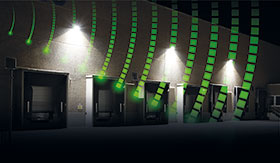
It’s actually a myth that bats have very poor eyesight. In fact, some species have very good eyesight. But what really allows a bat to be so highly attuned to its surroundings, able to safely navigate their way through forests, and be aware of other objects and animals in their immediate environment is highly sophisticated echolocation. This natural sonar allows bats to ‘see’ their environment even in complete darkness through the echoes returned from their high-pitched shouts. In radar technology, echolocation is used in a similar way to identify moving objects in low- or no-light situations.
Defining radar technology
Often associated with high-tech military equipment, radar systems have now been developed to strengthen commercial security systems or applications such as weather forecasts, road traffic monitoring, and collision prevention in aviation and shipping. Inspired by its uses in the automotive industry, namely in autonomous vehicles, security companies have been integrating radar into their offering for surveillance systems. This so-called ‘blind’ detection equipment provides accurate data with regards to speed, velocity and angle of travel of an object.
Called a ‘blind’ technology as it cannot visually define objects, but can detect them, a radar device transmits signals consisting of radio waves. When the radio waves hit an object, the signal is reflected back to the radar device, where it will be detected by a receiver. This enables the technology to provide information on an object’s position and determine its speed, size and direction.
At the same time, the information given by the radar enables PTZ cameras to automatically follow the object. This information can further help differentiate between humans, animals, vehicles and other objects.
Benefits of radar detection
Technologies that remove the need for manual human verification can help organisations cut costs. By being able to automatically detect something that has entered an area and distinguish whether or not it is a real threat without sending out security teams, costs and resources are saved.
Motion detection with radar differentiates itself from standard motion detection, as the former picks up on the changes in electromagnetic waves instead of pixels, which can help reduce the number of false alarms. One way to understand this is by looking at what doesn’t trigger a radar instead of what does. It will not be set off by a slight change in image pixels, like a visual camera does when lights, a spider web or a fallen branch come across its field of view. Instead, it’s about the radio waves bouncing off certain objects and back to the radar’s receiver.
By being able to set sensitivity levels on radar products to detect larger objects, an alarm will not, for example, be triggered by a rabbit, cat or other small animals that run through the perimeter and pose no threat. Similarly, it will not miss a real threat if the camera is pointed in another direction or a security guard is not paying attention. The technology works as an added layer of detection to complement and strengthen visual surveillance systems, resulting in a more accurate and reliable security system.
One typical scenario involves an initial video recording being triggered once an intruder has breached a perimeter. In doing so, all movements are captured, but an alert will only be sent if the trespasser goes through a pre-defined high-priority area.
Radar technology in action
Modern radar surveillance systems work well in wide open areas with moderate activity. Large stores that have big outdoor areas, such as warehouses, which often keep stock outside but are closed at night, can benefit from adding radar technology to their surveillance systems. Where light conditions are poor, the technology can still enable detection of objects passing through the area.
Again, in this scenario the radar’s information can be used to trigger a security sequence if the threat is authentic. Radar can automatically steer a PTZ camera so that it keeps track of the detected object. Floodlights can come on to scare the intruder and provide light for improved image quality, with an accompanying horn speaker telling the intruder they are being watched.
Blind technologies, such as radar, should be used in conjunction with other technologies, complementing visual and thermal video surveillance to support and optimise the security system. It will be interesting to follow how this technology can be further integrated and add value to the surveillance industry.
For more information contact Axis Communications, +27 11 548 6780, [email protected], www.axis.com
| Tel: | +27 11 548 6780 |
| Email: | [email protected] |
| www: | www.axis.com |
| Articles: | More information and articles about Axis Communications SA |






© Technews Publishing (Pty) Ltd. | All Rights Reserved.
 printer friendly version