


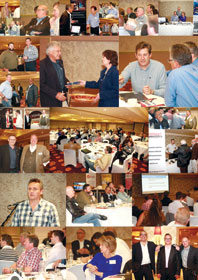
Hi-Tech Security Solutions and the South African chapter of the Transport Asset Protection Association (TAPA), held an Executive Breakfast event to discuss the latest in security as it pertains to the logistics market.
The event was well attended with visitors from a variety of businesses as well as a few system integrators joining Hi-Tech Security Solutions for the morning. Comments from the attendees affirm the success and usefulness of the event and the information shared during the presentations and on the exhibition floor.
Douw Steyn, national manager at Bidvest Protea Coin said, “It was a great event that opened doors for me in the industry of transport security.”
Piet du Preez, national risk manager at UTi SA, echoed this, saying, “The presentations were of great value and provided insight from different perspectives into the warehousing and security in the transport sector. It is informative and provided alternative ideas to research precautionary measures. The problem is common across all sectors and independent input creates more awareness.”
Making the event possible were five sponsors who had tabletop displays on which they informed visitors of their solutions as they pertained to the logistics market and beyond. Each sponsor was also given a five minute slot to present to the audience, highlighting the services and solutions they offer in the logistics market. Details of these services are highlighted later in this review. The sponsors were:
• G4S
• Intelligent Telematics
• Pulsit
• Reditron
• Xone Integrated Security
Below we offer a short summary of the presentations delivered on the day. The actual presentations were very comprehensive and would be too long to cover in-depth in this article.
Standards boost the bottom line

Steven Lashmar, marketing and sales manager at TÜV Rheinland Quality Services South Africa, delivered the keynote presentation giving a high-level overview of the need for security and risk management standards, focusing on the impact security processes can have on a business when the processes are aligned with business objectives.
When done correctly, Lashmar says implementing security processes according to standards is not a burden, but it empowers companies to focus on their core business goals. He believes the adoption and implementation of standards must reflect in the business’s bottom line, either through cost savings or revenue generation.
In the presentation, Lashmar explained that companies are always under scrutiny, whether from customers, competitors, government, shareholders, employees, criminals and others. When these companies are unstructured and run by the seat of their pants, all the observers will end up unhappy as they have no clear visibility into the running of the company and the ‘organised chaos’ reflects on the bottom line. The only winners are criminals and competitors as the processes in the company afford them multiple opportunities to take advantage of the disorganisation.
On the other hand, when the company has standards-based systems, processes and procedures in place, the business runs more efficiently and the state of the observers is the opposite. In other words, boards, customers, employees and so forth are satisfied and have faith in the company, while criminals and competitors find it harder to take advantage and exploit the company’s weaknesses.
Lashmar then went on the describe the business management system’s value chain and how the efficient structure of the system according to globally accepted standards will lead to better performance and operations. In structuring processes and procedures according to standards, Lashmar noted various ISO and TAPA standards, among others, that are designed to not only to improve efficiencies, but also to ensure the security of logistics operations.
Of course these standards go beyond security, but for the purpose of the breakfast, Lashmar focused on the development of an efficient security management system, specifically for logistics. The process for this involves various steps, including:
• Choosing a standard which will enhance your business outputs and increase your attraction to your customers and stakeholders,
• Appointing a person to take responsibility for the management of the system and have report directly to top management,
• Designing and verifying the organisations value chain, processes and activities and recording them, among other steps.
It’s also important, according to Lashmar, not only to adhere to standards, but to have your standards audited and verified by a professional body. Not only does this benefit your organisation, but puts you in a better position when dealing with third parties.
Secure in the warehouse

Massimo Carelle, risk manager at Ingram Micro South Africa and a member of the TAPA South African Work Group Committee followed, narrowing the focus to standards and best practices associated with securing goods in a warehouse. Carelle highlighted a number of aspects critical to ensuring the goods in a warehouse remain secure, from the time they arrive to the time they are shipped out.
Carelle broke the security process down into stages, from the perimeter, to controlling access and identifying people, including people working onsite in a fulltime or part-time capacity.
Security starts at the perimeter, and Carelle says nobody comes onto the Ingram site if they have no ID. Furthermore, no weapons are allowed and visitors must be met by a host from the company. Every company must have proper search procedures, which are adhered to at all times, including on exit. Furthermore, all access is documented.
The need for identity not only applies to visitors, as everybody on site needs to wear their identity tags openly, including staff.
Inside the warehouse, all documentation on goods must be controlled, supported by regular cycle counts. And naturally, all high-risk products must be kept out of reach to reduce temptation and the ease with which they can be grabbed. Furthermore, the company must employ quality CCTV systems that have been professionally specified and installed to cover as much as possible, and a minimum of 30 days of coverage should be stored.
When it comes to alarms, cheaper is not better. Moreover, the business needs to ensure its alarms are working and that the relevant control rooms receive the signals every time an alarm is raised. Carelle also stressed the need to know who is working for you. This will require criminal and identity verification checks of employees as well as contractors who are on site regularly.
Key to the success of your security system is strict and consistent standard operating procedures (SOPs), that are implemented with zero tolerance, but are still flexible enough to allow the legitimate business to function effectively.
From warehouse to customer

The final presentation was from Andre Du Venage, MD of Secure Logistics and chairman of the TAPA South African Work Group Committee, who focused on the task of securing goods in transit. He started by highlighting the realities of the criminal threats to goods in transit, not the official statistics. He then went on to discuss the potential solutions to transit security, including people, processes and technology.
In highlighting the realities of transit crimes in South Africa, Du Venage quoted Dr Johan Burger who lamented on the lack of intelligence related to these crimes within the SAPS, noting also some high-level members of the force who have been charged with corruption. He also noted the key involvement of organised crime groups in hijackings of freight.
Not surprisingly, South Africa is an important centre for organised crime syndicates, with about 230 (or more) international and local syndicates in operation. He also noted that research shows that the majority of truck hijackings, 90% according to Du Venage, involve collusion at some point. He says only 2% are real and violent hijackings.
To securely transport cargo, he advises companies not to adopt generic security strategies, and not to assume that once you have designed a solution that it’s all over and you’re secure forever. You need to revisit your strategies regularly and discover and optimise any vulnerabilities there are. Criminals study your operations continually and are very skilled at finding weaknesses and exploiting them.
Once again, Du Venage warns that risk management starts at the interview stage. Hiring is no longer a function for HR, but security should be involved as well. Syndicates want to infiltrate your business, and they do. It’s not all about criminal record checks however, it’s also important to engage with your staff and develop relationships with them – people tend to lie less to those they have good or close relationships with.
Transportation companies must make use of the technology available to protect their cargo, vehicles and drivers, including newer solutions that are designed to thwart jammers. It’s also a good idea to get involved with industry groups like TAPA, RFA and CGCSA. TAPA has well designed facility security and trucking security standards transport companies can benefit from. More information is available at www.tapaemea.com
For more information, contact:
Andre Du Venage, Secure Logistics, +27 (0)11 391 6268, [email protected], www.securelogisticssa.co.za
Massimo Carelle, Ingram Micro South Africa, +27 (0)11 928 8370, [email protected], www.ingrammicro.com
Steven Lashmar, TÜV Rheinland Quality Services South Africa, +27 (0)12 667 7700, [email protected], www.tuv.com






© Technews Publishing (Pty) Ltd. | All Rights Reserved.
 printer friendly version