

Five safety rules

Residential Estate Security Handbook 2017 Editor's Choice, Security Services & Risk Management, Residential Estate (Industry)

Working on electrical installations can be dangerous as those that are not properly connected or maintained pose a serious risk to both people and property, and can lead to injuries or even death. For this reason, DEHN Africa has adopted five safety rules according to the German standard series DIN VDE 0105 to help prevent electrical accidents.
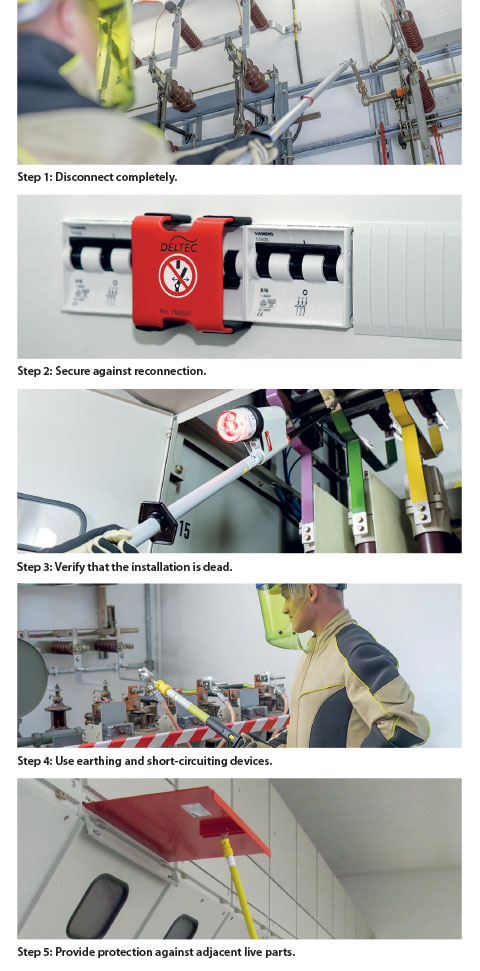
Step 1: Disconnect completely

When working on an electrical installation, it is best to ensure that it is disconnected from live parts on all poles.

Step 2: Secure against reconnection

To prevent an accidental reconnection of an installation where work is in progress, you need to replace the unscrewed fuses in the low-voltage system with lockable lockout devices, or ensure that all breakers on the off position are locked and adequate warnings are placed.

Step 3: Verify that the installation is dead

To verify that the installation is dead, you can use suitable test equipment such as a voltage detector to verify on all poles that the installation is dead. You also need to check the correct function of the voltage detector prior to using it.

Step 4: Use earthing and short-circuiting devices

After verification, connect the cables and the earthing system with short-circuit-proof earthing and short-circuiting devices. It is also important to ensure that the relevant parts must be earthed before they are short-circuited. Only after a successful application of the earthing and short-circuiting devices can the installation be considered dead and safe to work on.

Step 5: Provide protection against adjacent live parts

According to the five safety rules, adjacent parts are located in the vicinity zone. If parts of an electrical installation in the vicinity zone of the work location cannot be disconnected, additional precautions must be taken before work is resumed. In this case, it is essential to use insulating protective shutters or covering material as protection against any accidental contact.

For more information contact DEHN Protection South Africa, +27 (0)11 704 1487, alexis.barwise@dehn-africa.com, www.dehn-africa.com.


Share this article:
Share via emailShare via LinkedInPrint this page


Further reading:

Global security in 2026
Editor's Choice News & Events Security Services & Risk Management Industrial (Industry) Mining (Industry)
The World Security Report 2026 states: “In a world of increasing volatility, physical security has evolved. It is no longer just a defensive measure; it is a critical driver of corporate value.”

Read more...
Who is to blame for autonomous mistakes?
Editor's Choice Security Services & Risk Management Industrial (Industry) Mining (Industry)
Most supply agreements for AI-integrated equipment still closely resemble plant hire contracts from ten years ago: bilateral, human-focused, and silent on who bears the risk when a machine makes a decision on its own.

Read more...
Beyond the checkpoint
Veracitech Editor's Choice
For decades, mining corporations have treated employee screening as a necessary friction point, an operational cost to be managed rather than a strategic capability to be optimised. A new generation of full-body X-ray technology, purpose-built for the realities of high-throughput precious-metals environments, is beginning to change that calculus.

Read more...
Persistent surveillance with rapid deployment
Editor's Choice
Sky Robots has introduced an aerial drone system designed to operate as a consistent layer within security environments, addressing long-standing challenges around visibility and response across large or complex sites.

Read more...
The control room problem that nobody wants to talk about
Technews Publishing Editor's Choice
WhatsApp has become the unofficial backbone of security communications across the mining and industrial sectors, but it was never designed to be a security tool.

Read more...
Controlling access for people and vehicles
IDEMIA STid Security Technews Publishing Editor's Choice Access Control & Identity Management Asset Management Industrial (Industry) Mining (Industry)
When it comes to access control, the security requirements of mines and the industrial sector are similar, requiring a layered approach that combines physical barriers, digital authentication, and continuous monitoring to protect personnel, assets, and operational continuity.

Read more...
The post-Q1 security checklist
Asset Management Security Services & Risk Management
By this time of year, employees have changed jobs or roles, suppliers may have changed, and devices have moved between offices, homes, and sites. This is the right time for businesses to run a practical post-Q1 security check.

Read more...
PoPIA turns its attention to gated access
News & Events Security Services & Risk Management
The Information Regulator has gazetted its proposed Code of Conduct for the processing of personal information at gated access points. At 65 pages long, the code signals a significant shift in how personal information is collected and managed at entry points.

Read more...
Your company is already breached, you just do not know it yet
Information Security Security Services & Risk Management
Attackers are no longer relying on sophisticated exploits to break-in. Instead, they are systematically targeting weak credentials, misconfigured systems, and exposed devices stemming from preventable gaps such as identity weaknesses and poor visibility across digital environments.

Read more...
Excellerate Services sets a new standard
News & Events Security Services & Risk Management
Excellerate Services relies on specialist expertise and the sophistication of its operations deployment and management. Central to this is an investment in smarter, data-driven operations through the Velocity and Performance Centre platforms.

Read more...


While every effort has been made to ensure the accuracy of the information contained herein, the publisher and its agents cannot be held responsible for any errors contained, or any loss incurred as a result. Articles published do not necessarily reflect the views of the publishers. The editor reserves the right to alter or cut copy. Articles submitted are deemed to have been cleared for publication. Advertisements and company contact details are published as provided by the advertiser. Technews Publishing (Pty) Ltd cannot be held responsible for the accuracy or veracity of supplied material.


© Technews Publishing (Pty) Ltd. | All Rights Reserved.

