


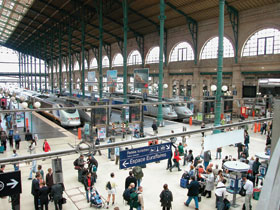
While video surveillance has always been a part of security systems in public transport systems, new technologies have changed the way operators use such systems. With intelligent video analysis, video surveillance can go far beyond just crime prevention, but also help to minimise the risk of accidents and to deal with some more recent threats such as copper theft on railway lines which becomes an increasing problem as copper prices soar. Recent developments in camera technology have greatly improved the quality of the captured video while reducing both bandwidth and storage requirements, allowing for better event detection, faster forensics, streamlined operations and cost reductions.
Operating public transport CCTV systems can easily become a big challenge for a couple of simple reasons. First, our cities are ever growing, and public transport has to grow with them – as has the video surveillance system. Second, most countries and cities today encourage their citizens to use public transport instead of their cars, and again this ultimately results in those systems being expanded. Third, existing systems and structures such as buses, trains and stations become more crowded, resulting in additional threats and offering new opportunities for pickpockets. Fourth, most railway and underground stations have seen decades or even centuries go by and have not been designed with video surveillance in mind. They often lack clear lines of sight and offer mediocre lighting conditions at best, making it very difficult to submit high quality images to the operations centre. And finally, the sheer volume of live pictures does typically by far exceed the capacity of the human resources that operators of transport systems can afford. So without further supporting technologies, it will become harder and harder for video surveillance to live up to its promises.
In today’s growing transport systems, video surveillance has to become much more efficient than it used to be. Efficient as in efficient operations, meaning that intelligent video analysis will have to take most of the burden of identifying exceptional situations. Efficient as in efficient use of resources, namely bandwidth and storage. And efficient as in efficient decision making, which is supported by high quality images even under unfavourable environmental conditions.
Efficient operations
One of the biggest challenges operators of large and distributed video surveillance systems face today is how to operate these growing systems effectively and efficiently with limited resources. Dealing with this challenge, more and more are moving to IP based solutions, which allow for not only a much simpler video architecture than analogue systems, but also for much more efficient video analysis and forensics. Today’s network-based monitoring and intelligent analysis enable a significantly more accurate detection of incidents, as lack of concentration and other human errors are excluded from the outset.
Second, they make the security staff more efficient, since operators only have to respond to alerts rather than continuously monitor a huge number of live images. This allows operators to spend more time on other tasks. Accuracy and speed can be increased even further through the use of metadata instead of the actual video recordings, which is obviously not easily achieved with analogue technologies. Such metadata are small text strings describing objects or movements which are much smaller than the images themselves and can be searched fast and automatically.
While the first intelligent systems were primarily designed to detect movements, there are far more diverse and sophisticated alerting criteria today. Instead of reporting each movement, modern systems can analyse the size of the object, its speed and its motion curve to avoid false alarms as in the almost proverbial cat that scurries through the image. Alarms are only sent when objects cross about a predefined line or multiple lines; follow a defined line of motion or its speed, shape or aspect ratio changes. For example the camera can send an alarm if a person comes too close to the tracks in a railway station or if somebody stumbles and falls on the platform. Colour filtering allows to follow movements based on colours or even saturation and shades, allowing operators to distinguish even between two people in red shirts.
Advanced video analysis software also allows the configuration of reference objects. In this case, all relevant object data such as size, speed, and colour in a selected live scene are detected with a single click on the object in question. This information can then be used as criteria for tracking similar objects – even across multiple cameras. Thus, operators can still quickly follow an offender if he for example uses the next train to leave a subway station and tries to escape via the next stop. They will just have to click on the offender in the surveillance video that recorded the incidence, and then have the analysis software look for matching patterns from cameras in other stations of the respective line.
Another important feature of intelligent video analysis is its capability to perform crowd detection. Namely in unstaffed environments, this capability can greatly improve passengers’ safety by alerting the operator in time and before critical conditions develop, be it on access or exit routes, in wagons or near the platform edge. In addition, video analysis is often used for track surveillance, automatically identifying obstructions, people entering subway tunnels, animals crossing tracks and the like.
Accurate response
Detecting a critical situation is one thing, responding to it is another. Although there are clear pictures in the central control room, security personnel or fire fighters do generally lack an overview of the actual situation when approaching the site. They will usually get some guidance on the phone, but one thing holds true: 'A picture tells a thousand words', namely in critical situations. Being able to access the images of the video surveillance systems in HD quality from mobile devices such as smartphones or tablets can greatly improve the effectiveness of the incident response team.
With intelligent dynamic transcoding, Bosch has developed a technology which allows just that. It enables the recording device to determine the available bandwidth to the mobile device and adapt image size and quality accordingly to guarantee transmission. The viewer can then switch back to full HD once he needs more details of a specific scene. This is specifically important as mediocre images are of little help when trying to evaluate a potentially dangerous situation.
Faster and more accurate forensics
While reliable live alarming is always important, it is often necessary to reconstruct and analyse events later. This can be an extremely time consuming task. If you want to accurately detect incidents in stored video, four times the live speed is usually the maximum you can use to view it. This means that every four hours of recording take one hour of work. And usually several cameras must be evaluated, which adds up accordingly. In some cases this is only expensive; in others the lengthy analysis can prevent a rapid response to a critical event.
One way to significantly speed up forensics is abstraction. Leading cameras can generate metadata to improve video analysis. These consist of simple text strings with descriptions of specific details such as objects or movements. The metadata have substantially less volume than the video itself and records can be searched much faster and automatically. Using appropriate filters and queries, four hours worth of recorded video can be analysed in less than a minute.
Efficient use of resources
Using IP as a transport protocol allows operators to run video surveillance across their existing network rather than building a separate video surveillance solution, saving cost and increasing operational efficiency. IP is also easily transmitted across wireless connections and allows fast implementation in buses, trams and trains. Also, sometimes environmental conditions require wireless connections such as in the new driverless metro line 5 in Milan. Here the peculiarity of the city’s ancient and magnificent architecture prohibited extensive cabling and resulted in Bosch and its partners installing a wireless LAN which covers the entire 13 kilometres of line as well as the stations.
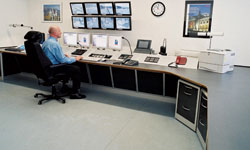
Another significant advantage of IP technology for transport authorities is the ability to design highly available distributed solutions without any single point of failure as in conventional architectures with a central server. The ability of IP based cameras to write directly to distributed storage systems also reduces the complexity of the solution and reduces the cost for systems and power.
The high processing power of modern IP network cameras and encoders allows planners to design distributed architectures with intelligent video functions within the encoders and cameras as well as distributed storage throughout the network. Using this approach, all video is stored at the camera location and only video images of events of interest are transmitted to the control centre, significantly reducing both network traffic and workload of the staff. Bosch has recently gone a step further with the introduction of intelligent dynamic noise reduction (iDNR). This does not only improve image quality, but also reduces bandwidth and overall storage requirements of all the new DINION and FLEXIDOME families of cameras by up to 30% compared to other HD cameras, potentially saving enormous cost on storage systems and overall total cost of ownership.
Image quality is key
While intelligent dynamic noise reduction is a very useful feature by itself, a key requirement in video surveillance is to provide a useful image under any circumstance and hence light sensitivity. With this in mind Bosch recently introduced the DINION and FLEXIDOME starlight family. The starlight technology was specifically designed for high performance in extreme low-light conditions and is able to show colour images where others can show only black and white where others show no image at all.
With their high sensitivity in both colour (0.017 lux) and monochrome modes (0.0057 lux), the HD cameras work with minimal ambient light, delivering clear images in a multitude of applications, even where poor lighting is the principle challenge – as is the case in a lot of subway stations but also in over ground environments during dark hours. This does, for example. allow operators to precisely determine whether a moving object is actually a human, rather than just seeing something move in the dark. In over ground environments, such as bus or train depots, the high light sensitivity can also greatly reduce the need of additional lighting for video surveillance, saving investments and operating cost.
Getting high quality images even under very unfavourable conditions greatly improves the operator’s ability to react fast and accurately to an incident. However, in a standalone video solution it will still be necessary for the operator to communicate efficiently with the operators of other security systems such as fire alarm or public address. Especially in large security networks like in public transport it is therefore advisable to integrate existing security systems into a central management system such as Bosch’s Building Integration System (BIS), which supports a unified management of safety and security technologies and integrates into popular Building Management Systems as well as custom solutions.
The Metro Sao Paulo for example uses the BIS Video Engine to integrate video surveillance into its overall Security Control Centre which monitors the entire metro network. Integration with other systems also allows it to use video not only for surveillance purposes, but also to verify fire alarms or other alerts.
Video surveillance has always helped passengers feel safer and secure in public transport systems and continues to do so. However, today video surveillance is about much more than this. With IP based systems, entirely new applications have come up which help operators to keep their business going in an efficient manner, saving money, hassle and sometimes even human lives.
For more information contact Bosch Security Systems - South Africa & Sub-Sahara Africa, +27 (0)11 651 9813, [email protected], www.boschsecurity.co.za






© Technews Publishing (Pty) Ltd. | All Rights Reserved.
 printer friendly version