


Alex Swanson, IndigoVision’s head of engineering, highlights the differences between digital video recorders (DVRs) and network video recorders (NVRs) and the implications for systems designers and end-users.
First came the camera and monitor, closely followed by the video cassette recorder (VCR), recording one video stream to a three-hour tape at 25/30 frames per second and often triggered by an input device (raid button in a bank, for example). Technology then brought us the multiplexer, which allowed several streams of video to be recorded onto the same tape and separated out into discrete, viewable streams on replay and the time-lapse VCR which enabled the dropping of frames and in so doing permitted a 3-hour tape to be used over much longer periods, albeit at the cost of lost information.
The DVR
The rapid development of video compression algorithms (MJPEG, MPEG-4, H.264, etc), computer processing speeds and a rapid reduction in data storage costs then gave rise to the DVR. This you could consider as being the functionality of a multiplexer together with a computer disk for storage in place of tape, all housed in the same box together with some additional ports for connectivity.
The DVR provides a convenient, if limited, replacement for the multiplexer + VCR combination and provides non-linear access to recorded material usually selected by camera ID, time and date. The consistency of quality of recorded material will in general be higher than that obtained with analogue tape although the actual quality achieved may or may not be better, depending on the compression algorithm and individual configuration.
In general more programmable options for individual video stream recording parameters, (picture resolution, number of frames per second, trigger options, start/stop times etc), are available, but a DVR is only useful where the analogue cameras are all cabled back to the DVR’s location. Competent DVRs now feature CAT 5 network ports so that the device can be provided with an IP address and thereby become accessible over an Ethernet network.
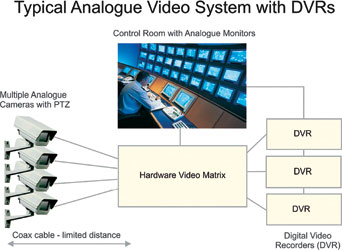
Many limitations still apply, however, not the least of which being that if it fails you’ll have most probably lost all your recordings (or they may not even have been made in the first place). This is not true of NVRs which can be used in ‘mirror’ mode – see below. On the subject of reliability if you are going to use a DVR make sure that the one you’re proposing incorporates an industrial grade hard disk drive (HDD) and not a domestic one, or failure might be a lot sooner than you think (most DVR failures arise from overworked and overheated hard drives) – ask the manufacturer which drives he uses.
Like most other things in this world the actual performance obtained from a DVR, its ease of use and reliability will depend upon the manufacturer, individual model selected and price paid.
On to the NVR
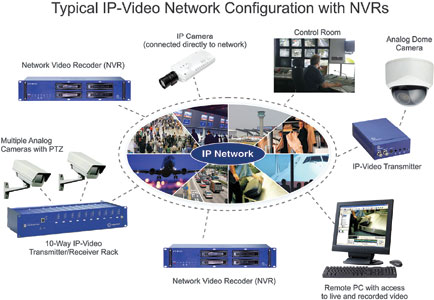
The NVR heralds the arrival of the next natural point in the development of recording technology. It is important to differentiate between DVRs and NVRs, as both are often termed ‘digital’. A DVR digitally compresses analogue video feeds and stores them on a hard-drive, the term ‘digital’ referring to the compression and storage technology, not the transmitted video images. The DVR therefore has to be located near the analogue feeds. In contrast an NVR stores digital images directly from the IP-network.
Therefore the most obvious difference between the DVR and NVR is that whereas the DVR records from analogue streams provided from analogue cameras the NVR records video streams that have already been encoded at the cameras. Thus you find no video connectors anywhere on a NVR; its input and output is IP data comprising compressed and encoded video.
This will typically be in either MPEG-4 or H.264 formats which have enjoyed widespread adoption in the CCTV industry as the compression technology of choice, due largely to their efficiency.
The huge advantage of architecture based on NVRs is that they can be located anywhere on a network – at the monitoring centre, adjacent to camera clusters, on the edge of a network, collected together in a hardened environment, indeed anywhere at all. In use their location is transparent to an operator – he or she simply calls up the recorded video stream to be viewed and, provided that they have the necessary authorisation there it is.
NVRs record and replay simultaneously, and recordings on any one machine can be remotely viewed by a number of operators spread across the network simultaneously, all totally independently and without affecting each other.
The importance of the independence of physical location, well away from the cameras if necessary, should not be underestimated – IT managers are notoriously zealous in safeguarding their network capacity and rightly so, but by calculating the data flow requirement across the network and strategically placing NVRs accordingly, the impact of video streaming on bandwidth usage can be minimised.
Typically an NVR might be placed on a Local Area Network (LAN) and near (in network terms, not necessarily physically) a camera cluster so that the load is carried by the local LAN capable of absorbing it easily, thus saving capacity on other, perhaps more restricted, parts of the network. The IT manager can specify what level of bandwidth he is prepared to make available for video streaming and this can be set as a cap, so that it is not exceeded under worst-case conditions when in operation.
Then, when a recording is required at any other point on the network (typically ‘at centre’, but not necessarily so) it can be called up seamlessly by the operator, streamed and then analysed, viewed (not the same thing) and acted upon accordingly.
To assist in the calculation of data flow requirement and disk storage capacity requirement spreadsheet-based calculators are available enabling these numbers to be estimated on a camera-by-camera basis using such parameters as the scene type (busy street / internal corridor etc), functionality of the camera (PTZ under continuous operator control / static for ID purposes etc), picture resolution and update rate in frames-per-second requirement, and if motion-sensing is used the motion frequency and type.
Competent NVRs now embody features such as:
* Hot-swappable disks.
* Simple Network Management Protocol (SNMP) support.
* Built-in diagnostics (much beloved of IT managers).
* Protection of files against deletion (whether accidental or otherwise).
* In-built firewall for the protection of data against unauthorised access.
* File export function which embodies the digital signature based on individual video frames and audit trail for security.
* Synchronised audio and video recording and playback.
* Hard disk temperature monitoring.
* Dual, fully redundant power supplies and network connections, providing uninterrupted and continued operation in the event of a single power supply or network failure.
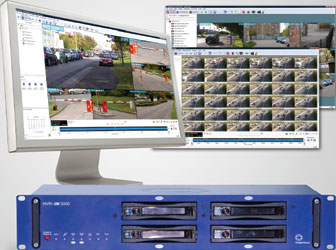
‘Mirroring’ techniques are now often used to duplicate the recording of video streams on additional NVRs located at different parts of the network, which provides a high level of protection against network failure; if one part goes down the other is there as a backup. You can have as many NVRs across a system as you like – adding another is just a matter of plugging it in and configuring it. There is no requirement for additional video cabling.
This feature really comes into its own during the consolidation of several independent systems into one managed environment, or in system rationalisation or expansion as it reduces system complexity and removes all of the cost associated with re-cabling.
Activity Controlled Framerate (ACF) is also used to reduce the size (and hence the cost) of disks. This facility relies on processing at the camera encoder. In use, should no movement be detected in the camera scene then the recorder falls back to a low recording rate (typically one frame per second). However, when movement is detected in the scene it changes back to its pre-programmed recording rate, achieving this in typically only 100 ms (or 1/10th of a second).
This feature is most effective in places where low activity occurs, such as in corridors or on fire escapes, or internally in buildings which are unoccupied at night, and can save as much as 50% of the disk storage capacity that would otherwise be required.
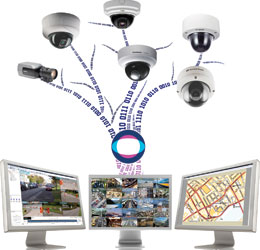
So what can we expect for the future?
Many tools are already available to assist the operator identify and replay events of interest from a recording. IndigoVision’s SMS4TM management software, for example, analyses movement in a scene and on command from an operator displays thumbnails on the screen that represent frames from recordings containing the specified movement. Clicking on one of the thumbnails then replays that section of video. The system can search 24 hours of recorded video and display these thumbnails in just a few seconds.
Changing the search variables allows the operator to sift through vast quantities of recorded material quickly and efficiently. Analytics software searches for the events requested, saving the frustrating and time-consuming task of manually searching through hours of video and freeing the operator to concentrate on more specialised and immediate tasks. These are not just features that benefit the user, but they also help to reduce the overall demand on the network. More advanced analytics such as Congestion Detection, Motion Detection, Abandoned Object Detection, Counter Flow (person moving against a defined route), Virtual Tripwire, Object Tracking and Theft Detection are also available.
This is just the tip of the iceberg – new developments encompass: Shape-based detection, automatic number plate recognition; gun-shot detection; facial recognition etc. It can be expected that huge productivity improvements will result from using analytics software during the searching of recorded material in post-event analysis, and for which the network video recorder is the key.

NVR in a box
The typical NVR solution simply requires a PC platform and hard disk storage. However, for more demanding fault tolerant applications NVRs can be packaged in stand-alone units. For example IndigoVision’s range of NVRAS 3000s is a range of self-contained rack mounted, Linux based, with the option of removable hard disk drives.
In addition, multiple disk NVRs have the option of built-in disk redundancy with either RAID1 or RAID5 configurations. The units also have optional power redundancy and built-in redundant network connections. Recordings can easily be mirrored to multiple NVRs around the network.
For more information contact IndigoVision, +44 131 475 7200, [email protected], www.indigovision.com






© Technews Publishing (Pty) Ltd. | All Rights Reserved.
 printer friendly version