


Whether it’s for home surveillance or monitoring a business, deciding between an IP and analogue closed-circuit television (CCTV) system is rarely a black-and-white choice. But IP surveillance has overcome many cost obstacles and, because of its digital nature, lends itself to more applications and new features. Recent independent research has clearly shown that today’s total cost of ownership for IP is on par, or even lower, than that of analogue systems.
This paper will speak to the total cost of ownership of IP versus analogue surveillance solutions. It will also discuss some important advantages of migrating to IP surveillance systems and point out several benefits that IP technology achieves. Finally, it will present an end-to-end IP surveillance system that is poised to drive the future of physical security.
Total cost of ownership
IP surveillance provides three main benefits over analogue surveillance that outweigh the disadvantages – image quality, scalability, and total cost of ownership. Better quality is achieved by using progressive scan and megapixel sensors. Scalability allows the simple addition of one camera at a time to enable systems to migrate from one camera to thousands, as well as the easy integration of additional systems. However, the critical issue for most users is still cost.
Studies have concluded that any IP-based system beyond 32 cameras, or a system for which IP cabling already exists, provides a lower cost of ownership over an analogue video system.

Independent research studies have helped clarify many misconceptions about higher costs of IP surveillance systems. Participants in these studies provided feedback, validation, and cost data on requests for proposal (RFP) based on a typical 40-camera surveillance deployment scenario for a small to mid-size school campus. There were no cameras or premise wiring in place at the study’s campus deployment site.
The finding of this research, which was conducted with the assistance of security integrators, value-added resellers and industry analysts, was a major victory for IP proponents. The conclusion was that total cost of ownership is lower for IP-based surveillance systems of 40 or more cameras. In fact, a typical scenario yields a 3.4% savings over analogue-based systems in terms of acquisition, installation, and operation costs.
The studies showed 32 cameras to be the total cost 'break even' point for IP versus analogue systems. It is also interesting to note that between 16 and 32 camera systems, the cost is very close, although slightly lower for analogue systems. However, other non-quantifiable advantages of IP-based systems, such as improved image quality, easier maintenance/troubleshooting, and increased flexibility/scalability will outweigh any slightly lower costs for the analogue system.
Further, as IT equipment prices continue to fall faster than analogue CCTV equipment, the comparison will continue to move in favour of IP-based systems. Finally, total cost of ownership is always lower for IP systems that use pre-existing cabling.
Cost of ownership must be considered over the long term. While the initial equipment costs may be similar for both IP and analogue systems, IP-based solutions provide superior return-on-investment (ROI) in many ways down the stretch. For example, if the user wishes to install additional cameras in an IP-based system, the only additional cost is adding one licence per camera. An analogue-based system requires buying a new 8- or 16-channel DVR to gain just a few new video streams.
The IP-based system also provides better long-term cost savings in the areas of upgrades to new features, ease of relocating equipment, remote viewing capabilities, ease of filtering for useful events, and an overall ease and operational flexibility. One surveillance system specialist even stated that the case for ROI is always difficult to determine in the security industry – the real question that needs to be asked is, “what will it cost to NOT implement this technology?”
The reality is that as HD cameras gain pricing parity with analogue cameras, total cost of ownership tips in favour of IP-based solutions, particularly when considering benefits – three times the resolution, the ability to leverage the existing IT backbone, and already having the maintenance and support expertise within the organisation.
Advantages of switching to IP
Although the total cost of ownership studies are extremely valuable for users deciding which surveillance system will best suit their needs, a 'cost-only' mentality tends to overlook many other important IP-based advantages. As IP-based systems continue to move toward cost parity with analogue-based systems in the surveillance market, many current analogue users may consider switching to IP to leverage an array of benefits.
* The image quality of IP-based surveillance systems is substantially superior because the IP cameras can be multi-megapixel and are not restricted to analogue NTSC or PAL standards.
* With IP technology, recording devices do not require direct connection to cameras, enabling cameras to be placed at any point within the facility that is connected to the network. Network video recorders, virtual matrix software and viewers can be located where they can best be serviced and used, not just at the end of a camera’s coax cable.
* IP-based surveillance offers flexibility on how, when and where video is stored, viewed and manipulated.
* Security and interference issues are diminished with IP-based systems, whereas wireless analogue cameras have problems with interference and are unencrypted – anyone can view the signal.
* Although the industry has developed a 'comfort level' with analogue, new IP technology will continue to bring forth new features and improved performance.
* As video continues to migrate into video formats, more applications can use the same data in a network environment, such as operations improvement, marketing analysis, training development programmes and employee performance reviews.
* Where IP video surveillance really shines over DVRs for budget issues is in the event of changes to the system or moving the systems. It’s always easier and cheaper to move equipment and cameras because they are all connected to the same network, thus, new cabling is not required.
* Since most businesses already have an IP infrastructure in place, a move to IP-based surveillance is a natural progression to attain the added benefits and features, as well as ensuring a future-proofed system that can adapt to the latest IP technologies.
It should also be noted that new construction still offers the greatest advantages to using IP, where IP video surveillance becomes another set of devices using the new building’s network communication infrastructure. An estimated 50-60% cost savings can be realised by laying down network cables instead of thick bundles of coaxial cable, PTZ control wires, audio wires and power cables. Additionally, existing smaller analogue systems that see fewer advantages of a retrofit to IP video may want to consider a hybrid system that can still provide the additional features and benefits offered by IP.
The end-to-end IP video surveillance solution
Of course, it’s important not to get so caught up in the IP versus analogue discussion that the perspective of an end-user’s video surveillance system requirement is lost. The important consideration is to deliver the most effective video solution to the user as a tool for the safety and security of his home or business. With that in mind, D-Link offers end-to-end IP video surveillance solutions for any personal and business security need.
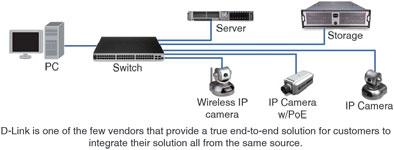
End-to-end IP video surveillance solutions offer several advantages for physical security requirements and differentiate D-Link from other manufacturers. Our solutions include every component from the IP cameras to the switches, IP storage, and network interface card (NIC) adaptor. Each system is completely integrated, tested, and certified with leading video surveillance software. D-Link’s partnerships with the leading surveillance software brands allow users the most advanced functionality and manageability for their security system.
Because of its high scalability, use of existing IP infrastructure, high security encryption, high image quality, advanced features such as digital zoom, and remote accessibility, D-Link’s end-to-end IP video surveillance solutions are becoming the preference over analogue camera solutions to send automated alerts and record video when security events occur, record to storage, index and searchable archived video and audio, flexibly adjust to handle different schedules, personnel alerts, device alerts, and granular event triggers.
Key benefits of D-Link’s end-to-end video surveillance solution include:
* Completely integrated and proven,
* Certified with leading video surveillance software,
* Single source of support,
* Full line of IP cameras and switches, and
* Price performance leading IP storage.
For more information contact D-Link South Africa, +27 (0)12 741 2023, [email protected], www.d-link.co.za
| Tel: | +27 12 741 2000 |
| Email: | [email protected] |
| www: | www.d-link.co.za |
| Articles: | More information and articles about D-Link Africa |






© Technews Publishing (Pty) Ltd. | All Rights Reserved.
 printer friendly version