


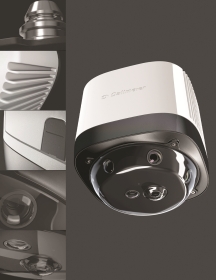
When capturing large spatial relationships with video technology, users still have to make many compromises. The 180- and 360-degree versions of the Panomera W series from Dallmeier have taken up the cause of overcoming these challenges and providing customers with the ability to monitor their indoor and outdoor premises most effectively for minimal outlay in terms of personnel and costs.
The task of providing surveillance for large outdoor expanses and indoor areas successfully, yet efficiently in terms of costs and personnel is one of the great challenges in video technology. Operators and staffing budgets alike are most often overstretched, then there are high infrastructure costs to consider, and not infrequently the result with regard to image quality, overview, achievement of objectives and operability falls short of expectations.
Tracking objects and changing perspectives
In the new Panomera W8 (360°) and W4 (180°) systems, the images from the individual sensors are merged by the Dallmeier operating software in such a way that the operator is presented with a logical, almost entirely rectified panoramic overview. The cameras even reproduce the area directly below the housing in high resolution.
Another unique feature of the Panomera systems is that, in principle, any number of operators can zoom into a scene at the same time, and the total overview image is retained at all times both live and in the recording. In this way, it is guaranteed that no valuable information or evidence is lost. If several systems are used at the same time, objects can be tracked across multiple camera systems very easily – or the same scene can be examined from various viewpoints quite conveniently.
Savings on every level
The Regensburg-based manufacturer states that during development of the Panomera W series, the economic efficiency of the overall system was the highest priority. As a result, usability innovations and the small number of cameras needed significantly help to save costs in all important aspects, from planning and implementation to operation and service. This in turn yields advantages for everyone involved and all stages of the project – from the installer to the person making the business decisions.
Lowest operating costs in relation to area
Those responsible for security will be glad of the simple operation of the systems due to the available video management software and the small number of screens needed to cover the scene. Situation assessments are made quickly; changing perspectives with a few clicks of the mouse and object tracking across multiple cameras make the system flexible and powerful. Operating even a large number of cameras as a total system is simplicity itself and enables large spatial relationships to be monitored more efficiently. Consequently, a very large overall context per operator can be captured and personnel costs relative to area covered with the new cameras are low for ongoing operation.
Low infrastructure requirement and flexible deployment
Since considerably fewer cameras are needed than for comparable solutions, the costs for masts, installation, cables and cable-laying or mounting points are also reduced. The manufacturer also offers a solution for environments with limited bandwidth: Upon request, the optional ‘junction box’ can be equipped with up to four terabytes of memory, thereby dispensing with the need for routing new cables and network components in certain scenarios. And the ‘quick lock’ mounting system enables the same camera systems to be swapped between different locations, for example if different crime hotspots are to be observed at different times in an urban surveillance setting.
New mounting concept
For installers, the integrated, newly developed ‘Mountera’ mounting concept of the Panomera W series offers many innovations for installing the cameras much faster and therefore less expensively: From the mounting handle for removal and transportation to an integrated ‘bubble protector’ which remains on the system until final installation, and the ‘quick lock’ system for mounting by a single technician.
Additionally, only one Allen key size is needed in order to complete the entire installation. The Panomera W series camera models have at last been made truly ‘plug-and-play’ capable with the full pre-calibration and pre-setting of all sensors. Accordingly, the effort needed to adjust the optical elements is reduced to a minimum as well.
| Tel: | +49 941 870 0111 |
| Email: | [email protected] |
| www: | www.dallmeier.com |
| Articles: | More information and articles about Dallmeier Electronic Southern Africa |






© Technews Publishing (Pty) Ltd. | All Rights Reserved.
 printer friendly version