

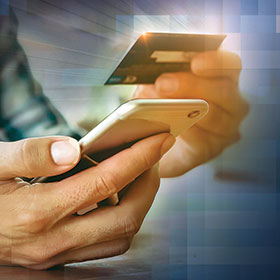
The safest way to pay

1 June 2019 Security Services & Risk Management, Financial (Industry)

In the ‘old days’ – the days of magnetic stripe cards – a cardholder proved that they were the rightful owner of a card with a handwritten signature at the point of sale. Then came the chip cards, where a PIN number was used for authentication in a card-present context.

Gerhard Oosthuizen
Gerhard Oosthuizen

In card-not-present situations like online shopping, however, it is much harder to validate a customer’s identity, because they only have to input strings of numbers. To prove that a shopper is the rightful cardholder, another authentication method is required, which often adds friction and frustration to a customer’s online-shopping experience.

But the widespread adoption and computing power of the mobile phone means that a solution might be on hand. Ticking the boxes of security and convenience, the mobile banking app has the potential to become the payment tool of choice.

The rise of the mobile banking app

The use of mobile banking apps has taken time to gather momentum in some markets. A reason often cited is the fear of fraud and identity theft. This is understandable when considering that securing a banking app with a username and password only goes so far in proving that a user is the legitimate banking customer – especially in an era where security breaches and attacks like phishing abound.

So how can a bank reassure its customers that having all their banking information literally in the palm of their hand can be as secure as it is convenient? And that paying with their banking app can be more secure than paying with their debit or credit card?

A matter of trust

It all comes down to trust. Establishing a relationship of mutual trust between a bank and a customer is crucial. It creates a secure foundation from which the bank can offer rich and innovative services, while giving customers the confidence to engage with these services without security concerns. The mobile phone makes all of this possible by means of three key pillars: identity, integrity, and communication.

The first step in establishing a foundation of trust is the notion of identity. Digital certificate technology makes it possible to uniquely identify any registered customer’s mobile phone as well as the banking app that was originally registered on the phone. This means the bank can be certain that they’re communicating with the right person.

Secondly, the bank needs to be sure that neither the customer’s mobile phone nor the messages being sent between the device and the bank have been tampered with. In other words, the integrity of the device, the app itself, as well as the environment in which the app is running, must be proven.

Finally, the bank and the customer need to know that communication is secure and private. This can be achieved through technology that establishes an encrypted communication channel between the bank and the customer’s banking app. Since this is a separate, secure channel, no fraudster can intercept sensitive messages meant for the customer – like authentication requests and responses.

As safe as the banking app

At Entersekt, we believe that with trust as foundation, mobile banking apps can become much more than tools for checking balances. They can become enablers of new forms of banking and commerce that will not only transform the banking industry but will also revolutionise customers’ lives.

Modern technology, such as cloud and mobile technologies, has given banks the opportunity to completely redefine the banking experience for their customers and re-establish personal relationships. Doing so turns the mobile phone into an extremely valuable commodity for customers – a passport to all types of digital experiences without the hassle of unnecessary authentication requirements. A range of banking and payments capabilities can be made available 24/7, from anywhere in the world, in the palm of the customer’s hand. More than that, when a bank has a foundation of trust in place, its app can also be the safest way for customers to transact.

For more information, visit www.entersekt.com


Share this article:
Share via emailShare via LinkedInPrint this page


Further reading:

Understanding the Shared Responsibility Model
Infrastructure Security Services & Risk Management
While the cloud can certainly be a growth enabler in many ways, it can also introduce new security risks. Companies want to have a clear understanding of where their security duties end and where their cloud service provider’s begin.

Read more...
“This Is Theft!” SASA slams Mafoko Security
News & Events Security Services & Risk Management Associations
The Security Association of South Africa (SASA) has issued a stark warning that the long-running Mafoko Security Patrols scandal is no longer an isolated case of employer misconduct, but evidence of a systemic failure in South Africa’s regulatory and governance structures.

Read more...
Making a mesh for security
Information Security Security Services & Risk Management
Credential-based attacks have reached epidemic levels. For African CISOs in particular, the message is clear: identity is now the perimeter, and defences must reflect that reality with coherence and context.

Read more...
Privacy by design or by accident
Security Services & Risk Management Infrastructure
Africa’s data future depends on getting it right at the start. If privacy controls do not withstand real-world conditions, such as unstable power, fragile last-mile connectivity, shared devices, and decentralised branch environments, then privacy exists only on paper.

Read more...
From friction to trust
Information Security Security Services & Risk Management Financial (Industry)
Historically, fraud prevention has been viewed as a trade-off between robust security and a seamless customer journey, with security often prevailing. However, this can impair business functionality or complicate the customer journey with multiple logins and authentication steps.

Read more...
Security ready to move out of the basement
AI & Data Analytics Security Services & Risk Management
Panaseer believes that in 2026, a board member at a major corporation will lose their job amid rising breaches and legal scrutiny, as organisations recognise that cyber risk is a business risk that CISOs cannot shoulder alone.

Read more...
Cyber remains top business risk, but AI fastest riser at #2
News & Events Security Services & Risk Management
The Allianz Risk Barometer 2026 ranks cybersecurity, especially ransomware attacks, as the #1 risk, while AI is the biggest riser and jumps from #10 to #2, highlighting the emerging risks for companies in almost all industry sectors.

Read more...
OT calculator to align cyber investments with business goals
Industrial (Industry) Information Security Security Services & Risk Management
The OT Calculator has been developed specifically for industrial organisations to assess the potential costs of insufficient operational technology (OT) security. By offering detailed financial forecasts, the calculator empowers senior management to make well-informed decisions.

Read more...
From digital transformation to digital sovereignty
Security Services & Risk Management IoT & Automation
As cyberthreats grow, data regulations tighten, and AI becomes central to economic competitiveness, countries are recognising the need to control and protect their own digital assets.

Read more...
The age of Lean 4.0: Orchestrating intelligence and efficiency
Security Services & Risk Management
The convergence of Lean principles and AI (what we now call Lean 4.0) is no longer a theoretical exercise; it is the defining operational paradigm for survival and growth in a complex, data-intensive economy.

Read more...


While every effort has been made to ensure the accuracy of the information contained herein, the publisher and its agents cannot be held responsible for any errors contained, or any loss incurred as a result. Articles published do not necessarily reflect the views of the publishers. The editor reserves the right to alter or cut copy. Articles submitted are deemed to have been cleared for publication. Advertisements and company contact details are published as provided by the advertiser. Technews Publishing (Pty) Ltd cannot be held responsible for the accuracy or veracity of supplied material.


© Technews Publishing (Pty) Ltd. | All Rights Reserved.

