


Incidents of fraud, corruption, misappropriation of assets, misconduct and misrepresentation, among others, are continuously being publicly exposed and reported on in the media the world over. To address and mitigate the implied reputational, or even legal or financial risk to the associated entities, background screening continues to gain global attention and is being adapted as part of employment and procurement practices.

According to Michelle Baron-Williamson, CEO of Managed Integrity Evaluation (MIE): “This trend is expected to grow rapidly in the coming years. In fact, the global employment screening services market is forecasted to grow to US$ 5.46 billion by 2025. Furthermore, as pressures mount to combat and eradicate all forms of fraud and corruption, markets are also seeing growing demand for quality, comprehensive and cost-effective background screening and verifications solutions.”
In South Africa, the latest MIE Annual Report (available at www.securitysa.com/*MIE2, redirects to https://www.mie.co.za/docs/2019/background-screening-index-2018.pdf), based on the company’s 2018 transactional data, highlights an increase in the number of requested checks conducted year-on-year (y-o-y). “This indicates that despite another year of subdued economic and business growth – with unemployment in South Africa remaining high at 27.1% – there is still movement in the job market and steady demand for and adoption of background screening and verification services and solutions,” adds Baron-Williamson.
The report shows that over the last year there has been an increase in demand for company checks, which highlights growing market awareness on the importance of supplier vetting. Requests for fraud listing and insurance regulation checks have also increased, in line with regulation adoption – especially within the financial services sector.
“In terms of candidate screening, findings show that employers are becoming increasingly aware that qualification and criminal checks alone, are not sufficient to gauge a candidate’s suitability. As a result, there is growing market recognition on the importance of conducting employment history checks and comprehensive vetting of the candidate’s CV, whether for a part- or full-time appointment,” indicates Baron-Williamson.
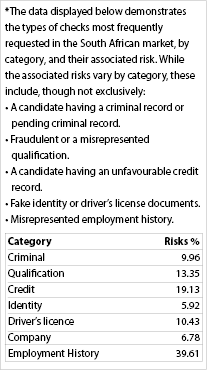
Key findings
Criminal checks
• Criminal record checks remain the most requested check within MIE.
• Of the 778 319 criminal checks conducted by MIE in 2018, 9.96% were found to have associated risk, where a candidate either has a criminal or a pending criminal record.
• 7% of people whose criminal record check was done either lied about having a criminal record or did not know they have a criminal record.
Qualification checks
• Qualification(s) are still the most likely aspect of a candidate’s CV to contain discrepancies.
• Of the 530 161 qualification verifications conducted by MIE in 2018 –13.35% were found to be either misrepresented, fraudulent or cancelled.
• The financial services industry presented the highest number of requests for qualification checks – this trend is also in keeping with regulation changes and adoption in the industry.
Credit checks
• Risk associated with credit checks saw a y-o-y growth to 19.05% (from 18.08 in 2017).
• 2018 data saw a decrease in the number of credit checks conducted by MIE, (361 545 down from 394 988 in 2017). This is due to amendments to the NCA and other market legislation changes (including PoPI).
MIE Global
• MIE statistics show that qualification verification remains the most requested check across Africa and globally.
• For non-national candidates, checks should be conducted in each/every country the individual has previously resided in.
• In-country partnerships and understanding the local environment is crucial to successfully providing quality and comprehensive international screening services.
2019 and beyond
• Adoption of background screening and verification services and solutions will continue to grow.
• Requests for social media checks will likely continue to increase y-o-y.
• More employers are adopting the practice of periodically re-checking their employees as part of their ongoing risk and HR management.
“More robust risk management is often a key predictor of economic and business success, especially in the complex, competitive and highly regulated operating environments of today. Therefore, mitigating risks associated with an unsuitable appointment – in a candidate or supplier – will continue to gain traction as a top priority as public and private sector entities, alike, become more aware of the value added to their proactive and operational risk management,” concludes Baron-Williamson.
For more information contact Managed Integrity Evaluation (MIE), +27 12 644 4000, [email protected], www.mie.co.za






© Technews Publishing (Pty) Ltd. | All Rights Reserved.
 printer friendly version